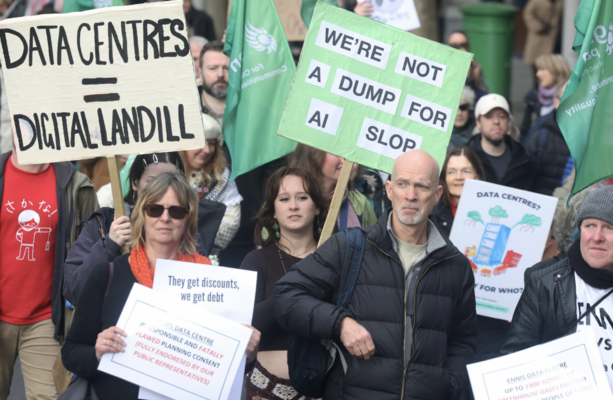
Thousands March in Dublin Against Data Centre Expansion
Thousands of demonstrators converged on Dublin’s Parnell Square on Saturday for Ireland’s first national protest against the rapid proliferation of data centres.
Organized by Friends of the Earth Ireland, the march served as the focal point of a coordinated, Europe-wide day of action involving more than 85 groups across 10 countries, according to The Journal.
The protesters are demanding an immediate government-imposed moratorium on new data centre construction. Their grievances center on the industry’s heavy footprint on the national power grid, which participants argue is driving up energy costs for ordinary households and undermining climate targets.
The Cost to the Irish Grid
The demonstration comes at a time of acute sensitivity regarding utility bills. According to Central Statistics Office (CSO) figures cited by The Journal, wholesale electricity prices have nearly doubled over the past year. Rosi Leonard, campaign lead for Friends of the Earth Ireland, pointed to an analysis suggesting that the intensity of data centres on the grid may have cost the average Irish household an additional €360 between 2015 and 2023.
Data centres currently consume 23% of Ireland’s total electricity, a figure described as unprecedented on a global scale. Critics argue this demand forces a greater reliance on fossil fuels, complicating the country’s transition to renewable energy. During the protest, People Before Profit TD Paul Murphy echoed these concerns, stating that citizens are paying a high price for a government strategy that prioritizes tech infrastructure over public affordability.

A Pan-European Backlash
The unrest is not confined to Ireland. As reported by The Guardian, activists in Amsterdam recently breached the construction site of a Microsoft data centre, with some protesters scaling cranes and hanging banners to decry the environmental and social impacts of the artificial intelligence boom.
While the Dublin march remained a peaceful demonstration, the broader European movement—dubbed “Stop Dirty Data Centres“—highlights a growing friction between technological expansion and local community interests. Euronews reports that annual investments in European data centre projects have surged from €12 billion in 2020 to approximately €25-26 billion in 2026. Projections from the PwC Global Data Centre Outlook 2026-2050 suggest total spending in the sector could reach €176 billion between 2026 and 2031.
Communities Facing Local Pressure
Beyond the national energy debate, local residents are raising alarms about the immediate physical impact of these facilities. In Clondalkin, the Environmental Protection Agency is investigating complaints regarding noise and sleep disruption linked to Echelon’s DUB10 development.
Similar opposition is playing out in other regions:

- County Waterford: Planning permission for a campus at a former cheese factory was refused in October following local pushback.
- County Kildare: Residents in Naas and Jigginstown are actively opposing large-scale developments, citing a lack of transparency from local councils.
- County Westmeath: A €1 billion data centre and solar project in Rochfortbridge is currently under appeal.
“We’re not against data centres completely but already there is so many data centres in Ireland, there’s more going to be built and we’re just completely over-represented by them compared to any other European country,” Anna Roche, a resident from Naas, told The Irish Times.
The Industry Perspective
Tech companies maintain that data centres are critical infrastructure for the evolution of artificial intelligence and that they provide essential economic growth. Industry representatives emphasize that these facilities create jobs during both the construction and operational phases.
However, the political appetite for unchecked expansion appears to be shifting.
A recent poll commissioned by The Irish Times found that 61% of respondents support a moratorium on new data centre connections. As EU heads of state prepare for upcoming meetings, the Irish government faces the unresolved policy challenge of balancing its role as a global tech hub with the demands of its own citizens.
Worth a look
IPPF FGM/C Provider Training Consultancy 2026: Apply Now
The International Planned Parenthood Federation (IPPF) is searching for a specialized consultant to develop comprehensive training materials aimed...

Six Killed in Krakow Mass Shooting Linked to Far-Right Ideology
Poland Declares National Mourning Following Krakow Market Square Attack Poland has entered a period of two days of...

Southeast Asian wildlife species face extinction Risks from habitat loss
Southeast Asian Wildlife Faces Extinction Risks The dense forests, sprawling river systems, and isolated islands of Southeast Asia...

Ireland to Lead EU Climate Negotiations at COP31 Summit in Turkey
Ireland Steps Into Leading EU Role as COP31 Climate Summit Opens in Turkey Ireland will assume a central...