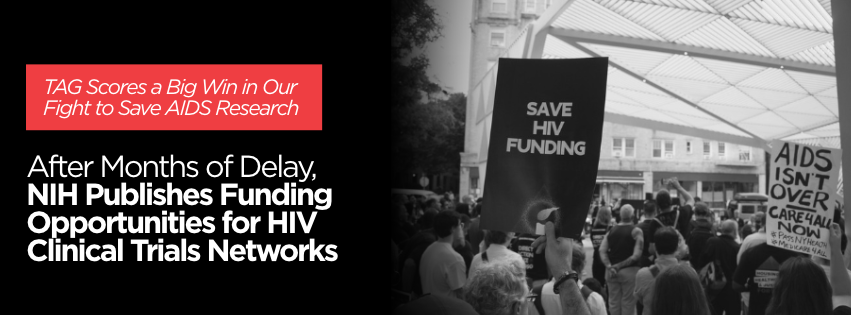
The Trump administration restarted the competition for federal funding that sustains the nation’s four major HIV clinical trials networks, publishing long-delayed Notices of Funding Opportunity on November 20 after months of uncertainty that froze new studies and threatened to dismantle decades of research infrastructure.
The National Institute of Allergy and Infectious Diseases released the NOFOs for the Leadership and Operations Centers, Laboratory Centers, Statistical and Data Management Centers, and Clinical Trials Units that underpin the AIDS Clinical Trials Group, the HIV Prevention Trials Network, the HIV Vaccine Trials Network, and the International Maternal Pediatric Adolescent AIDS Clinical Trials Network. Applications are due March 9, 2027.
The publication follows a postponement earlier in 2026 that left researchers unable to submit renewal applications and forced NIAID to tell the networks to pause new trials. Without the NOFOs, funding would have run out after December 2027.
Vaccines removed from network names
The renewed competition comes with a major change. The word “vaccines” has been stripped from the names and research agendas of all four networks. The vaccine-focused network is now called the Immune-Based Prevention Clinical Trials Network, a rebranding that shows a broader scope encompassing broadly neutralizing antibodies and research on diet and the microbiome's effect on immune function.
Health officials said vaccines would “continue to be evaluated in this new network” and that the name change “reflects that it is designed to evaluate immune-based approaches and strategies for H.I.V. prevention, not limited to just vaccine candidates.” The shift reflects the second Trump administration‘s suspicion of vaccines, according to The New York Times.

Another restriction: foreign sub-awards are not allowed under the new NOFOs, a limitation advocates say is “most unfortunate” for global research collaborations.
Advocacy forced the release
“Millions of people living with HIV are alive because of research conducted over the past four decades by NIH-funded clinical trials networks,” said Mark Harrington, executive director of Treatment Action Group. “These networks, as well as the NIH as a whole, are the crown jewels of U.S.-funded science. Under this administration, these networks were at risk of extinction due to anti-science fanatics in high places.”
Mitchell Warren, executive director of AVAC, called the release “an important and long-overdue step forward” but noted the foreign sub-award restriction. Andrea Weddle, executive director of HIV Medicine Association, emphasized the need to maintain partnerships with clinical trial sites outside the United States and prevent disruptions to ongoing studies.
Brain research moves forward
While the major networks waited, a separate $3 million grant from the National Institute of Mental Health moved ahead. Weill Cornell Medicine and Rutgers School of Medicine researchers received the award on August 10 to open a center studying the lasting neurological effects of HIV. The project, which began August 6, runs through April 30, 2030.
“I'm honored that NIMH has given us the unique opportunity to move cutting-edge research forward that we hope will ultimately transform the lives and care of people with HIV,” said Lishomwa Ndhlovu, immunology in medicine at Weill Cornell and co-director of the center. He noted there are “still no effective therapies that specifically prevent or mitigate ongoing brain injury” from HIV.
The team pursued NIMH funding to avoid the stalled NIH grant cycle. The two institutions previously collaborated on a $4.5 million NIH grant in 2021 for HIV treatment and prevention among New York-area patients.
NIH policy shifts create HIV funding chaos
The NIH’s HIV research stance has been erratic. In January 2026, the agency ended its dedicated AIDS grant cycle, forcing HIV applicants to compete with all NIH proposals. In July, the administration cut foreign aid, closing over 1,700 HIV treatment sites worldwide.
An 80% cut to a CDC prevention program was proposed for the 2027 budget. A $2 billion cut to addiction and mental health programs — which also fund HIV prevention — was initially made, then reversed.
“Research funding has been given back, and then cut, and then given back,” said William Lodge II, public policy. He warned that rules restricting research on “gender ideology” and an executive order recognizing only male and female sexes make it harder to fund studies involving transgender populations disproportionately affected by HIV.
“If NIH and the United States government doesn't recognize transgender women or trans individuals as a gender, then that means funding and applying for [HIV funding] is actually much harder,” Lodge said, adding this “ultimately undermin[es] [researchers] ability to advance health equity in HIV research and address the needs of populations disproportionately affected by HIV.”
Applications for the network renewals are due March 9, 2027, with review extending through summer and fall 2027. Existing grants expire in November 2027. Health officials say the networks should continue without a funding gap — if Congress passes funding legislation without a government shutdown. Scientists warn the margins are thin after months of delay, and participant safety in ongoing trials remains at stake.
Keep reading
- Al Ahly Sack Amouta; Board to Present New Candidates Within Hours
- Todd Blackadder Calls Sir Graham Henry’s All Blacks Fatigue Claim Dangerous
- Jensen Huang Returns to Nvidia CEO Role After Trump Intervention (world-today-news.com)
- Trump's Beef Quota Filled About 37% in Month One; Ground Beef Fell 13 Cents (daybreakwire.com)

Al Ahly Sack Amouta; Board to Present New Candidates Within Hours
Egyptian giants Al Ahly dismissed Moroccan head coach Hussein Amouta and his backroom staff early Tuesday, hours after...

Todd Blackadder Calls Sir Graham Henry’s All Blacks Fatigue Claim Dangerous
The All Blacks will play their 13th test of the year, in line with recent seasons: 13 tests...

Pooled Scandinavian Cohorts: Fruit, Fish Cut Crohn’s Risk; Fruit Raises UC Risk; Teen Salty Snacks Raise UC Risk
A pooled analysis of three Scandinavian birth cohorts links high fruit and fish intake in childhood to lower...

Inter Miami on Brink of Elimination After 3-0 Loss to Columbus Crew
“Step one is done and there’s another game coming on Friday,” Columbus Crew interim head coach Laurent Courtois...