
In a city where residents speak more than 100 languages, dealing with City Hall can be overwhelming for anyone whose first language isn’t English. That reality is exactly what Kansas City’s Office of Language Access was created to change, and on Saturday, October 24th, community members and partners gathered at Guadalupe Centers on Avenida Cesar E. Chavez to celebrate two years of that work, Northeast News reported.
The free “Two Years Connecting Communities” event marked the anniversary of an office launched in 2024 to bring language accessibility directly into city government. Since its creation, the office has worked to reshape how the city communicates—rewriting websites in plain language, adding translation and ADA compliance tools, and providing interpreter and translation support so residents can actually use the services they fund through their taxes.
Music, Stories, and Resource Tables on Avenida Cesar E. Chavez
The Saturday morning celebration at 1015 Avenida Cesar E. Chavez offered attendees interpretation services in Spanish, Dari, and Oromo upon request, with live American Sign Language interpretation running throughout the event. The programming opened with a musical performance by Tanya Pidhurska playing the bandura, a traditional Ukrainian instrument, before moving into community stories, interactive activities, and presentations that showed residents exactly how to reach city services.
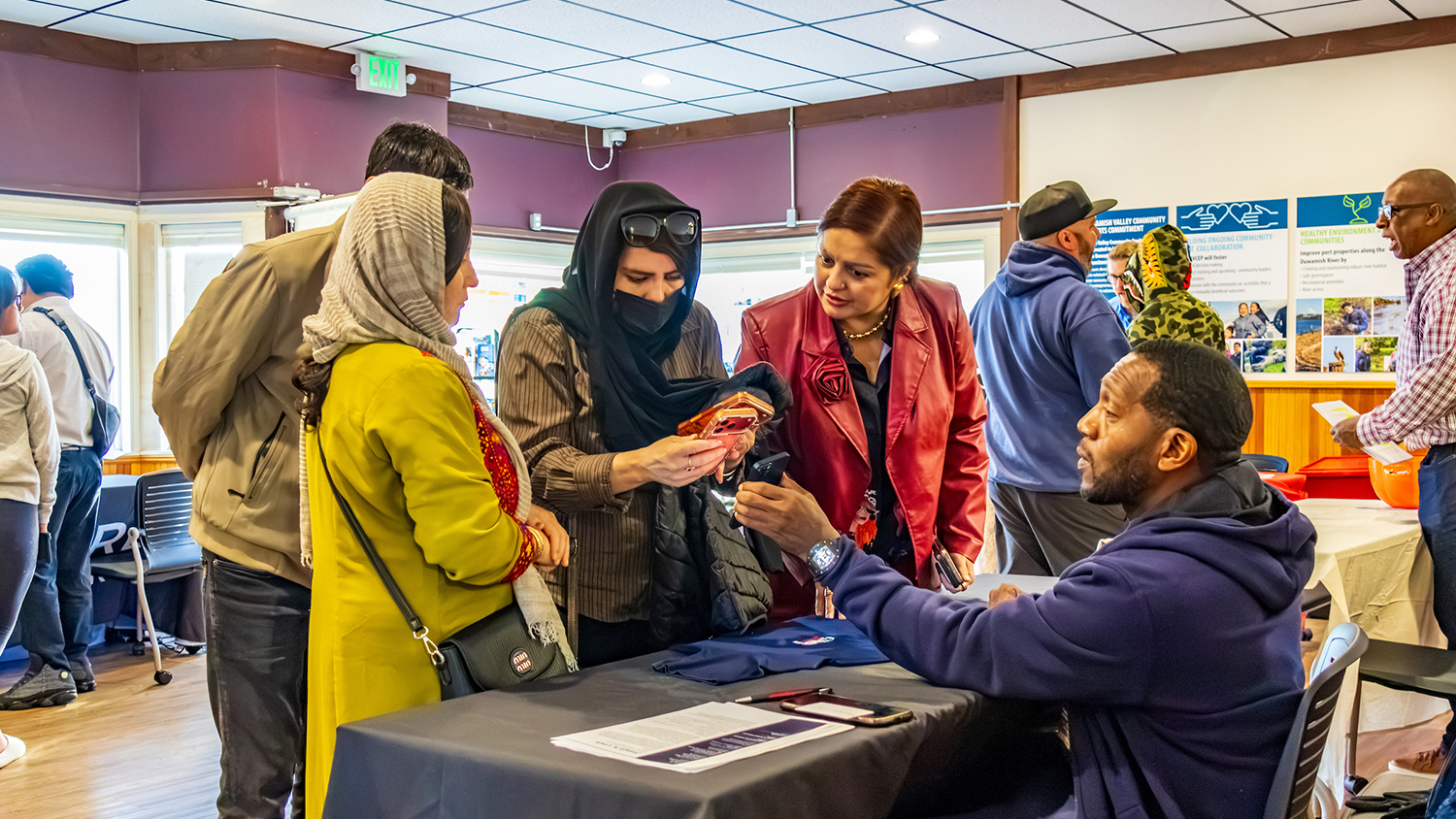
Attendees circulated through resource tables where they could connect directly with city departments, grabbing light refreshments and pastries while they learned about the office’s daily operations. They also participated in hands-on knowledge tests designed to help them recognize the difference between information that was genuinely accessible and information that wasn’t—spotting errors in materials that failed to use plain language or meet ADA standards.
Why Language Access Goes Beyond Translation
Leidy Quitián Varón reminded the audience that the office’s mission stretches far beyond converting words from one language to another.
“Language access is not simply translating words. People think about language access as interpreter or translation services and it goes beyond that,” Quitián Varón said.
Mario Vasquez, who has lived in the United States for almost 40 years, grounded the conversation in lived experience and the shifting demographics of the city, where more than 100 languages are now spoken. He described how finding information in one’s own language was crucial when he first arrived, and remains crucial for newcomers today.
“I’ve been in the United States for almost 40 years now, but I think having the ability to find places where you can get the information you need in the language you speak and be able to take advantage of these services are important,” Vasquez said. “It was important when I first came here and I’m sure it’s important to many others that are here now for the first time as I once was. The journey to become a city manager was built upon the support that I received, not just from my family, but also the community, resources, and the places that I grew up.”
Three Pillars Embedded in City Government
The office’s approach rests on three concrete focuses: plain language, accessibility, and translation and interpretation. By adding translations to city websites and public documents, the office helps residents who speak Spanish, Dari, Oromo, or any of the other languages in Kansas City access government services directly, without needing a personal advocate. Andrew Kling praised Quitián Varón and her team—Olga Pashchenko, Warda Belkass, and Eduardo Herrera—for keeping accessibility at the forefront of every event detail, from the live ASL interpretation to the resource table layouts.
Where the Office Stands Now
As attendees left the celebration, they carried a gift card, a boxed lunch, and a goodie bag from the Office of Language Access. For residents who need interpretation, translation, or help accessing city services in their own language, the office maintains resources at the city’s official language access page.
Two years in, the office has moved from concept to infrastructure. As the city’s linguistic diversity grows, these translations decide whether a resident can read a utility bill, apply for a permit, or understand a public notice without speaking English as their first language.
“We make this investment in this work because we believe in the people of Kansas City, and we want them to be fully part of our community. Our community is not whole unless everyone who lives here is a part of it,” Kling said.
Port of Seattle Wins IAP2 Program of the Year for Community Equity
In October, at the International Association for Public Participation's North American Conference in Vancouver, B.C., the Port of...

Cape May and Burlington Counties’ school funding proposals advance on ballots
More than three-quarters of voters in the Avalon Stone Harbor School District backed a $1.5 million bond referendum...

Six new couples named to lead Church historic sites in February 2027
The First Presidency of The Church of Jesus Christ of Latter-day Saints has named six new couples to...

Writer argues Texas’s Republican identity may be giving way
In a column for The New Yorker, a Texas-based writer argues that the state's seemingly unchangeable Republican identity...