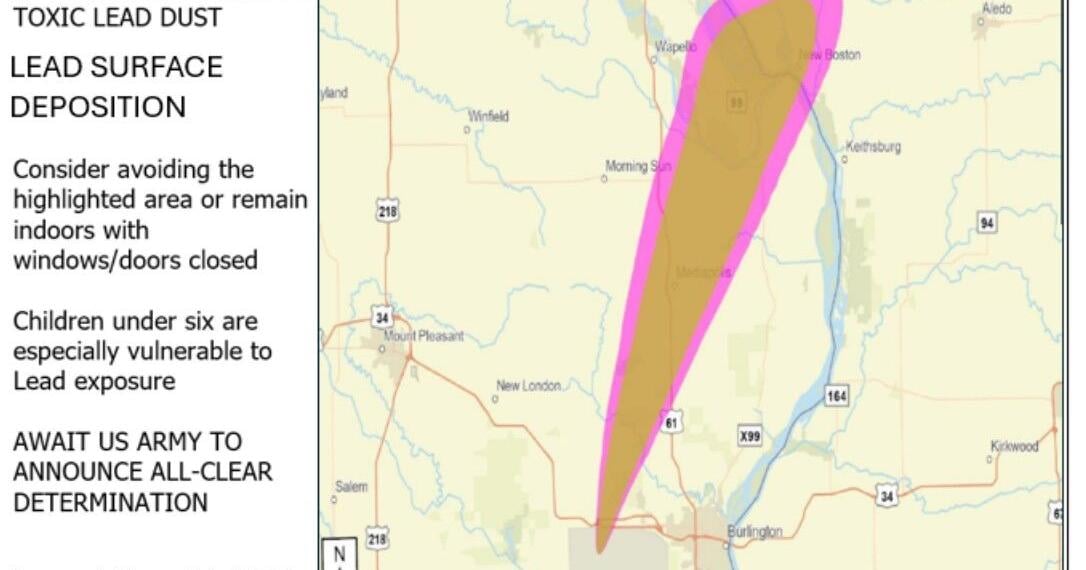
The U.S. Army plans to detonate 68 barrels of degraded lead azide at the Iowa Army Ammunition Plant on Friday, sending a toxic plume up to 60 miles across southeastern Iowa that could settle on farms, rivers and neighborhoods, The Seattle Times reported.
The controlled explosion at the Middletown plant is scheduled for noon on Nov. 20. Army officials said the material has become too unstable to move, leaving open detonation inside concrete bunkers as the only option to eliminate what the Environmental Protection Agency called an “imminent and substantial threat to human health and the environment.”
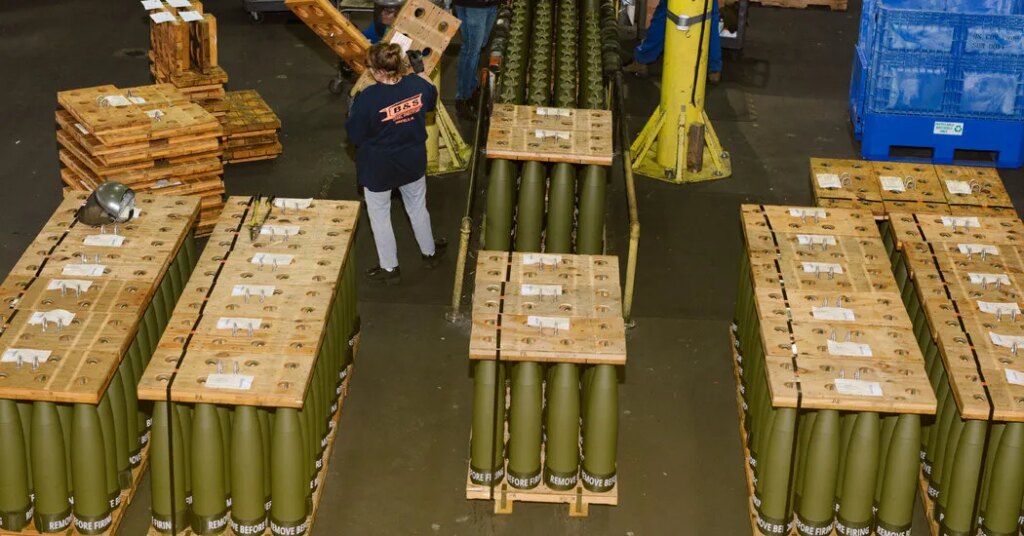
Lead azide is a primary explosive used to initiate larger munitions. The stockpile at the plant has degraded over decades, creating a risk of accidental detonation that the Army deemed unacceptable for transport. “Destroying it in place is the only responsible option,” the Army said in permit documents, adding that doing so “restores vital military-industrial readiness.”
“I would evacuate. I would not stay there,” said Erik D. Olson, senior director for environmental health at the Natural Resources Defense Council. “The idea that there’s no other alternative to open detonation of something like this is just staggering to me.”
Army revises plume projection to 60 miles
Early Army modeling estimated the lead dust could travel 100 miles. By Wednesday the service revised that figure to 60 miles, with the plume projected to move north and east depending on Friday’s winds. The barrels will be detonated inside earth-covered concrete magazines surrounded by sand-filled barriers roughly two stories high.
Air monitors have been placed around the site. The Army said it would publish updated trajectory estimates Friday morning. KWWL reported that the Army has released two maps — one for airborne exposure through respiration and another for surface deposition — and will update them 48 hours before the blast, six hours before, and hourly thereafter.
The EPA issued an emergency permit for the detonation last week under the Resource Conservation and Recovery Act. The agency did not respond to requests for comment from The Seattle Times.
Health risks and community response
Lead is a neurotoxin particularly dangerous for children and pregnant women, whose bodies absorb the heavy metal more readily. Exposure can interfere with fetal brain development, cause permanent cognitive and behavioral harm, and increase the risk of premature birth or miscarriage.
The Army has offered temporary shelter to residents nearest the plant. For those who stay, it advises remaining indoors with windows closed, setting HVAC systems to recirculate indoor air, and wet-cleaning children’s toys, windowsills and outdoor play equipment after the plume passes.
The Army Corps of Engineers is conducting pre-detonation soil sampling for about 150 residents who requested it and will offer post-blast testing, with remediation promised if results exceed regulatory thresholds.
Jill Holler of Muscatine, about an hour’s drive north of the plant and within the projected plume path, said she would evacuate with her husband and daughter Friday. But she worries about the family farm nearby. “How is this going to affect crops or the cows eating the grass from the land?” she said.
State officials left in the dark
The plans have stirred frustration among state and local leaders who say they were largely excluded from the decision-making process. Mason Mauro, a spokesperson for Gov. Kim Reynolds, said the state learned of the detonation only on Monday following the Army’s public advisory. The governor’s staff and state agencies have since been meeting with the Army to address the situation.
A legacy of buried waste
The Pentagon has been phasing out lead azide for environmental and safety reasons, leaving behind aging stockpiles. For decades the military buried dangerous waste — lead, cyanide, radioactive materials — or dumped it at sea, said Jacob Hamblin, a historian at Oregon State University who focuses on science, technology and the environment. Stronger regulations have curtailed that practice.
“It seems that the Army and EPA are trying to avoid a future disastrous explosion by doing a controlled one now,” Hamblin said. “But they are courting long-term controversy over health effects, given the known links between lead inhalation and illness.”
Rain forecast for Saturday could help wash lead dust off surfaces, Army spokesperson Lori McFate said Wednesday. “We are all banking on a good wash.”

Isofy Adds 60 Jobs at North Charleston Headquarters
isofy will add 60 jobs at its North Charleston headquarters, the company announced today. The network software company,...

UofA Alum Julia Soule Presents Research on Ozarks Trail History and Meaning
University of Arkansas alum Julia Soule argues that the trails threading the Ozarks are not neutral ground but...

Forty-seven artists and collectives fill the fifth edition of Greater New York at MoMA PS1
Forty-seven artists and collectives fill the fifth edition of Greater New York at MoMA PS1, a survey delayed...
Diocese of Harrisburg Holds First STREAM Competition: Students Build Emergency Shelters
Twenty teams of middle-school engineers huddled over craft sticks, straws and foil Wednesday, racing to build emergency shelters...