A study published today in The Astrophysical Journal argues that dark energy — the mysterious component driving the universe’s accelerating expansion — may emerge from the quantum vacuum of the strong nuclear force, without requiring any new particles or fields.
The model, developed by researchers at the University of British Columbia and the University of Sheffield, draws on quantum chromodynamics (QCD), the established theory describing how quarks bind inside protons and neutrons.
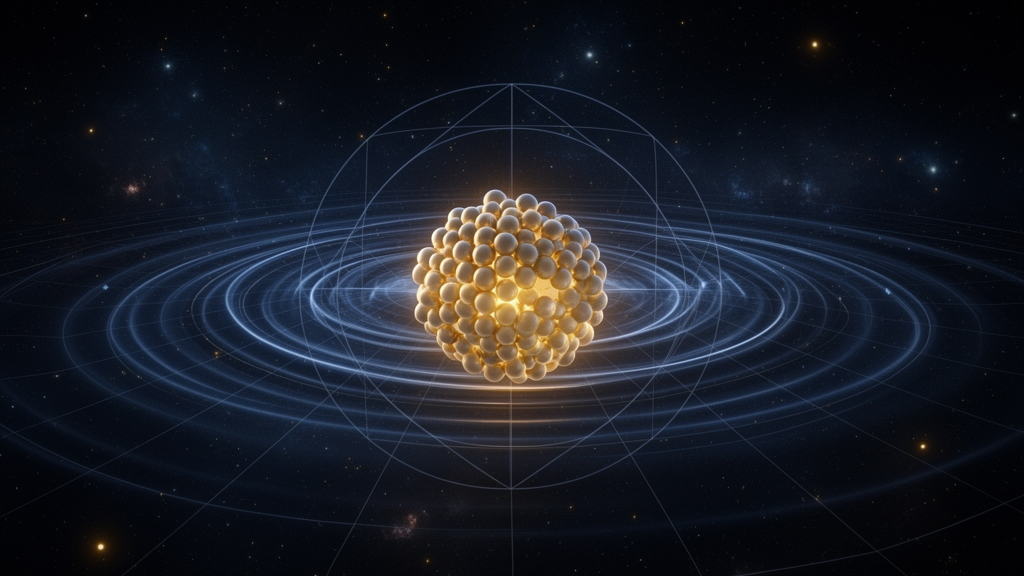
In QCD, empty space is not void but a complex environment with topological properties. The team proposes that as the universe expands, this subatomic vacuum structure responds differently over time, generating an energy shift that naturally matches the observed dark-energy scale.
From nuclear force to cosmic acceleration
Dark energy accounts for approximately 70 per cent of the universe’s total energy budget, yet its physical origin has remained unknown since astronomers discovered the accelerating expansion in 1998.
The standard cosmological model, ΛCDM, treats dark energy as a constant vacuum energy — a “cosmological constant” — but that explanation faces two long-standing problems: particle physics predicts a vacuum energy enormously larger than observed, and it is a coincidence that dark energy only began to dominate recently in cosmic history.
The new work, led by Dong Ha Lee, a doctoral researcher at Sheffield, builds on theoretical concepts developed over more than a decade by UBC professor Ariel Zhitnitsky. “Our theoretical framework suggests no new particles may be required at all,” Zhitnitsky said in a UBC release.
“The characteristic energy scale predicted from the QCD vacuum and gravity comes out close to the observed dark-energy scale today without having to introduce an ad hoc new field or a new parameter.”
“The most striking result is that the observed dark-energy scale emerges naturally from known physical constants, without the need for any additional fitting parameters,” Zhitnitsky said.
The researchers tested their QCD-induced model against a combination of early- and late-time cosmological datasets: Planck, Atacama Cosmology Telescope, and South Pole Telescope (SPT-3G) cosmic microwave background data; Dark Energy Spectroscopic Instrument (DESI) DR2 baryon acoustic oscillation measurements; and Type Ia supernova samples from Pantheon+ and DES-Dovekie.
The model reproduces the late-time dark-energy evolution preferred by DESI, which last year hinted that dark energy may be weakening over time rather than staying constant. It also predicts effective phantom crossing behaviour at intermediate redshifts (z ∼ 0.67) while avoiding the instabilities associated with phantom scalar fields.
Using Bayesian model-selection tools — including Akaike and deviance information criteria and Bayesian evidence estimated from Markov Chain Monte Carlo chains — the authors report that the QCD-DE model is consistently favored over ΛCDM for the full dataset combination.
Model requires two parameters for vacuum switching behaviour
The model introduces two parameters describing when and how quickly the QCD vacuum effect switches on — the same number of extra parameters as the generic evolving-dark-energy model it is compared against. The UBC release notes that the dark-energy scale emerges “without the need for any additional fitting parameters” regarding the overall size of the effect, but the switching behaviour still requires parameterization.
Lee emphasized that testing such models against cosmological data is an essential step: The idea that the quantum vacuum as described by QCD could have the right properties to account for the accelerated expansion of the universe is very intriguing. It raises the possibility that dark energy could be connected to the established theory of the strong nuclear force, without introducing new fundamental fields.
The team plans to refine its calculations and test the framework against incoming data from next-generation surveys, including further DESI releases, Europe’s Euclid space telescope, NASA’s Nancy Grace Roman Space Telescope, and the Vera C. Rubin Observatory.
The paper also points to a possible laboratory test: the same mechanism predicts a tiny extra contribution to the Casimir effect — the attraction between closely spaced metal plates caused by the quantum vacuum. Detecting that “topological Casimir effect” would directly support the QCD-vacuum account of dark energy.
The University of British Columbia, where Professor Ariel Zhitnitsky developed the theoretical concepts underpinning the model, hosts TRIUMF, Canada’s national particle and nuclear physics laboratory, which operates the world’s largest cyclotron. Established by provincial legislation in 1908, UBC awarded its first degrees in 1916 and now operates with an annual research budget of $893 million across two main campuses near Vancouver and Kelowna.
The research was funded in part by the Natural Sciences and Engineering Research Council of Canada.
Worth a look
- PAHO: U.S. Loses Measles Elimination Status as Cases Top 5,700
- SA Records 60 Murders Daily as Cachalia Links Gang Violence to Apartheid Legacy
- Diversified Energy Gives 350 Shoe Pairs to Oklahoma City Students (archyde.com)
- Top UN court finds Myanmar committed genocide against Muslim Rohingya (newsarchyuk.com)

PAHO: U.S. Loses Measles Elimination Status as Cases Top 5,700
The United States has lost its measles elimination status after the virus spread continuously for at least 12...

SA Records 60 Murders Daily as Cachalia Links Gang Violence to Apartheid Legacy
Police recorded 60 murders daily between July and September and dismantled 15 major drug factories in the past...

Google Rolls Out Gemini Computer-use Controls for Mac
Google rolled out computer-use controls for the Gemini Mac app on Thursday, letting the AI click, type, and...

Pakistan’s Ex-Army Chief Waheed Kakar Dies at 89
General Abdul Waheed Kakar, the Pakistani army chief who forced a president and a prime minister to resign...