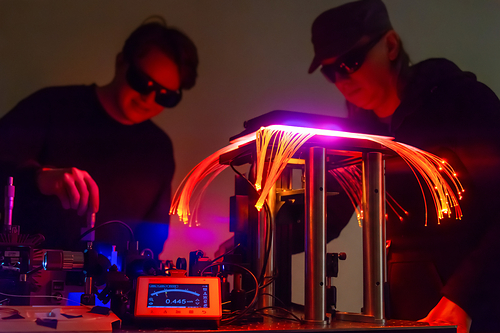
UbiQD, Inc. has been awarded a $200,000 grant through New Mexico’s Quantum Technologies Award to develop a room-temperature light source for quantum computing and secure communication networks. The funding, provided by the New Mexico Economic Development Department (NMEDD) via its Technology and Innovation Office, supports the creation of a device that emits single photons on demand, connected directly to fiber optic cables, as reported by PR Newswire.
This development addresses a fundamental bottleneck in quantum hardware. While many current quantum computers rely on superconducting circuits that require massive, expensive refrigeration systems to stay near absolute zero, light-based systems—which use photons to carry information—can operate more efficiently over long distances and require far less extreme cooling. The challenge has been finding a reliable light source that doesn’t either waste energy by emitting random clusters of photons or require its own deep-freeze environment to function.
Moving Quantum Hardware Out of the Deep Freeze
The stakes here are largely about scalability and cost. For quantum computing to move from specialized laboratories into broader industrial use, the hardware cannot depend on the “large, expensive refrigerators” currently required for superconducting circuits. By utilizing quantum dots, UbiQD aims to create a source that is safe, tunable, and, most importantly, capable of operating at room temperature.
The company uses proprietary I-III-VI semiconductor quantum dots. According to the company, these materials are free of cadmium, lead, and mercury, making them a safer alternative to some traditional semiconductor materials. This project isn’t starting from scratch; it builds on a 2024-2025 partnership with Los Alamos National Laboratory under the Technology Readiness Gross Receipts (TRGR) Initiative, which provided some of the first detailed measurements for these specific materials.
“New Mexico has the foundational science, and we have the infrastructure and team to turn decades of quantum dot materials development into products that accelerate the quantum computing industry,” said Hunter McDaniel, PhD, Founder and CEO of UbiQD. Hunter McDaniel
McDaniel’s history with the field dates back to his time as an undergraduate researcher in the group of Nobel laureate John Martinis at UC Santa Barbara. That academic foundation has evolved into a commercial strategy focused on turning lab-scale physics into patentable hardware.
A Strategy Built on Intellectual Property
UbiQD isn’t just chasing a single grant; they are building a defensive wall of intellectual property to secure their position in the quantum industry. The company currently owns or exclusively licenses 17 granted U.S. patents and 23 international patents, with another 27 applications pending. This portfolio is structured in layers, moving from the raw quantum dot material to usable forms like films, and finally to specific end-uses in sectors like agriculture and solar energy.
One specific piece of this puzzle is US patent #12,085,443, “Fiber-coupled Broadband Light Source,” which has also been granted in several other countries, including France, Germany, and Canada.
Nikolay Makarov, Senior VP of R&D at UbiQD and the principal investigator on the grant, noted that the company is moving beyond just manufacturing materials to building a full optical product. This transition is supported by research as far back as 2017, when Makarov co-authored a Los Alamos study demonstrating that copper indium disulfide quantum dots could emit single photons at room temperature.
The Industrial Ripple Effect
So, why does a $200,000 grant in Los Alamos matter to the broader economy? If UbiQD succeeds, the “quantum advantage” becomes less about who has the biggest refrigerator and more about who has the most efficient light source. This shifts the power dynamic of the industry toward companies that can manufacture reliable, room-temperature components at scale.
However, the path from a grant-funded prototype to an industry standard is steep. The “Devil’s Advocate” view is that while room-temperature operation is a massive advantage, the reliability and “fidelity” of single-photon emission must meet incredibly stringent industry targets before these devices can replace existing superconducting systems.
To address this, UbiQD will use the NMEDD funds for optical equipment and device prototyping at their Los Alamos headquarters. The immediate goal is to measure exactly how reliably their quantum dots produce single photons and refine the materials until they hit those performance targets.
The company, founded in 2014, continues to expand its reach through strategic partnerships and licensing across the energy and security sectors. By pairing the Quantum Technologies Award with their existing IP, UbiQD is betting that the future of the quantum internet will be written in light, not just chilled circuits.
Worth a look

Oklahoma City Thunder name starters for game against Dallas Mavericks
The Oklahoma City Thunder will start Shai Gilgeous-Alexander, Ajay Mitchell, Jared McCain, Kenrich Williams, and Isaiah Hartenstein tonight...

North Dakota DOT offers Uber and Lyft vouchers for safe Halloween rides
The North Dakota Department of Transportation is offering $10 ride vouchers for Uber and Lyft from Oct. 29–31...

NYT Cooking AI substitution tool sparks significant user backlash
The New York Times has launched an AI-powered ingredient substitution tool within its Cooking app for iOS subscribers,...
NYT Cooking AI Ingredient Substitutions Spark Reader Backlash
Roughly 77% of readers who commented on the New York Times' announcement of new AI features for its...