
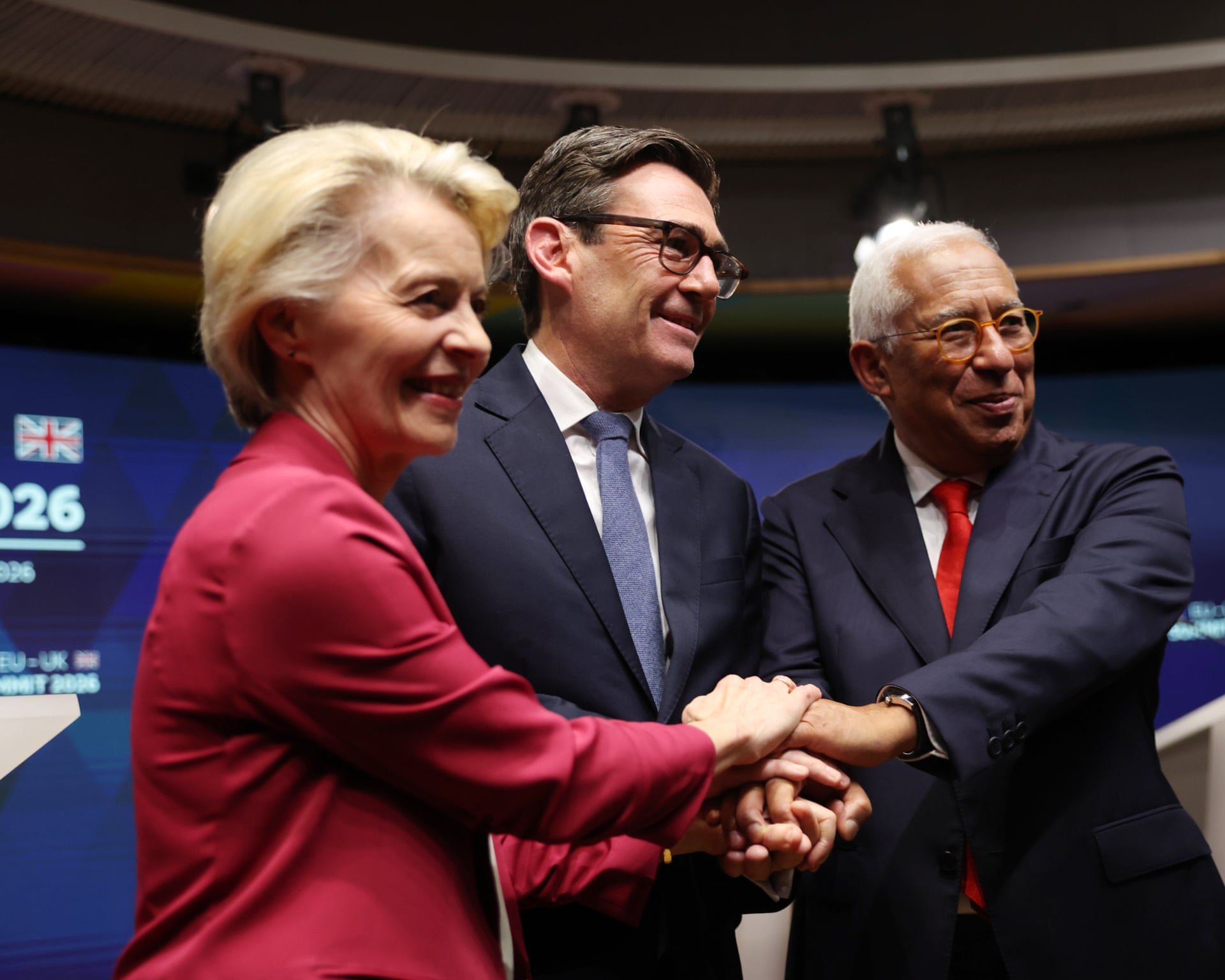
Prime Minister Andy Burnham sealed a post-Brexit reset deal with the European Union in Brussels on Friday, agreeing to ease food trade, link carbon markets and launch a youth mobility scheme — a package the Treasury says could add 0.5 per cent to UK GDP and boost the economy by up to £17bn a year.
The agreements, announced after a summit with European Commission President Ursula von der Leyen and European Council President António Costa, mark the most concrete unwinding of Brexit barriers since 2016.
They cover a sanitary and phytosanitary deal to cut checks on animal and plant products, a link between the UK and EU emissions trading systems to spare steel and other goods from border carbon levies, and a scheme allowing up to 100,000 young people from each side to live, work or study in the other’s territory for up to three years.
Two years ago, we started a reset of our relationship which led to our first EU-UK summit last year in London. Since then, we have continued to deepen our cooperation and strengthen our ties. And today, with this summit, we are taking another step forward. We are turning our… pic.twitter.com/A7rwrIA1UR
— Post by @eucopresident on X
“This is a good day for Britain. This is a good day for Europe,” Burnham told EU leaders at the start of talks. Downing Street confirmed negotiations have concluded and both sides will now work through the legal processes required for implementation.
Burnham said the food agreement alone is worth an estimated £5.1bn ($6.7bn) to the British economy, while the emissions trading link will exempt British and EU goods such as steel from each other’s carbon border taxes. The youth scheme aims to be operational by January 2030.
SECURED ✔️Cutting costs ✔️Restoring opportunities for young people ✔️Easing pressure on food prices in the shops A £17 billion boost for the British economy. That’s what we’ve secured at today’s UK EU Summit. Find out more: https://t.co/8A6CvgP3wu pic.twitter.com/296ybmZEwU
— Post by @cabinetofficeuk on X
Tuition fees dispute holds up implementation
Despite the celebratory tone, the EU has made implementation of the food accord, carbon market link and youth scheme conditional on resolving a dispute over university tuition fees for European students in the UK. Brussels wants EU students to pay domestic rates; London has offered “significantly reduced” fees but not parity. Both sides have given themselves six months to find a solution.
The Guardian reported that EU sources say at least some agreements will not take effect until the tuition-fees issue is settled. Burnham acknowledged the linkage, saying “talks will continue on some areas.”
The EU-UK agreement reached today is good news for people and businesses on both sides. More young people will be able to work and study across the Channel. They must have the same tuition fees as domestic students. This is just a beginning. The UK and the EU should work closer…
— Post by @MichelBarnier on X
Burnham frames reset as parliamentary limit
Burnham told reporters the package is “probably the limit of what we can achieve in this Parliament, given what needs to be done to implement it.” He said his government will publish a 10-year plan next month setting out ambitions for reindustrialisation and growth in “all parts of Britain,” and that both sides will “seek to conduct an informal brainstorming process” before the next UK-EU summit to explore options for the long-term relationship.
“Beyond that we do need to consider what is the right long-term relationship. Incremental steps only take us so far,” Burnham said. He stressed that any future moves would respect Labour’s 2024 manifesto pledge of “no return to the single market, the customs union, or freedom of movement,” and that “at every stage the British people will be the boss.”
A decade of economic debate
Legislation to implement the deal is expected in the UK Parliament next week. The six-month window on tuition fees runs until spring 2027. The next UK-EU summit will take stock of progress and the informal “brainstorming” on long-term options. The next general election must be held by August 2029, which Burnham has previously identified as the earliest point for major constitutional choices.
“What we are announcing today is probably the limit of what we can achieve in this Parliament, given what needs to be done to implement it. But we want to inform the Parliament after this one, so that decisions can be taken about that long-term relationship,” Burnham said.
The EU and the UK are closest neighbours, reliable allies and natural partners – bound by deep historical ties and shared values. And in an increasingly challenging world, we have both a responsibility and a duty to work together. https://t.co/aq5meSSTGe
— Post by @eucopresident on X
This approach aims to provide the necessary groundwork for future leaders to address the complex challenges regarding the long-term relationship between the UK and the EU.
Earlier coverage: UK and EU Agree Post-Brexit Reset Deal; Tuition Fees Still Open

Commonwealth Shared Scholarships Open 10 November 2026 for 2027 Awards
Nigerian graduates can apply from 10 November 2026 for Commonwealth Shared Scholarships that cover full tuition, a monthly...

Estonia to Close All Three Russia Border Crossings After Failed Arson Attack
Estonia will close all three land border crossings with Russia on December 1 after its security service said...

Pakistan Minister Visits India for SCO Forum After 2025 War
The Government of Pakistan remains committed to promoting dialogue among civilisations and fostering people-to-people contacts within the SCO...

Peres Jepchirchir Banned Three Years for EPO Positive Test
Peres Jepchirchir received a three-year ban after testing positive for EPO. The Athletics Integrity Unit announced the penalty...