UN climate talks in Antalya collapsed Sunday after nearly 200 countries failed to adopt a cover decision for the first time since Copenhagen in 2009, CBC reported.
- COP31 ended without an overarching agreement after two weeks and 48 hours of overtime.
- The EU and vulnerable nations rejected a Turkish–Australian draft that omitted fossil fuels.
- Saudi Arabia led opposition to any mention of phasing out fossil fuels.
- Finance, electrification and carbon-capture targets also remained unresolved.
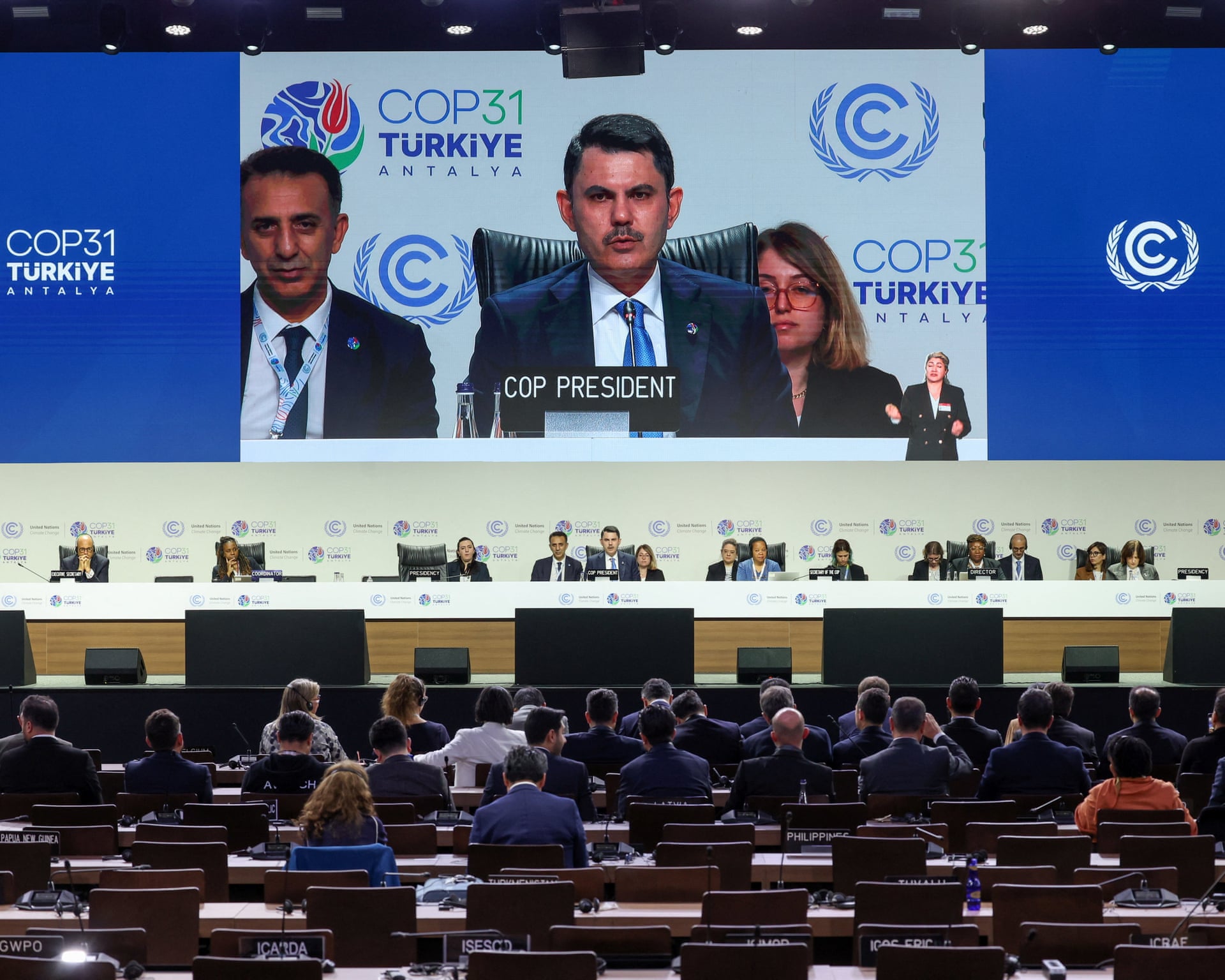
The breakdown came after the joint Turkish–Australian presidency presented a final text that recalled the 2023 Dubai deal but contained no explicit reference to fossil fuels, the chief driver of global warming, Global News reported.
“It’s unconscionable that we would have a climate act that makes no reference to fossil fuels,” Irish Climate Minister Darragh O’Brien said on behalf of the 27-nation European Union. We recognize that there is no consensus on this document.”
More than 100 countries had pushed to keep language calling for an “immediate transition away from fossil fuels in energy systems” that appeared in the first draft Monday, CNN reported. All such mentions were stripped from every subsequent version. COP31 President Murat Kurum acknowledged the impasse: “We recognize that there is no consensus on this document.”
🌍 Calls for a stronger climate deal intensified as #COP31 reached its final scheduled day. Countries across regions demanded explicit action on fossil fuels and stronger climate finance. Read the report from Antalya 👇https://t.co/hrgsH3Zfb9
A larger group of nations argued that reaching any consensus was more important and accepted the weakened proposal, often reluctantly.
“You cannot solve a fossil fuel crisis by pretending we don’t need to phase out fossil fuels,” said Harjeet Singh, founding director of the Satat Sampada Climate Foundation, in comments to CNN. Panama rejected the deal for failing to acknowledge the scale of the crisis, while Norway’s Climate Minister Sigrun Gjerløw Aasland said the draft “takes us backwards.”

Climate finance for developing countries proved a parallel sticking point. Kenya’s delegation said the text “rightly speaks of least developed countries and small island states, but not once of Africa’s special needs and circumstances,” according to CBC. “Those who took the lead in emissions must take the lead in support.”
Jeanne-Marie Huddleston, Canada’s chief climate negotiator, expressed “deep disappointment” that a consensus could not be reached. “You need to mention the problem if you’re going to actually get to solutions,” she said. Russia was also against mentioning fossil fuels in the agreement.
Decisions on the Just Transition Mechanism agreed at COP30 were postponed until COP32 in Addis Ababa in 2027.
Now that #COP31 has concluded, I want to send a message to civil society, young people, Indigenous Peoples, scientists & frontline communities: Keep spreading the facts. Keep demanding #ClimateAction. Keep turning up the heat. Hold governments and companies to account.… pic.twitter.com/Nvsp2FOHeh
Fossil-fuel language stripped from drafts
More than 100 countries pushed to keep that language, but every subsequent version removed all fossil-fuel references, the network said.
At COP28 in Dubai in 2023, parties agreed to a first-of-its-kind call to "transition away from fossil fuels," CNN noted.
I'm deeply disappointed that #COP31 has ended without consensus on an overarching outcome. I share the very profound frustration of all those who expected governments to rise to the moment the climate crisis demands. But this setback does not change the facts. There may be no… pic.twitter.com/SBMZPpfU5l
Finance and electrification targets also divide
Russia also opposed mentioning fossil fuels in the agreement, the broadcaster said.
Disagreement extended to a 35 per cent electrification target for 2035 and an abruptly proposed carbon-capture utilisation and storage goal — an expensive, unproven-at-scale technology that would have licensed continued fossil-fuel expansion, IISD reported.
Rebuilding trust before next summit
“This was the worst Cop ever,” former Irish president and COP veteran Mary Robinson said.
Existing frameworks from previous summits remain in effect, CBC noted.
Existing frameworks from previous summits remain in effect. The next UN climate conference is scheduled for Addis Ababa, Ethiopia, with interim talks in Bonn next June aimed at rebuilding trust, IISD reported. “This was the worst Cop ever,” she said.
Related reading
- Timor-Leste Claims Chinese and Russian Interest in Greater Sunrise as Analyst Warns of Sovereignty Risk
- Sheila Mangubat, ’90 Day Fiancé’ Star, Dies at 35 in Philippines
- Airbnb's Chore Limits Cover Bookings Made From Nov. 20, Not Stays (daybreakwire.com)
- Theresa May warns Andy Burnham to move on from Brexit after EU talks (newsarchyuk.com)

Timor-Leste Claims Chinese and Russian Interest in Greater Sunrise as Analyst Warns of Sovereignty Risk
Woodside Energy sold its 33.4% stake in Greater Sunrise to Timor-Leste last month, leaving the government with near-total...

Sheila Mangubat, ’90 Day Fiancé’ Star, Dies at 35 in Philippines
Sheila Mangubat, who appeared on Season 6 of TLC's 90 Day Fiancé: Before the 90 Days, died Saturday...

UK Right and Labour Condemn Trump Over ‘My Friend’ Putin Post
British political leaders across the right have broken with Donald Trump after the US president posted a photograph...
UKMTO Reports Tanker Incident With Military Forces in Gulf of Oman
“A company security officer alerted UKMTO to the incident. "Authorities are aware and investigations are ongoing," the UK...