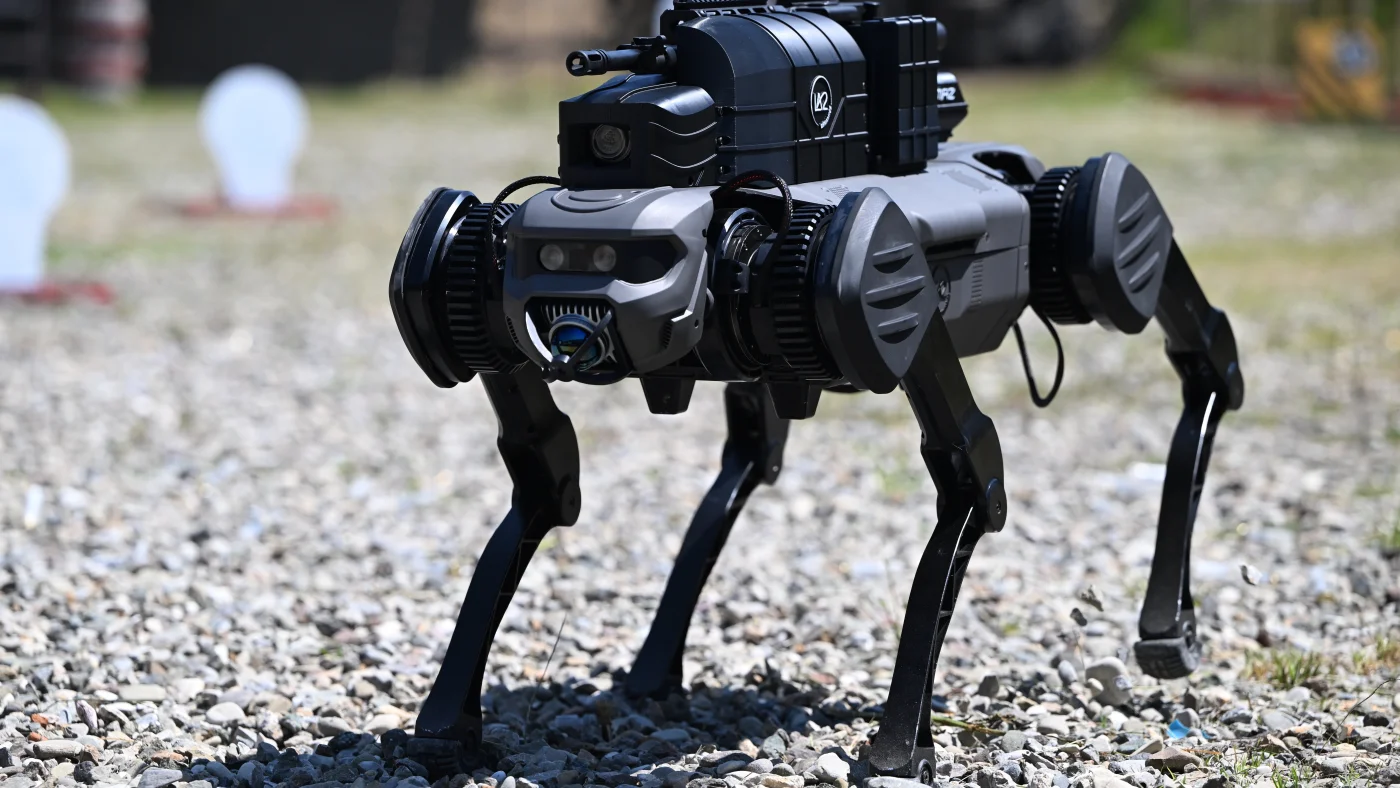
“States have agreed it is sufficient to just talk about the issue, for the 14th year, while these weapons enable atrocities,” said Max Tegmark, a machine learning specialist at the Massachusetts Institute of Technology and founder of the Future of Life Institute, regarding the outcome of the talks.
Efforts to set firm rules on AI-powered killer robots and drones ran aground in Geneva as U.N.-backed talks produced a softened agreement to extend discussions for two more years. Scores of countries ended the week-long conference by agreeing to “elaborate” a possible accord on lethal autonomous weapons systems by 2028, falling short of the binding rules sought by U.N. Secretary-General António Guterres and various international advocacy groups.
The outcome underscored the difficulty of achieving concrete results in diplomacy amid global conflicts and major military powers jockeying for dominance. Izumi Nakamitsu, the U.N. high representative for disarmament affairs, hailed a “significant achievement” while acknowledging a “glass half full or half empty” scenario, citing Guterres’ hopes for a legally binding deal this year.
The 7th Review Conference on the Convention on Certain Conventional Weapons has concluded at @UNGeneva. #CCW has agreed to launch the elaboration of an international instrument on lethal autonomous weapons system, to be conducted over the next 2 years.https://t.co/9ybn4k3xlB
Activists accused military powers like Russia and the United States of blocking stronger language. Stop Killer Robots lamented a “watered-down mandate,” and Beatrice Fihn, founder of international law advocacy group Lex International, said the decision amounts to “pushing the can down the road for two more years.”
Before the meeting, seven countries proposed launching negotiations on a rulebook that could prevent or limit the ability of machines to kill without human control or accountability. That effort ultimately fell short.
We need a serious debate about prohibiting autonomous weapons. This week, governments are meeting in Geneva to discuss a treaty to regulate autonomous weapons. States must seize this moment to disarm AI. ⬇️Read my shout out: “AI in conflict: The time to disarm AI is now”…
“Technology is moving faster than diplomacy,” said Ambassador Frederico Meyer of Brazil, which joined Austria, Belgium, Ireland, Mexico, New Zealand and Panama in proposing such negotiations, adding that diplomats are very slow.
Advocates said that Russia and other major tech-developing nations want a freer hand to develop high-tech armaments. Meanwhile, the Pope and various humanitarian groups have framed the issue as an existential debate, urging quick action to rein in AI weapons before they become too commonplace to regulate easily.

Activists say armed drones that can independently strike targets have already been deployed in select instances in conflict zones, though a widespread rollout has not yet happened. Talks centered on the Convention on Certain Conventional Weapons, ratified by 128 countries, where decisions are made by consensus, meaning any single country can thwart an agreement and push any resulting deal toward the low common denominator.
Writing in a position paper submitted for the Geneva conference, the Holy See argued that irreversible decisions concerning life and death cannot be entrusted to artificial systems because machines only calculate while moral judgment involves conscience. The Holy See called for a moratorium on lethal autonomous weapons alongside a binding international framework.
Military powers managed to impose many obstacles to the objective of a protocol, but at least it remains a possibility with a short-term mandate, a diplomat who attended the talks that concluded past 4 a.m. said.
The discussions in Geneva are set against a backdrop of unique international significance. It holds the highest number of international organisations globally, including headquarters for the International Committee of the Red Cross. Furthermore, it is the location where the Geneva Conventions on humanitarian treatment in war were signed.
“States must act to ensure the future of warfare is not handed over to machines,” said Mirjana Spoljaric, president of the International Committee of the Red Cross, in a statement released during the conference.
🎤 Disarmament talks debate call to agree on legally binding instrument for ‘killer robots’ 🎤 Myanmar war must end, insists @antonioguterres at ASEAN-UN summit 🎤 #COP31: @UNESCO report highlights AI role in climate disinformation https://t.co/4qTIhZrl2C
Worth a look

Beloved hippopotamus Fiona died on Thursday at the Cincinnati Zoo in Ohio at nine years old
Beloved hippopotamus Fiona died on Thursday at the Cincinnati Zoo in Ohio at nine years old after ingesting...

Westside Cowboy Named BBC Introducing Artist Of The Year For 2026
Manchester quartet Westside Cowboy have been named the BBC Introducing Artist of the Year for 2026, becoming the...

Strictly Come Dancing Brings Eight Couples to Blackpool Tower Ballroom
Strictly Come Dancing returns for its annual visit to the Blackpool Tower Ballroom with eight couples taking to...

Newfoundland Historical Society: Irish Migrants Arrived in Late 1600s
Irish migrants began arriving in Newfoundland in the late 1600s, primarily continuing through the 1700s and up to...