
University of Arkansas researchers have 3D-printed interlocking bricks from simulated lunar dust without any binder, a first step toward building Moon habitats from material already on the surface.
The study, published August 29 in npj Advanced Manufacturing, used a commercial simulant called Lunar Highlands Regolith Simulant (LHS-1) — a powder developed by the University of Central Florida’s Exolith Lab and supplied by Space Resource Technologies — and a laser powder bed fusion printer to produce centimeter-scale blocks shaped like crosses and the letter H. Those pieces fit together like LEGO bricks.
The material is porous and weaker than binder-based alternatives; test cubes reached a peak compressive strength of about 3.4 megapascals.
“There's nothing else it's binding to. The regolith powder is binding to itself,” said Cole McCallum, who led the experiments as an undergraduate and is first author on the paper. “These structures we're making can be self-supported. But I would be hesitant to say our process could be used for something that's supporting other loads at this moment yet.”
Binder-free printing cuts Earth supply chain
Earlier lunar construction concepts relied on polymer binders or cement shipped from Earth. The Arkansas team showed a low-power laser can sinter the simulant directly, eliminating the need to transport adhesives. The process spreads a thin layer of powder, fuses selected areas with a laser, lowers the bed, and repeats — building parts layer by layer through sintering rather than gluing.
Senior author Wan Shou, an assistant professor of mechanical engineering, said further work is needed to understand how the process behaves in microgravity and vacuum, and to improve the bricks’ mechanical properties before they become practical for load-bearing structures.
Modular shapes enable reconfigurable walls and shielding
The cross-shaped and H-shaped geometries draw on mortise-and-tenon joinery principles. The cross piece acts as a projecting connector that fits into the recessed H module, allowing assembly in multiple directions without mortar. Researchers demonstrated small wall and shielding configurations that can be disassembled and rearranged — an advantage over monolithic 3D-printed structures, because a damaged block could be replaced without rebuilding the whole section.
Rough surfaces on the printed parts prevented some joints from making close contact, a fit problem that will compound as more courses are stacked. The team also said that thermal protection for habitats would require additional layers beyond the regolith bricks themselves.
Researchers test solar concentration to replace laser
Separate one-centimeter cubes printed at higher laser power showed more connected material between scan lines and layers, even though overall porosity remained similar. That suggests bond quality between neighboring tracks matters as much as reducing void space. Scaling the process to a larger printer bed while maintaining that consistency is a key engineering challenge.
The researchers are also investigating whether concentrated sunlight — focused through Fresnel lenses or parabolic mirrors — could replace the laser, letting future missions use two resources already on the Moon: regolith and solar energy. For now, the bricks remain experimental, suited mainly to self-supporting components rather than load-bearing walls.
An undergraduate’s launchpad
McCallum, a Little Rock native, joined Shou’s lab early in his undergraduate career. “He had this really strong belief that undergrads should get involved more with research,” McCallum said.
The project taught him how to handle the iterative failures of experimental work: “It helps you refine and overcome all the problems you have as a researcher. There are a lot of mistakes that I made the first time through. It was really nice to have a head start on everyone else and make those mistakes early.”
McCallum graduated in May with degrees in mechanical engineering and physics, then won an inaugural Lafayette Fellowship — one of 30 selected from more than 3,400 applicants — to pursue a master’s in aerospace engineering at ISAE-SUPAERO in Toulouse. The program was created to celebrate the 250th anniversary of the United States. He begins the program in France this fall, building on the hands-on experience that shaped his undergraduate career.
Worth a look
Mars and Jupiter Seen in Sky Over China’s Heilongjiang
Mars and Jupiter reached their closest apparent separation in the night sky on Sunday appearing as a spectacular,...

Scientists Discover Dragonball Organelles in Deep-Sea Mollusc
Deep inside an enigmatic ocean-floor animal, researchers have uncovered a tiny organelle that has no known counterpart anywhere...
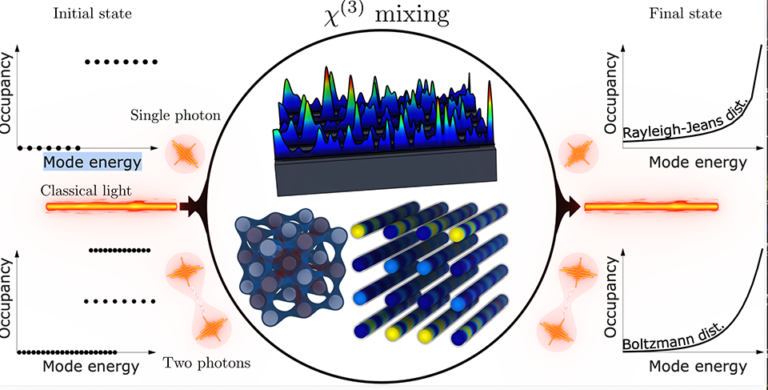
SLU Researchers Simulate Quantum Behaviors Using Classical Light Dynamics
Researchers from Saint Louis University and two German institutions have demonstrated that classical nonlinear light dynamics can induce...

Expert Warns Summer Was a Wake-Up Call and Winter Could Be Dire for Food Supplies
Winter flooding threatens Wales' food supply just as summer droughts and wildfires exposed vulnerabilities in an import-reliant distribution...