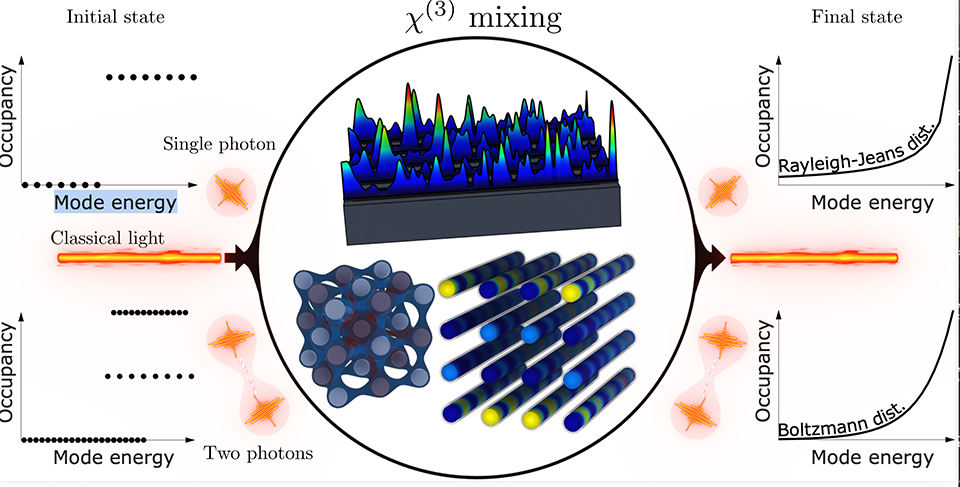
Researchers from Saint Louis University and two German institutions have demonstrated that classical nonlinear light dynamics can induce effective photon interactions, allowing quantum light to reach thermal equilibrium.
The study, published in Sciences Advances, offers a new way to explore quantum behavior without the need for exotic materials that are typically difficult to fabricate. By using standard, readily available classical optical structures, the team successfully simulated quantum behaviors that were previously considered practically inaccessible in optical setups.
Photons are essential for high-speed data transmission and quantum technologies due to their coherence and speed. However, they possess a fundamental limitation: the absence of direct photon-photon interactions. To overcome this, the research team—comprising experts from Saint Louis University (SLU), the Max Born Institute, and Humboldt-Universität zu Berlin—investigated how quantum light propagates alongside intense classical light fields.
Through numerical experiments, the scientists found that single- and two-photon states embedded in these configurations do not simply maintain their initial states or suffer from decoherence. Instead, they thermalize, forming statistical distributions consistent with Rayleigh-Jeans and Boltzmann distributions.
By leveraging the intense classical wave dynamics to mediate effective interactions, the system successfully bridges the gap between macroscopic nonlinear optics and microscopic quantum mechanics.
Armando Perez-Leija, research scientist at Saint Louis University
The research provides a framework for investigating open quantum systems and many-body thermodynamics. By lowering experimental barriers, the team expects to open new avenues for observing phenomena such as quantum phase transitions within standard optical laboratory settings.
The implications of this work extend far beyond foundational optics, reaching deep into statistical mechanics and condensed matter physics.
Ramy El-Ganainy, professor of electrical and computer engineering at Saint Louis University
The international team included researchers from SLU’s School of Science and Engineering, including Şahin K. Özdemir, Ramy El-Ganainy, and Armando Perez-Leija. They were joined by Fouad Chahrour and Kurt Busch from the Max Born Institute and Humboldt-Universität zu Berlin. The project was supported by funding from the US Air Force Office of Scientific Research (AFOSR) and the Army Research Office (ARO).
By lowering the experimental barriers required to study complex quantum photon interactions, the research opens fresh avenues for light dynamics and deepens our fundamental understanding of how statistical equilibrium emerges in quantum systems.
Şahin K. Özdemir, professor and chair of electrical and computer engineering at Saint Louis University
The study, titled “Thermalization of quantum light induced by classical nonlinear wave dynamics,” is available for further review.

Expert Warns Summer Was a Wake-Up Call and Winter Could Be Dire for Food Supplies
Winter flooding threatens Wales' food supply just as summer droughts and wildfires exposed vulnerabilities in an import-reliant distribution...
NASA’s CHAPEA Mars Crew Finally Emerges After More Than a Year in Isolation
Four research volunteers stepped out of NASA’s Mars Dune Alpha habitat on Oct. 31, 2026, completing the agency's...

Rising Temperatures Halted the Start of a New Ice Age in the Arctic
It was just getting started, everything was normal, the next glaciation was about to happen—and yet it stopped,...
NASA Artemis II Launch Caused GPS Disruptions Across North America
A positioning error of a couple of meters is enough to cause an autonomous car to change lanes,...