
The U.S. Army planned to detonate 68 drums of degraded lead azide at the Iowa Army Ammunition Plant in Middletown on Friday, November 20, a decision authorized by an emergency EPA permit announced just five days earlier.
Acting Secretary of the Army Adam Telle postponed the blasts to Monday, November 23, citing a forecasted temperature drop that risked further destabilizing the material, Al Jazeera reported. Hours later, the Eighth Circuit Court of Appeals granted an interim stay blocking the operation while it weighs a lawsuit from the Iowa Environmental Council and the Sierra Club’s Iowa chapter challenging the EPA’s emergency authorization.
The Army is responding to the questions and concerns I’ve shared from Iowans. I’ve emphasized the need for increased communication. The Army is delaying the controlled detonation until Monday to further educate the public. https://t.co/yAX22Xx2aK
The stockpile — roughly 9,700 pounds of explosives containing about 6,900 pounds of lead — has sat in earth-covered magazines for 20 years. A March safety review found the liquid in the drums had evaporated, causing the lead azide to recrystallize and become dangerously sensitive to shock and friction, according to the Army’s environmental assessment. Moving the drums risks an uncontrolled explosion; leaving them in place risks a spontaneous one.
“We’re trying to do a controlled detonation to minimise the impact to the community and the environment. This is not something that we take lightly.”
Justine Barati, Army Sustainment Command spokesperson told a local television station earlier this week.
Hey @grok can you confirm if the U. S. Army is detonating a toxic iron azide bomb in my state that could cause widespread lead poisoning this Friday? pic.twitter.com/miXUsvFRHD
The plume problem
The Army’s November 15 advisory warned Middletown’s 360 residents that the blasts would loft a dust plume containing “some lead,” accompanied by loud explosions and ground vibrations. Containment relies on drenching the soil above the magazines with water and sand-filled barriers roughly two stories high designed to direct force vertically.
Modeling predicts airborne lead levels will remain below the threshold requiring EPA protective actions. But Patrick O’Shaughnessy, an environmental health professor at the University of Iowa who will monitor fallout, said the critical variable — how much lead each explosion actually propels into the air — remains undisclosed.
Is the Army about to unnecessarily poison Iowa and our Nationwide food supply? If the Army's own research center proved on this exact plant that a biopolymer crust reduces respirable dust and held an explosion-protection berm stable for over three years, why did that same…
“The unprecedented aspect of it is that normally in the world of air pollution, we have some estimation of what’s called the emission factor, the emission strength. We know how many pounds per second will be distributed out into the air from a smokestack, but in this case, we have no idea.”
O’Shaughnessy told Al Jazeera.
Maps released by the Army show a worst-case scenario assuming all lead becomes airborne — a scenario Iowa State University field agronomist Virgil Schmitt told PolitiFact “will not” happen. Still, Illinois officials warned residents in Mercer County, 55 miles northeast, they could be impacted. The Army planned to release updated maps six hours before detonation based on current weather, PolitiFact reported.
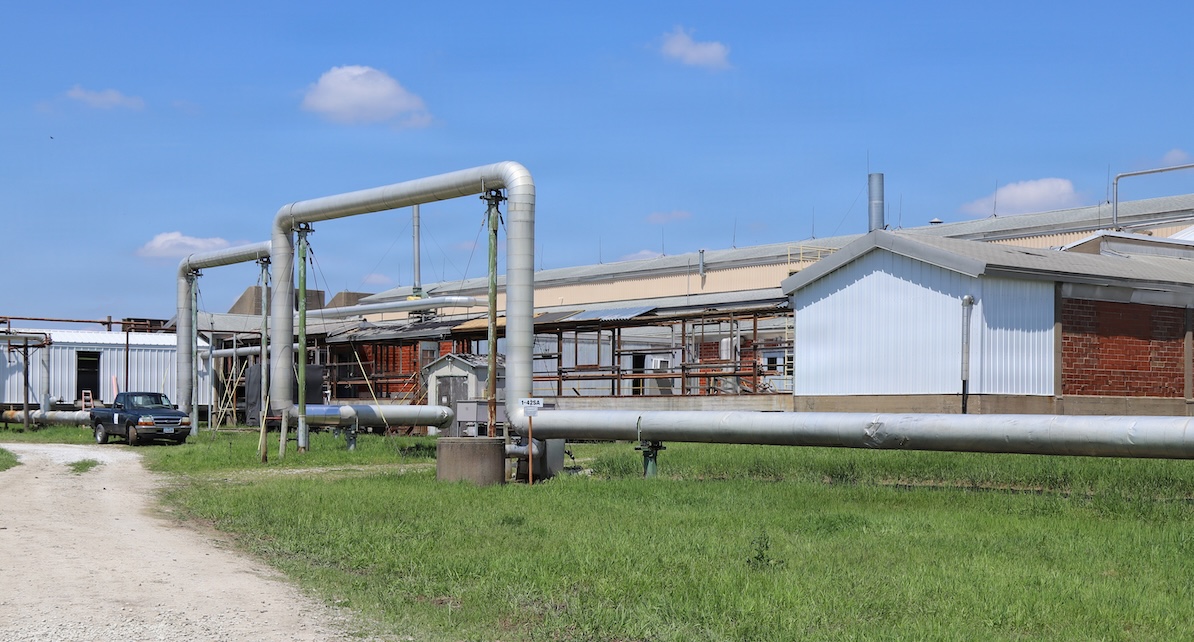
Lead azide explosion redistributes toxic lead particles
Lead azide is roughly 71 percent lead by mass. Elemental lead cannot be destroyed by heat; it vaporizes or fragments into fine particulate dust. The Army’s fact sheet asserts the intense heat of a proper detonation “incinerates” the explosive material. Experts dispute that framing.
“When lead azide detonates, it decomposes primarily into nitrogen gas and lead. The lead may be released as fine particles of metallic lead, lead oxides, and other lead compounds. The explosion doesn’t destroy the lead. It redistributes it.”
Bruce Lanphear, who co-authored a 2018 study estimating that long-term lead exposure was linked to 412,000 deaths annually across the US, including 256,000 deaths from cardiovascular disease, told Al Jazeera.
The safety of Iowans now and in the future should be government’s top concern. An unacceptable lack of communication and clarity has made Iowans understandably concerned and angry about this situation. The public deserves to know, if this is the safest option, why other options…
Communication breakdown
Tammy Duckworth called the operation “poorly planned and poorly communicated” and a “failure of leadership of epic proportions.” Dick Durbin urged the Army to hold a community town hall on Saturday before any Monday blast.
The Army said it held an open house in mid-October for residents within a 50-mile radius and engaged stakeholders since March. Environmental groups argue the EPA emergency permit bypassed meaningful public notice and consideration of safer disposal alternatives. Earthjustice filed the federal appeal on their behalf Thursday.
What happens now
The Eighth Circuit’s interim stay temporarily blocks the detonation under the EPA permit. Justice Department lawyers noted Friday the federal government could invoke separate emergency powers to bypass the permit requirement and proceed. No detonation time for Monday has been announced. The court may lift the pause before then.
The U.S. Army succeeded the Continental Army, formed in 1775 during the American Revolutionary War. It is designated as the army of the United States in the United States Constitution. The Army is the largest military branch, with a projected headcount of 1,005,725 soldiers for FY2022.
Evacuation orders for two Middletown neighborhoods — prompted by risk of window damage from blast force — remain in limbo. Environmental teams stand ready to test and remove contaminated soil afterward, per EPA regulations. But the central tension remains: a known, immediate explosive hazard versus an uncertain, distributed toxic legacy.
🔴 U. S. Army to detonate 68 barrels of unstable lead azide in Iowa on Nov 20 The Army will destroy the material at its ammunition plant in Middletown, Iowa, at around 12:00 p.m. Central Time on November 20. The lead azide—a highly sensitive explosive used in detonators—has been… pic.twitter.com/zBTFxhmOzd
More on Al Jazeera
The U. S. Army will detonate degraded lead azide at the Iowa Army Ammunition Plant in Middletown, Iowa, on Nov. 20 at approximately 12:00 PM CST. Lead azide is a highly sensitive primary explosive used in detonators. The stockpile is 68 barrels that have sat at the plant for… pic.twitter.com/166lk6avjJ
Related reading

Trenton Ruth Scores 25 Points in Stonehill’s 95-82 Victory Over Northeastern
Trenton Ruth scored 25 points helping Stonehill win 95-82 against Northeastern on Saturday. This victory for the Skyhawks,...

Cother’s Career Night Leads Winona State Past Truman State, 71-41
Rylie Cother dropped a career-high 19 points off the bench Saturday as Winona State blew past Truman State...

Tri-M’s Cinderella Production Faces Challenges November 19–22 & 28–29, 2026
Cinderella production faces challenges November 19–22 & 28–29, 2026. Tri-M Productions’ fall presentation of Rodgers & Hammerstein’s Cinderella:...

Cardinals Elevate Zay Jones for Chiefs Game
The Arizona Cardinals elevated wide receiver Zay Jones from the practice squad for the second week, Arizona Sports...