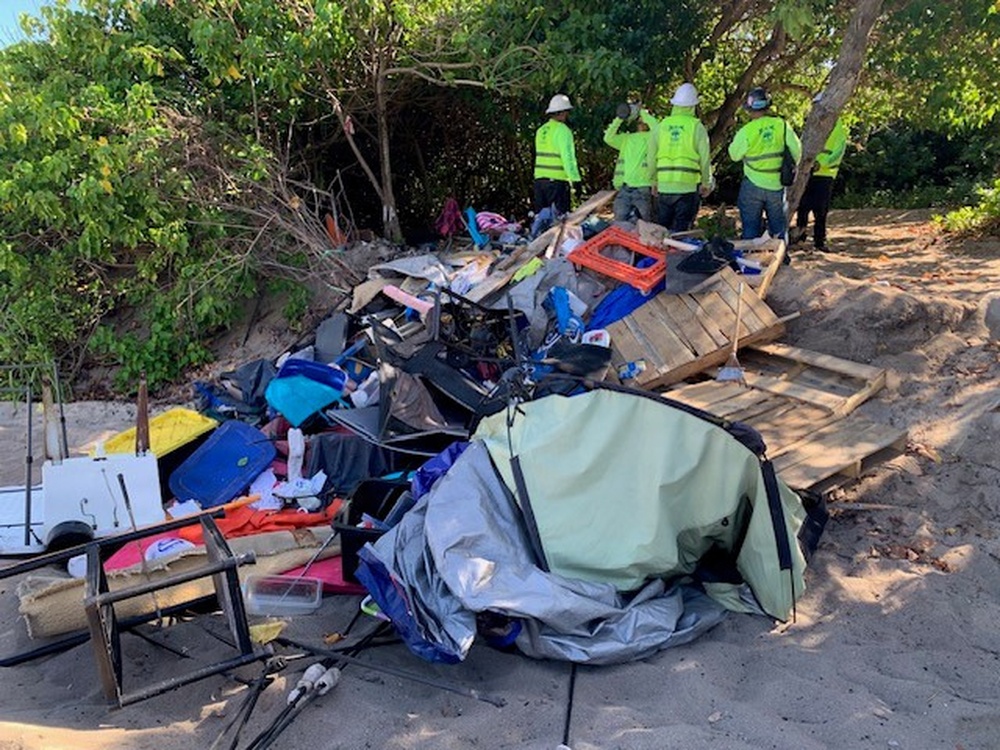
“I am extremely proud of our U.S. Army Garrison Teams who partnered with our community to make a huge difference in such a short amount of time,” said Col. Rick Luce, Commander of U.S. Army Garrison Hawaii. On October 24, those teams and their civilian partners put that pride into measurable action, pulling roughly 30 tons of debris from six encampment sites along Dillingham Army Beach in a single four-hour operation.
That haul matters. Dillingham Army Beach sits on Oahu’s North Shore, a stretch of coastline where military land, public access, and environmental pressure collide. When encampments accumulate along coastal property, the debris does not stay put — it migrates into the surf, threatens marine habitat, and raises public safety concerns for the families and service members who use the beach. A cleanup measured in tons is not a photo opportunity. It is the difference between a shoreline that can absorb a storm and one that cannot.
A Four-Hour Operation, Months in the Making
Working side by side, crews removed approximately 30 tons of debris from six encampment sites and collected two five-gallon buckets of hazardous medical waste.
Hazardous medical waste is the detail that separates a routine beach cleanup from a genuine public health intervention. Its presence at encampment sites signals that the problem along this coastline is not simply litter — it is a symptom of unaddressed housing instability meeting an unmanaged shoreline.
Why the Youth Challenge Academy Showed Up
One of the participating organizations was the Hawaii Youth Challenge Academy, a program dedicated to helping young teens and adults build leadership, discipline, life skills, and a sense of personal responsibility. For the Army, the connection is particularly meaningful. Both military members and the young people preparing to become future leaders in their communities share service as a core value.
“Being able to work side-by-side with the City and State, not to mention the local non-profit organizations who provide the services for the homeless and houseless is a tremendous honor and duty for our team,” Luce said. Col. Rick Luce
Stewardship Does Not End at the Installation Boundary
For U.S. Army Garrison Hawaii, the Dillingham effort fits a broader pattern. The garrison’s environmental stewardship, officials said, does not stop at the fence line. Working with state agencies, youth programs, and local organizations is how it addresses concerns that affect both military and civilian communities — coastal erosion, debris accumulation, and public safety along shared shoreline.
That matters for Oahu residents because Dillingham Army Beach is not a closed base. It is a recreational area where civilian families swim, fish, and picnic alongside military personnel. When 30 tons of debris and hazardous waste sit six encampments deep along that property, the risk is not borne by the Army alone. It lands on every beachgoer, every surfer paddling out at dawn, and every marine ecosystem downstream.
The partnerships with HDOT and Hala Toa Mui Contractors also show how the logistics of coastal cleanup scale. A four-hour window only works when the transportation, disposal, and heavy-lifting capacity is already coordinated. The Army cannot move 30 tons with volunteers alone; the state and contractors provide the machinery and the legal pathways for waste removal.
What Collaboration Actually Looks Like on the Ground
The operation demonstrated something harder to photograph than a pile of trash: that government agencies and community organizations can move in the same direction on the same day. The Honolulu Police Department’s presence addressed safety. The Surfrider Foundation brought coastal advocacy expertise. Kealahou West Oahu connected the effort to local West Oahu residents. The garrison’s own environmental and military police units anchored the work inside the installation.
Each partner had a distinct role, and none could have done the job alone. That is what October 24 showed — collaboration is not a slogan here, but the coordinated cleanup that removed approximately 30 tons of debris in four hours.
The cleanup at Dillingham Army Beach is one example of ongoing partnerships addressing shared environmental concerns along Hawaii’s coastline.

Four Bulldogs Set to Compete in Upcoming ITA Tournaments
Four Mississippi State men's tennis players will compete across two ITA tournaments between November 5 and 8, with...

3.06 Inches of Rain Soak Hibbing Minnesota This Week
Hibbing has taken the heaviest soaking in Minnesota this week, accumulating 3.06 inches of rain as of 6...

Matt Poitras Wears bubble shield in Bruins practice after nose injury
Matt Poitras Wears a Bubble Shield in Practice as Bruins Travel to Pittsburgh With His Nose Reset The...

Augusta County voters reject all three constitutional amendments
When the ballots were counted Tuesday night, Augusta County sent a message that couldn't be ignored: while Virginia...