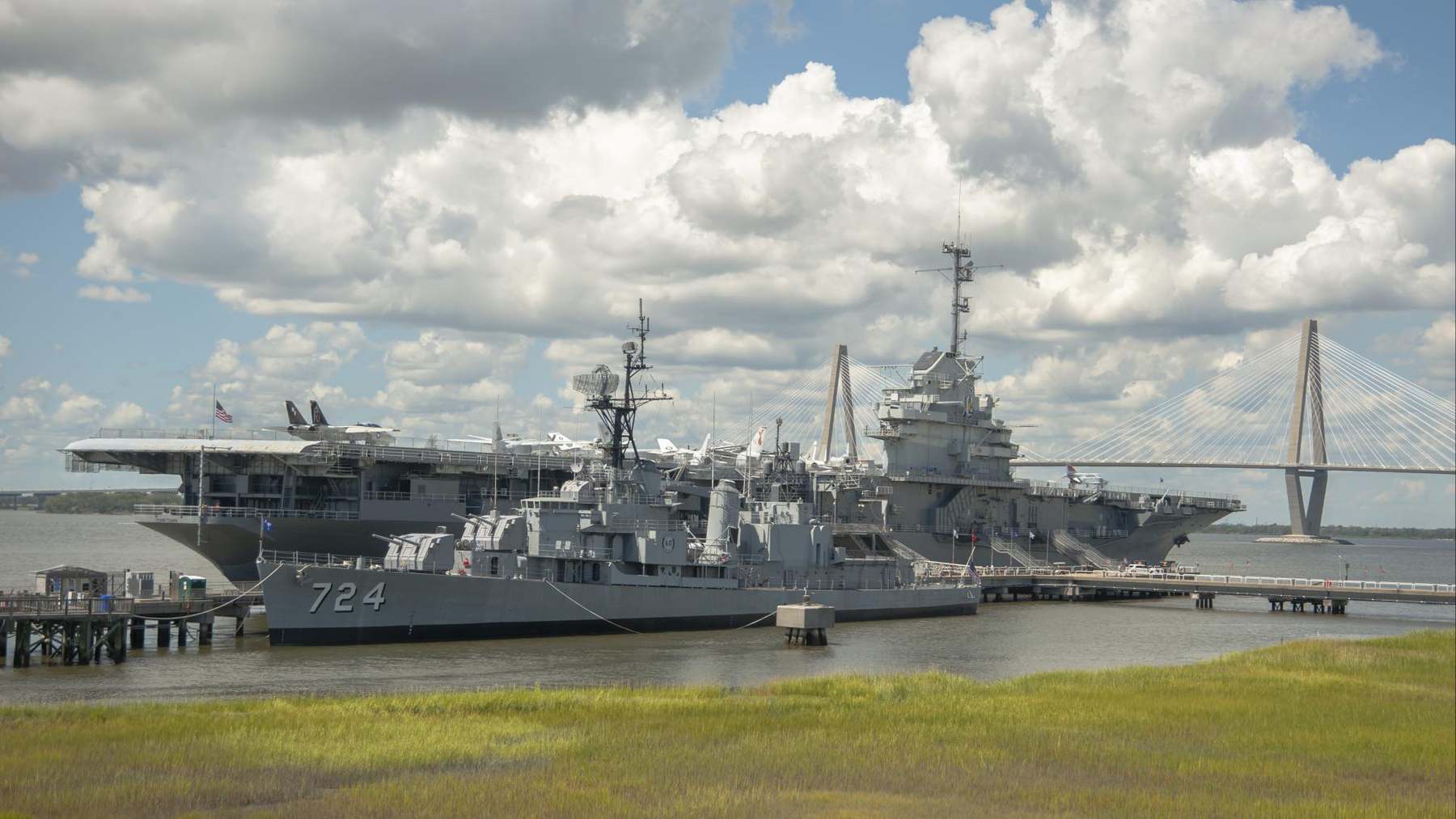
The USS Yorktown has not truly floated since 1975, wedged more than 25 feet into Charleston Harbor pluff mud, while the destroyer Laffey beside her rises and falls with the tide.
The World War II aircraft carrier has moved exactly twice in 51 years, according to Patriots Point Naval & Maritime Museum. Hurricane Hugo lifted her roughly 6 feet in 1989 before she settled back, and a December 2023 nor’easter shifted her about 6 inches in her berth, Autonocion reported.
Why the carrier cannot be towed
Pluff mud — the soft, dark sediment that lines South Carolina tidal marshes — holds the 27,100-ton Essex-class carrier so tightly that officials told the Associated Press they could not break her free. The destroyer Laffey, secured at the same pier, rises and falls with the tide on her mooring lines. The Yorktown does not.
Hazardous materials left aboard
Federal law did not require the Navy to empty the ship when she was decommissioned in 1970, so South Carolina received her “as is,” hazardous materials included, according to the governor’s office. A 2013 study for Patriots Point estimated about 1.6 million gallons of toxic waste remained on board.
Cleanup conducted in place
After the outer hull began to corrode, Gov. Henry McMaster signed an executive order directing the state Office of Resilience to remove the waste. The Yorktown stayed open to visitors throughout the work, the AP reported.
Divers patched 35 holes in the hull before pumping began.
Crews then worked through more than 130 tanks, vacuuming oily sludge tank by tank, trucking it to holding tanks on shore and sending it for treatment. The largest tanks are 32 feet deep and measure 28 feet by 8 feet, Patriots Point Executive Director Allison Hunt told the AP.

Stability maintained with fresh water
Once a structural tank was clean, crews refilled it with fresh water to keep the ship stable. “Basically, if you pull a couple million gallons of liquid out of a ship, you change how she sits, and nobody wanted to find out what that does to a carrier that’s wedged into the harbor floor,” Autonocion reported.
Two-phase removal totals
| Phase | Fluids removed | Asbestos waste | Hull/tank repairs |
|---|---|---|---|
| Phase I | 568,800 gal oily water + 8.88 tons sludge and mud | 4.5 tons | 35 outside hull patches |
| Phase II | 1.4M+ gal contaminated fluids and heavy fuel oil from 100+ structural and 30+ non-structural tanks | 9.1 tons pipe insulation | 375+ temporary structural tank repairs |
Combined, the two phases removed about 2 million gallons, a figure also reported by the SC Daily Gazette and Maritime Executive. McMaster said the state’s final spending came to $31.6 million, all from federal pandemic relief money, and called it the cost “to get her clean as a whistle,” Live 5 News reported.
Commissioned on 15 April 1943, the USS Yorktown (CV-10) entered service in the Pacific Theater of Operations during World War II, participating in multiple campaigns and earning 11 battle stars and a Presidential Unit Citation.
After decommissioning in 1970, she was recommissioned in February 1953 as an attack carrier (CVA) and served with distinction during the Korean War, later modernized again to become an anti-submarine carrier (CVS) and serving in the Vietnam War, where she earned five more battle stars.
Ship specifications and history
The Yorktown entered service in 1943, constructed at 872 feet long with a flight deck spanning 147 feet 6 inches and a standard displacement of 27,100 tons, according to the Naval History and Heritage Command.
Her tonnage eventually climbed to 45,000 after a 1950s rebuild that added an angled flight deck and hurricane bow, the National Park Service landmark file shows. She is one of only a handful of Essex-class carriers preserved as museums. The Yorktown remains where she was parked on June 15, 1975, give or take about 6 inches.
Keep reading
Arizona Flu Cases Rising Early Faster Than Usual Ahead of Thanksgiving
Statewide cases reached 5,416 this season, with 1,484 in the past week alone Gateway Urgent Care visits up...

Hertz Hiring Manager Trainee in Albuquerque With Path to Branch Manager in 12-18 Months
Hertz is hiring a Manager Trainee for its Local Edition branch at 9231 Coors Blvd NW in Albuquerque,...

Devils Sweep Blue Jackets with Shootout Win Behind Hellebuyck
The New Jersey Devils beat the Columbus Blue Jackets 3-2 in a shootout Wednesday night at Nationwide Arena,...
A 15-Foot Divide and a Supreme Court Decree: How the Great Lakes Do Not Drain South
The Great Lakes do not drain into the Mississippi River because of a continental divide that is just...