
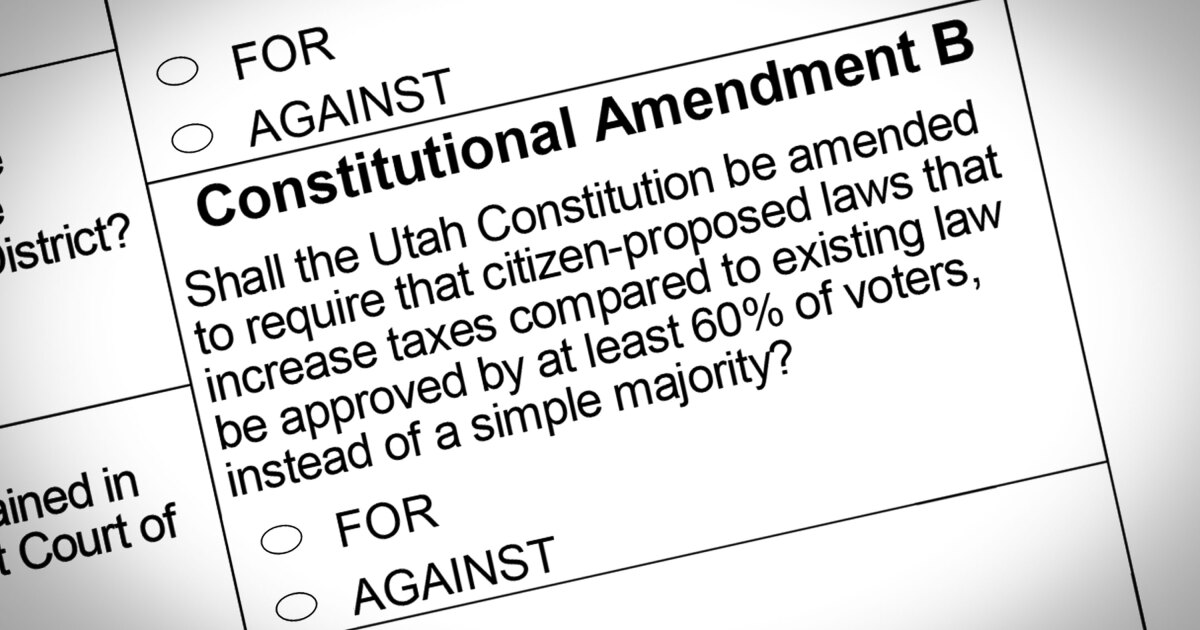
Utah voters have delivered a decisive message to the state Legislature: when it comes to raising taxes through citizen-led ballot initiatives, the power still belongs to the people, not the politicians. In a stunning reversal from early polling, Amendment B—which would have required a 60% supermajority for any ballot measure that increases taxes—failed by a landslide margin of 71% to 29%, according to unofficial returns reported by The Salt Lake Tribune. The defeat preserves the simple majority threshold that has allowed Utahns to shape state policy through direct democracy since 1900, and it hands a significant rebuke to Republican lawmakers who championed the measure as a shield against out-of-state spending.
The constitutional amendment, sponsored by Sen. Lincoln Fillmore, R-South Jordan, was designed to protect families from outside groups funding tax hikes. But alongside its defeat, voters approved Amendment A by 53% to 47%, which removes the requirement that proposed amendments be published in newspapers and allows the Legislature to post them on state websites instead. The Associated Press called the Amendment B race at 9:36 p.m., as KUER reported, cementing a result that few predicted just two months earlier.
A Runaway Defeat for a Once-Promising Measure
Early on, the amendment’s backers seemed to be in control. A Noble Predictive Insights poll conducted in early September found that half of Utah voters supported Amendment B, with just 21% opposing it. Fillmore said his goal was to shield Utah families who were already finding it hard to get by from outside groups injecting funds into ballot measures that would raise their taxes. The Utah Republican Party and the Utah Taxpayers Association echoed that framing, telling voters that the 60% threshold would ensure that people in St. George wouldn’t face higher taxes for a Salt Lake City cause.
But after a campaign blitz by opposition groups, the script flipped entirely. Last week, the same polling firm found that 56% of Utahns opposed Amendment B, while support had fallen to 34%. Utah GOP Chair Robert Axson dismissed that survey in a statement, claiming it held “hidden liberal agendas to confuse and complicate” the discussion, and argued that national liberal activists were spending millions to defeat the amendment for a reason. The plea fell on deaf ears.
The Money That Moved the Needle
The opposition campaign was fueled largely by $1.7 million from The Fairness Project, a nonprofit based in Washington, D.C., that has pumped millions into initiatives across multiple states defending abortion rights, ballot access and pro-worker measures, according to The Salt Lake Tribune. The political issues committee Utahns Protecting Our Constitution poured nearly $3.2 million into campaigning against Amendment B, more than half of which came from that Washington, D.C.-based organization. Supporters of the amendment spent considerably less, with Americans for Prosperity putting in about $100,000 and Taxpayer Shield PAC, formed by the Utah Taxpayers Association, spending about $20,000.
Because they are nonprofits that don’t have to disclose donors, both The Fairness Project and Americans for Prosperity are considered “dark money” groups. The spending disparity was stark, and it appears to have mattered. Opponents like Utahns Protecting Our Constitution argued that the amendment was an attempt by Republican legislators to chip away at grassroots initiative power that has been in the Utah Constitution for more than a century, contending that it would “effectively kill ballot initiatives forever.”
Why the 60% Threshold Would Have Changed Everything
The stakes extended far beyond abstract constitutional theory. Utahns have approved seven ballot measures since the initiative power was incorporated into the Utah Constitution in 1900. Three of those passed in 2018 alone, expanding Medicaid coverage for low-income Utahns, banning partisan gerrymandering in political districts and legalizing medical marijuana. Had Amendment B been in place, the Medicaid expansion and medical marijuana initiatives would have needed 60% approval. Both barely got over 50%. Just two initiatives have ever surpassed 60% in Utah history: one making English the state’s official language, and another limiting when law enforcement can seize property in criminal cases.
Some conservatives broke ranks to side with the opposition. Former Republican gubernatorial candidate Phil Lyman argued that the amendment would also make it harder to pass initiatives that would lower property taxes—a direct hit to homeowners’ wallets. That argument resonated in a state where 27% of voters told a Deseret News/Hinckley Institute of Politics poll that corruption would have a major impact on how they vote this year.
Legislature Modernizes Publication Rules
While Amendment B went down in flames, Amendment A drew no widespread opposition and appeared headed for victory. The Utah Constitution has long required the Legislature to publish the text of proposed amendments in newspapers across the state, though compliance has been spotty. In 2024, the Utah Supreme Court invalidated two proposed amendments because they had not been published in newspapers. Amendment A will permit the text to appear on state websites or in whatever manner the Legislature considers fitting, updating a requirement that had turned into a legal hazard. By Tuesday, voters had turned down only 11 of the 83 proposed amendments that reached the ballot during the last 50 years.
What This Means for the State Capitol
The defeat leaves lawmakers facing an open question about their relationship with direct democracy. Jason Perry, director of the University of Utah’s Hinckley Institute of Politics, was cautious about calling Amendment B a referendum on leadership, but noted it could be revealing.
“Keep in mind our Constitution is very clear that the powers of the legislature are co-equal between the people and the legislature, and this amendment kind of gets to what kind of power the people would like our legislature to have,” Perry said.
That co-equal balance of power has been strained by the aftermath of the 2018 anti-gerrymandering initiative, which triggered an almost decade-long ordeal resulting in a map featuring a Democratic-leaning congressional district based in Salt Lake County. The outcome frustrated Republicans in the Legislature, and Amendment B was widely seen as their response. Now, with voters rejecting it and a separate data center controversy having ousted Senate President Stuart Adams in the June primary, politicians have another indicator of how voters feel about business at the Utah State Capitol. Lawmakers will decide on new legislative leadership on Nov. 6, and they’ll do so knowing that the electorate just refused to make it harder for them to be held accountable by the people they serve.
More on Amendment
Related reading

Tennessee Supreme Court Upholds Law Capping Metro Nashville Council at 20 Members
Twenty. The Tennessee Supreme Court on Monday upheld a 2023 state law capping the Metro Nashville Council at...

South Dakota Republicans win statewide races, including secretary of state Heather Baxter
Republicans won in South Dakota on Tuesday. What happened instead was a clean sweep: the GOP finished ahead...

Yale SOM alumni win seats in Connecticut, Kentucky and Rhode Island
59% to 41%. That was the commanding margin by which Connecticut Ned Lamont won his third term on...

Charleston Voters Approve Half-Cent Transportation Sales Tax Extension
Charleston County voters have chosen to keep a half-cent transportation sales tax in place, with the extension projected...