
Vermont foreclosure rates hit record lows
Vermont recorded the lowest foreclosure rate in the United States this August, according to real estate analytics firm ATTOM.
The state saw just one foreclosure for every 67,808 housing units, a sharp contrast to the rising trends seen across much of the country.
While the nation moves toward instability, Vermont remains an outlier. Foreclosure filings across the U.S. rose 13% compared to last year, averaging one filing for every 3,569 housing units. States like South Carolina, Nevada, and Florida are currently experiencing the highest foreclosure rates in the nation, according to the ATTOM data.
Vermont Public reported that while the state’s housing affordability crisis persists, the actual loss of homes to foreclosure remains uncharacteristically low. State data through the end of September shows 426 people had begun the foreclosure process this year, which represents a 14% decline from the previous year.
Equity acts as a financial buffer
A primary reason for this stability is the sheer amount of wealth embedded in Vermont’s real estate. Vermont currently leads the nation in “equity-rich” homeowners. Approximately 79% of mortgaged homes in the state have loan balances that are no more than half of their estimated market value. Nationally, that figure sits at just 41%.
This massive equity cushion changes the math for homeowners facing financial hardship. Instead of losing a home to a bank, many Vermonters have the option to sell the property, settle the mortgage, and retain cash.
“When you have conditions like that, there’s a lot more incentive to try to work to, you know, save that equity and not lose it,” said Aaron Ferenc, deputy commissioner of banking with the Vermont Department of Financial Regulation.
Ferenc noted that this equity also serves as a vital safety net when unexpected expenses arise. But not everyone can use this wealth, especially as the cost of living continues to climb.
The struggle behind the statistics
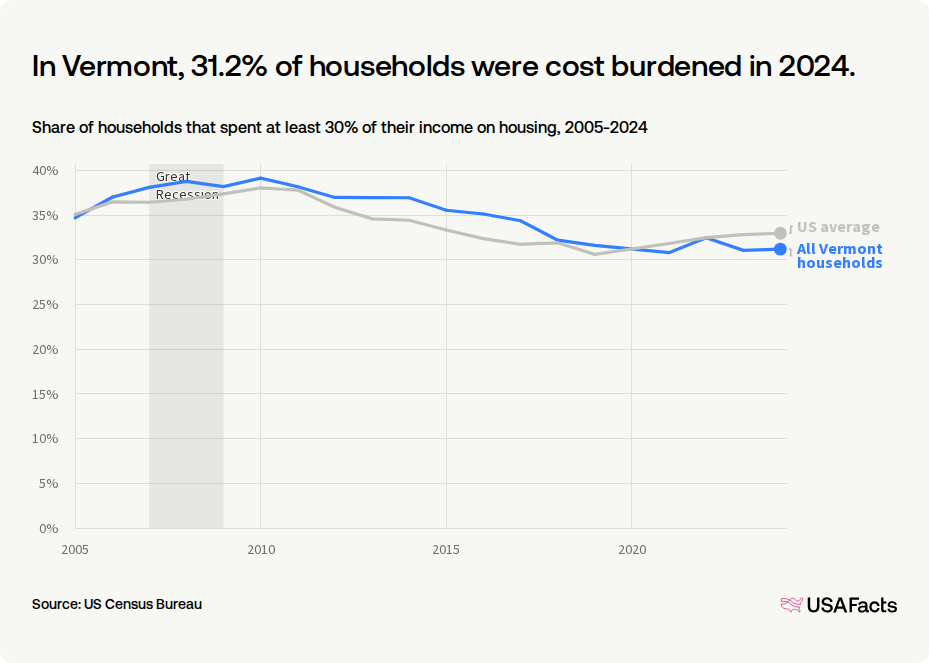
Low foreclosure numbers do not necessarily indicate a lack of financial stress. The 2026 Vermont Public Poll revealed a gap between home ownership stability and general affordability. One in five Vermonters reported being late or falling behind on rent or mortgage payments during the last year due to other financial pressures. An additional 12% of respondents said they had nearly fallen behind.
The tension lies in the fact that while people aren’t losing their homes, they are struggling to keep them. Many homeowners are currently “locked in” to mortgage rates of 3% or less from the pandemic era. With current interest rates significantly higher and housing inventory remaining scarce, the traditional methods of managing debt—such as refinancing—have become prohibitally expensive.
Christopher D’Elia, president of the Vermont Bankers Association, noted that homeowners are unlikely to refinance to pull out equity unless they face absolutely dire circumstances.
Vermont programs help borrowers find repayment alternatives
Vermont has specific institutional safeguards designed to prevent the loss of property. Following the 2008 housing crash and subsequent recession, lawmakers established a foreclosure mediation program. This allows borrowers to meet with lenders to find repayment alternatives before legal proceedings escalate.
Lenders generally view these programs as a way to avoid the high costs and legal complexities of the foreclosure process. D’Elia emphasized that the outcome of a foreclosure is rarely a positive one for financial institutions.
“The last thing any lender wants to do is go through foreclosure,” D’Elia said. “Foreclosure is not a good outcome for anyone.”
For those currently facing mounting debt, experts suggest that proactive communication is the most effective tool. D’Elia advised homeowners to approach their lenders immediately rather than waiting for the situation to become unmanageable, noting that lenders are often willing to find ways to ease the pressure.
The current data regarding foreclosure starts can be reviewed through the Vermont Department of Financial Regulation.
As housing inventory remains tight and interest rates remain high, the state’s reliance on home equity as a stabilizer remains a defining feature of its economy.
Worth a look

Fishermen Rescue Royal Caribbean Crew Member After Going Overboard
Three fishermen spotted a man floating on his back in the ocean about 20 miles offshore near Catalina...

Seahawks Beat Cardinals 17-3 as Charbonnet Shows Physical Growth
Seahawks defense holds Cardinals to three points The Seattle Seahawks allowed only three points during the entire game...

Miss Manners Addresses Bride’s Dispute Over Wedding Aesthetic Similarities
A dispute over wedding etiquette and creative boundaries has surfaced in a recent column for Miss Manners, where...

Social Security Benefit Cuts Loom in 2032 as Trust Fund Depletion Approaches
The federal safety net supporting millions of Americans is facing a structural reckoning that will hit retirement income...