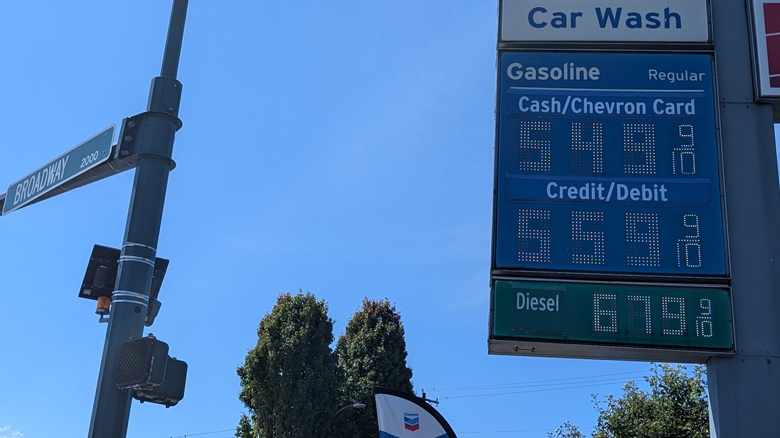
The Climate Commitment Act has pulled in more than $4.3 billion since its 2021 launch, yet drivers on the Highway 2 Trestle between Everett and Lake Stevens still face a tolled replacement bridge.
That disconnect is the fight State Rep. Sam Low (R–Lake Stevens) plans to take to the Legislature when it gavels in this January.
Low, the ranking Republican on the House Transportation Committee, argues the cap-and-trade auctions that charge emitters for gasoline and diesel allowances function as a de facto gas-tax hike — roughly a dollar more per gallon at the pump — but none of the proceeds touch pavement preservation or new construction.
“Why don’t we reprioritize some of the funding that’s already there, specifically, the Climate Commitment Act dollars… before we’re looking to the taxpayer for more money?” Low told Everett Post.
The numbers sharpen the tension. Quarterly auctions generated approximately $1.8 billion in the program’s first year, dipped to $1.1 billion during the 2024 repeal campaign around Initiative 2117, then rebounded to roughly $1.7 billion in 2025. Voters rejected I-2117 by a 62% to 38% margin, locking the program in.
The March 2026 auction alone cleared about $183 million, and the state has agreed to link its carbon market with California and Québec starting in 2027. Under current statute, at least 35% of proceeds must benefit overburdened communities and 10% must support Tribal-led projects; zero percent is earmarked for the traditional transportation budget that relies on a stagnant gas tax.
Virginia model penalizes efficient vehicles
While Low pushes for CCA redirection, House Transportation Chair Jake Fey (D–Tacoma) is drafting a “highway user fee” modeled on Virginia law. The Virginia structure charges owners of high-MPG vehicles more — about $7 annually for a 25-mpg car versus up to $75 for the most efficient hybrids — creating what Low calls a perverse incentive to buy a gas-guzzler.
“Fey introduced the bill a couple years ago on the road usage charge… That one never gained any legs,” Low said. “So he looked for a different alternative, and he came up with this highway user fee that Virginia does.”
“It’s my understanding, he’s going to bring forward a bill around this highway user fee that models Virginia. It hasn’t been introduced yet.”
— Sam Low, State Representative (R–Lake Stevens), to Everett Post
Sen. Marko Liias (D–Mukilteo), who chairs the Senate Transportation Committee, signaled openness. “As construction costs continue to rise, I welcome new ideas that could help us sufficiently fund the growth, maintenance, and preservation of our transportation system for years to come,” Liias told Everett Post.
“I appreciate the work Rep. Fey has done to craft this interesting proposal, and I look forward to giving it full consideration if it comes before the Senate.”

Tolls become the default
Absent new revenue, tolling has become the default financing tool for mega-projects. The Highway 509 extension south of Sea-Tac and the Highway 167 completion from Puyallup to Fife both opened recently with tolls. The SR 99 tunnel, the SR 520 bridge, and the Tacoma Narrows Bridge followed the same path.
Low’s district — covering Lake Stevens, Granite Falls, Snohomish, Marysville, and Everett — sits directly in the crosshairs for a tolled Highway 2 Trestle replacement. “Pretty much all these construction projects now are going to have a toll on it,” Low said. “My constituents, it’s very clear they don’t want a toll.”
The conundrum nobody has solved
Fuel-efficient hybrids, electric vehicles, remote work, and transit gains have eroded gas-tax collections for years. A road-usage charge (RUC) and pay-per-mile pilot went nowhere politically. The Virginia-style fee shifts the burden onto the very drivers the state has incentivized to go green.
The CCA throws off billions but is legally walled off from asphalt. Low frames the moment bluntly: “We are in a conundrum with this. I think the bigger issue for me is the taxpayers are already taxed out, fee’d out. They don’t have any more.”
Low, born in 1970, graduated from Maranatha Baptist University with a theology degree and ran a painting business in Lake Stevens for a decade before entering public office.
He served on the Lake Stevens city council, including as Council President and Mayor Pro Tem, then won a Snohomish County Council seat in 2016 by defeating appointed incumbent Hans Dunshee. While on the county council, Low chaired the state Transportation Improvement Board, a role that preceded his 2022 election to the 39th district House seat.
Bills can be pre-filed in December ahead of the January session. The public, Low insists, must weigh in: “The public votes who they want to represent them and they should have these conversations with their lawmakers that they want to see more money go into roads, more of this money going to preservation and maintenance because we’re not making those obligations now. It can be a bipartisan discussion. But right now, it’s pretty one-sided in Olympia.”
Related reading

Sources: Moore Team Weighed Replacing Lt. Gov. Miller With Jake Day
Governor Wes Moore recently stood alongside Lieutenant Governor Aruna Miller to celebrate a successful reelection campaign, yet behind...

Albany Firefighters Rescue Elderly Man From Bedroom Fire; Two Displaced
Firefighters in Albany, Oregon, rescued an elderly man from a burning home on Wednesday, Nov. 18, while simultaneously...
9-1-1: Nashville Reveals Pharaoh Identity in Midseason Finale Cliffhanger as Don and Rogue Kidnapped
The midseason finale of 9-1-1: Nashville concluded with the revelation of the Pharaoh, played by A.J. Buckley, and...
Charleston Finalizes First Peninsula Plan Draft in 27 Years: 20 MPH Limits, Transit Hub, Burial Ground Protections, Project 3500 Housing
Charleston released its first peninsula plan draft in 27 years, a 20-year strategic playbook connecting projects like Project...