
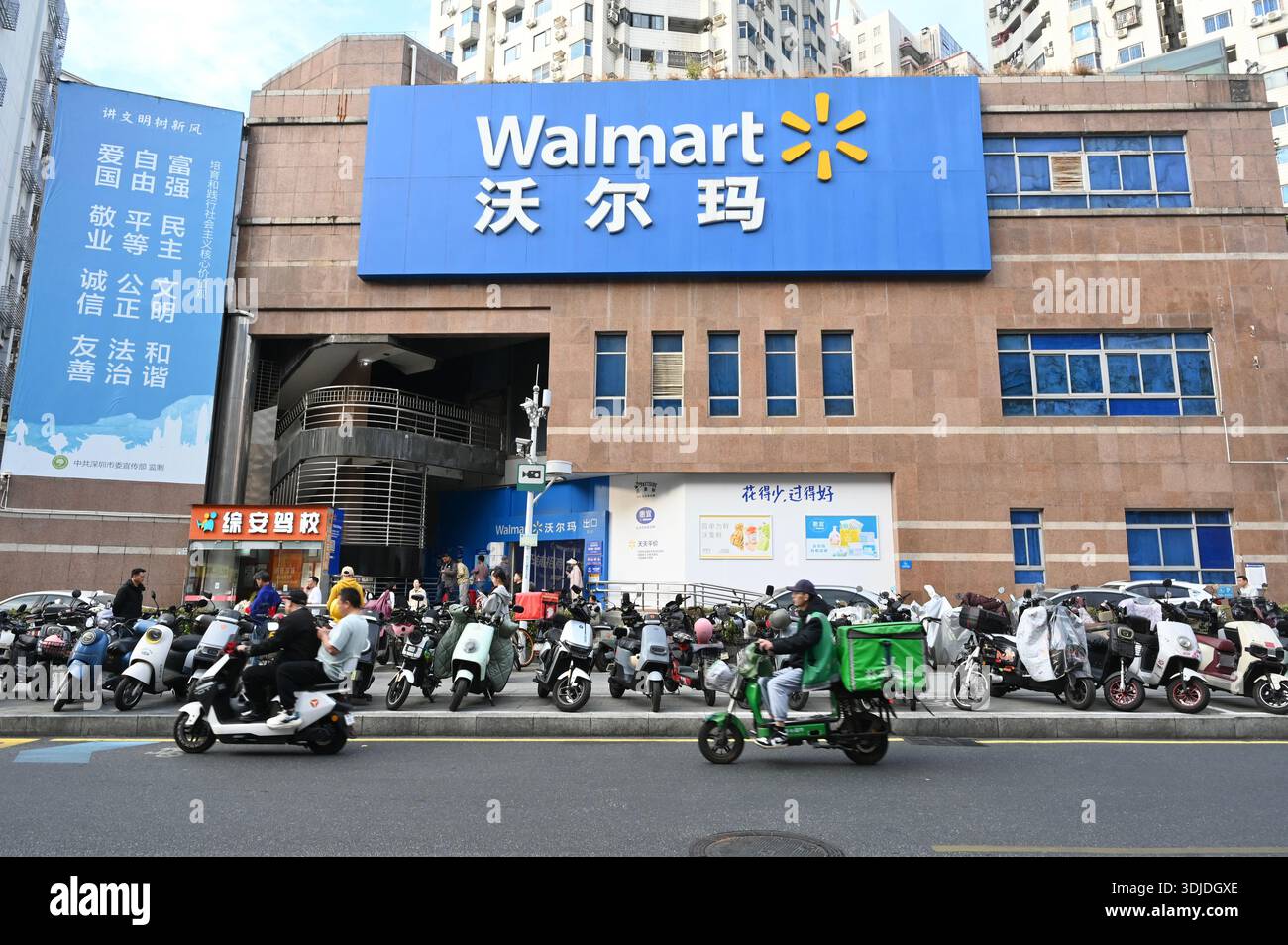
Walmart China opened its 49th Shenzhen store on Oct 11, the third next-generation format launched in a single month, China Daily Global reported.
The Shenzhen Futian KK ONE outlet adopts a compact, single-floor design heavy on fresh food, groceries, beverages and snacks — categories where the Bentonville, Ark.-based retailer says it holds competitive advantages. Around 70 stores have been upgraded this year; more than 100 renovations are targeted by year-end. New-generation stores are also slated for Beijing and Liuzhou, Guangxi.
The physical push coincides with a massive supply-chain bet. In September, Walmart China signed an agreement with the Jiaxing municipal government in Zhejiang province to rebuild its smart logistics hub — the company’s largest single supply-chain investment since entering the market three decades ago.
Construction starts soon for a 2029 finish. The facility will grow from 48,000 to 278,000 square meters, roughly quadrupling daily processing capacity with automated warehousing, intelligent scheduling and integrated online-offline inventory management to serve both Walmart supercenters and Sam’s Club stores across East China.
“Over the past three decades, Walmart China has grown into one of its leading retailers in China. Its development reflects both China’s continued opening-up and the company’s long-term commitment to the market and focus on quality,” said Peng Jianzhen, director of the China Chain Store and Franchise Association.
Sam’s Club, Walmart’s warehouse club arm, opened its 70th China store in Wuxi, Jiangsu on Oct 13 — the third in that city since 2022. Worldpanel by Numerator data shows Walmart Group increased market share by 1.2 percentage points in the first half, with Sam’s Club as the primary growth engine. Overall consumer penetration rose about 4 percentage points, driven by accelerated neighborhood-store rollouts and expanded private-label offerings.
Costco Doubles Down Despite Tiny Footprint
Costco reported fiscal 2026 net sales of $297.2 billion worldwide, up 10.1% year-on-year. The Issaquah, Wash.-based retailer operates only seven warehouses in China versus 939 globally but plans nine more by 2030, more than doubling the local network. China Chain Store and Franchise Association figures put Costco China 2025 sales at 10 billion yuan ($1.5 billion), with average per-store sales exceeding 1.4 billion yuan — growth driven by store productivity rather than rapid expansion.
In July, Costco broadened reach by partnering with JD.com. The cooperation lets non-members buy Costco products online at roughly 20% above member prices, using JD Logistics' nationwide network covering more than 2,800 districts and counties. Since trial operations began in May, the online flagship store has drawn over 30 million visits, extending the warehouse retailer’s customer base well beyond physical warehouse cities.
-
The Bottom Line:
- Walmart’s Jiaxing logistics hub quadruples capacity to 278,000 sq m by 2029 — largest China supply-chain bet in 30 years.
- Sam’s Club hits 70 China stores; Walmart Group gains 1.2 pp market share H1, penetration up 4 pp.
- Costco’s 7 China stores average 1.4B yuan sales each; 9 new warehouses planned by 2030 plus JD.com digital channel.
Omni-Channel as Competitive Moat
Walmart’s app now promises delivery within 30 minutes for customers within 5 kilometers of supercenters, stitching together supermarkets, neighborhood stores and online shopping. The Jiaxing hub’s integrated inventory management is the backbone — automated warehousing and intelligent scheduling feed both brick-and-mortar and digital orders from a single stock pool.
Costco’s JD.com partnership mirrors the logic: physical footprint stays small while digital reach explodes. The 30 million visits since May prove latent demand exists far beyond the seven warehouse cities. Non-member pricing at a 20% premium protects the membership model while monetizing the broader audience.
Supply-Chain Localization Deepens
Peng Jianzhen noted Walmart’s strengthening ties with local suppliers and improvements in quality control, logistics and product innovation have supported growth across the supply chain. The Jiaxing investment locks in that localization — a 278,000 sq m automated hub in the Yangtze River Delta positions Walmart to source, process and distribute domestically at scale, reducing reliance on cross-border logistics and tariff exposure.
For APEC economies, the signal is clear: multinational retailers are embedding Chinese operations into regional growth strategies, not treating China as a standalone market. The supply-chain infrastructure being built today — automated, data-driven, omni-channel — becomes the connective tissue for cross-border trade tomorrow.
What the Numbers Don’t Show
Walmart does not break out China revenue or operating income in SEC filings; the segment rolls into “Walmart International.” Costco’s 10-K similarly aggregates “Other International.” Neither company discloses China-specific EBITDA or capital-expenditure allocations. The 1.2 pp market-share gain and 4 pp penetration lift come from Worldpanel by Numerator, a third-party panel, not audited financials. The 30-minute delivery claim is a company target, not a measured service-level agreement.
Costco’s 1.4 billion yuan average per-store sales figure lacks a disclosed timeframe — whether fiscal 2025 or calendar 2025 — and no comparable global average is provided for context. The JD.com partnership’s economics — revenue split, marketing spend, customer-acquisition cost — remain private.
The retailers winning in China aren’t just opening stores — they’re building logistics networks that double as regional distribution arteries. Walmart’s Jiaxing hub is a 2029 asset that pays dividends across East Asia supply chains.
The next measurable milestone arrives with Walmart’s year-end renovation count — more than 100 upgraded stores — and Costco’s warehouse-opening cadence toward the 2030 target of 16 total China locations. Both companies’ next earnings calls will be watched for any China-specific commentary on consumer sentiment, margin trends or capital-expenditure pacing.
Disclaimer: The information provided in this article is for educational and market analysis purposes only and does not constitute financial, investment, or legal advice. Always consult with a certified financial professional before making investment decisions.
- Leon County Commissioners Unanimously Approve Framework to Resolve Fire Service Dispute With Tallahassee
- Paula Yvette Genereaux, Pokagon Band Elder and Retired Four Winds Casino Employee, Dies at 72
- US retail sales slowed to 0.2 percent in October as high prices weighed on shoppers (newsarchyuk.com)
- Tuscaloosa Leaders Honor Late Advocates at Tennis Center Expansion (world-today-news.com)

Leon County Commissioners Unanimously Approve Framework to Resolve Fire Service Dispute With Tallahassee
Leon County commissioners voted unanimously Monday to approve a framework that could end a two-year fight with Tallahassee...

Paula Yvette Genereaux, Pokagon Band Elder and Retired Four Winds Casino Employee, Dies at 72
Paula Yvette Genereaux, a Pokagon Band Elder and retired Four Winds Casino worker, began her journey to the...

FEMA Runs Emergency Alert Test in Colorado as Blackout Rumors Spread
Colorado radio and television programming cut out at 12:20 p.m. Mountain Time Tuesday for a minute-long federal emergency...
California DMV Bans Waymo Robotaxis From State Freeways Over Safety Hazard
California’s Department of Motor Vehicles banned Waymo robotaxis from all state freeways effective November 11, citing an “imminent...