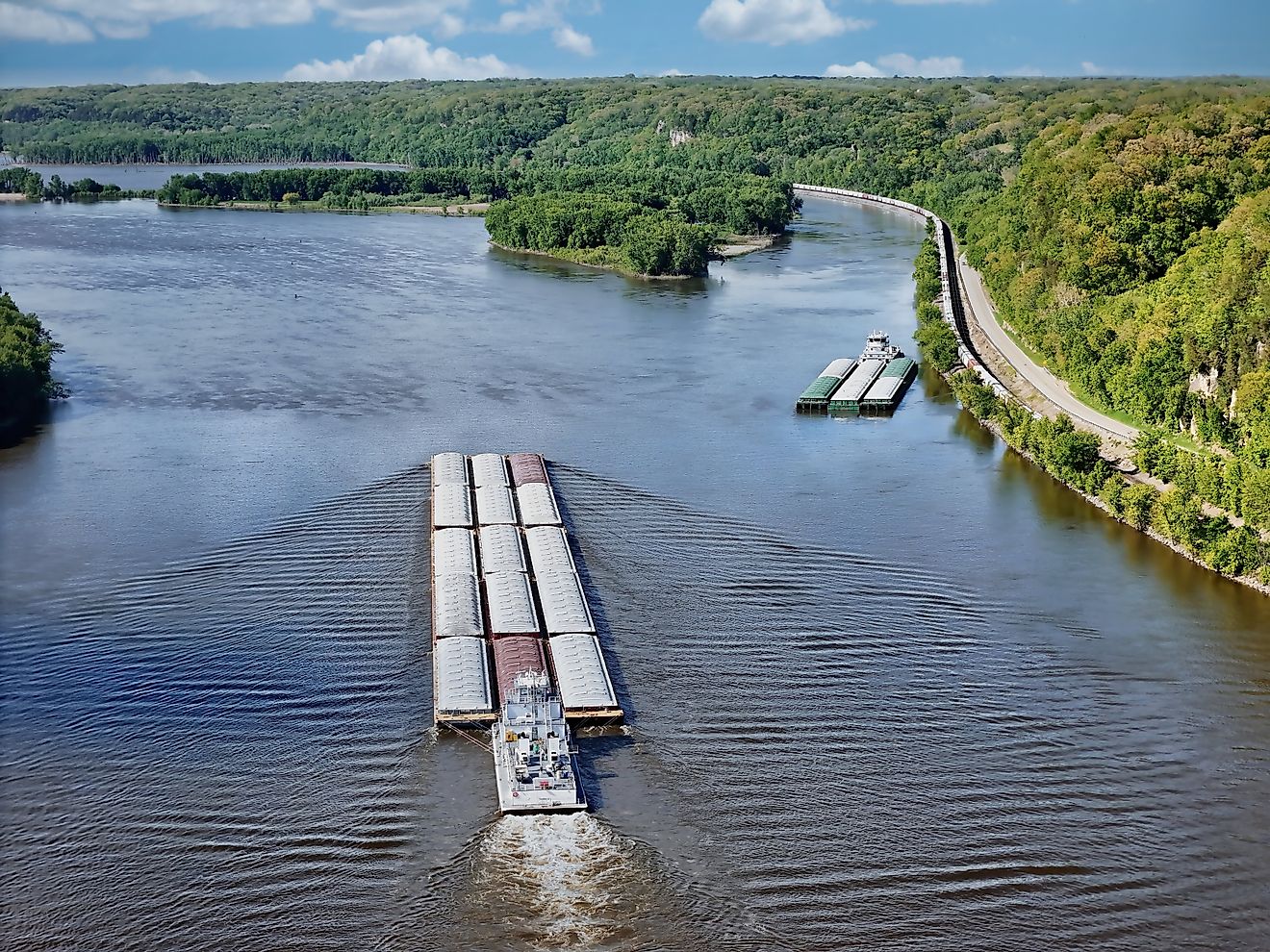
A barge tow needs two to three weeks to travel roughly 1,800 miles from Minneapolis to the Gulf of Mexico, World Atlas reported, while a single drop of water drifts the same stretch in roughly 90 days.
That leisurely pace hides a staggering payload: a standard 15-barge tow carries about 22,500 tons of grain or coal, the equivalent of 870 rail cars or more than 1,000 semi-trucks, all pushed by one boat and a small crew. The Mississippi system moves roughly 500 million tons of freight a year, including about 60 percent of all U.S. grain exports.
“The slow boat down the river, it turns out, is the quiet backbone of American trade,” the outlet said, “and a couple of weeks in transit is a very small price to pay for moving a thousand trucks’ worth of cargo in one go.”
Speed is not the bottleneck; geometry is. A fully loaded tow typically travels 8 to 12 miles per hour, aided by a 1.5-to-2-mph current on the Upper Mississippi and a swifter flow below the Ohio River confluence. The real clock is the lock chamber.
Twenty-nine locks and dams stair-step the Upper Mississippi, but most chambers are only 600 feet long. A 15-barge tow stretches roughly 1,200 feet, forcing the crew to break the tow in half and lock through in two passes — a maneuver that can burn two hours at a single lock.
Below Cairo, Illinois, where the Ohio joins the Mississippi, the locks vanish. The Lower Mississippi runs free, unbounded by dams, so the second half of the journey passes far faster than the first. Commercial navigation effectively ends at Minneapolis; the uppermost 480 miles of the river’s 2,320-mile length are too shallow and wild for anything but canoes and kayaks.

Heading upstream rewrites the math. Fighting the current the whole way adds days to the trip, and every lock cycle repeats the same double-cut delay. Yet the economics barely flinch: one towboat, a handful of crew, and a fraction of the fuel required by rail or truck keep the cost per ton-mile the lowest in the freight network.
The river does not negotiate. It sets the schedule, the draft, and the width of the channel. Shippers plan around high-water closures and low-water groundings, but the tonnage keeps moving. Two to three weeks downstream, a few more up — measured against the 90-day journey of the water itself, the barge is practically sprinting.
Related reading
Oklahoma Adds Four Lakes to Mercury Fish Advisory List
Oklahoma added four lakes to its mercury advisory list on November 18, expanding a warning that now covers...

Deputy Shoots, Kills Hit-and-Run Suspect Who Grabbed Long Gun in Hibbing
A St. Louis County sheriff's deputy shot and killed a hit-and-run suspect early Wednesday after the man picked...

New York Unveils 30-Point Master Plan for 5 GW Nuclear Buildout, Largest in Decades
Gov. Kathy Hochul on Nov. 18 unveiled a 30-point master plan to build 5 GW of nuclear power,...
New York Unveils Master Plan for 5 GW Advanced Nuclear Buildout, Largest in Decades
New York is laying the groundwork for the largest nuclear buildout the country has seen in more than...