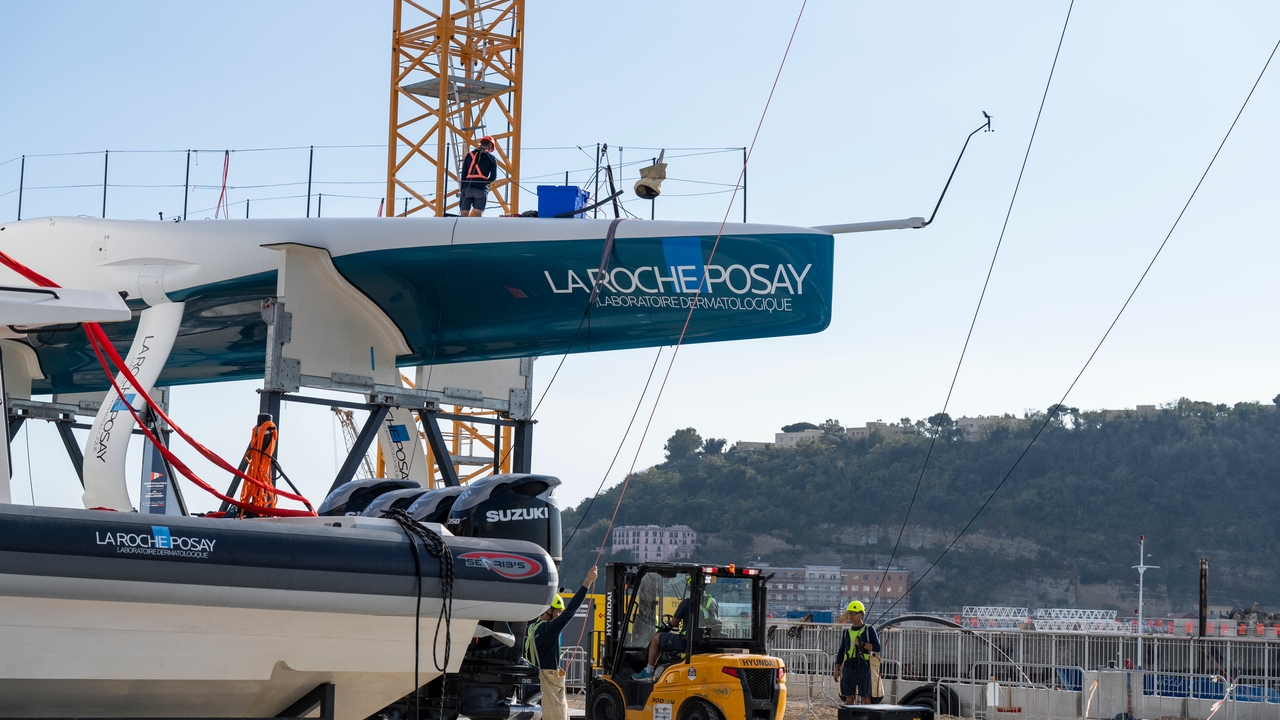
The La Roche-Posay Racing Team spent a day at their Bagnoli base rigorously calibrating their AC75’s mast and measurement systems without sailing. By loading the cap shrouds independently with temporary load cells while keeping the lower shrouds slack, engineers sought to isolate rig response, validate onboard fibre-optic sensors, and correlate physical loads with optical camera data.
Why the French Spent the Day Calibrating the Mast
When the La Roche-Posay Racing Team rolled their AC75 test boat, B1, out of the shed at the Bagnoli base in Naples, no sailing was on the schedule. Instead of chasing boat speed on the water, the shore crew hoisted a technician up the mast to execute a meticulous, highly unusual rig-tuning session. According to the America’s Cup report, the exercise went far beyond a routine rig check, pointing instead to a systematic validation of the measurement systems and structural models underpinning the team’s AC75 sail development.
The core mystery of the day centers on whether the calibration was prompted by a specific data discrepancy or simply marked a scheduled phase of the team’s development program. Whatever the catalyst, the setup was designed to strip away variables and force the mast to reveal its exact mechanical behavior under known loads.
Reading the Shroud Tensions and Removing Lower Shroud Constraints
The most telling clues of the session emerged from how the rig was instrumented. On each cap shroud, the usual link at the mast fitting was replaced by an in-line load cell tethered to a cabled handheld display. Up the mast, the technician recorded readings of 6,860 on the port cap shroud and 6,752 on the starboard cap shroud. While the exact unit of measurement was not legible in the report, those numbers translate to roughly 66 to 67 kilonewtons of tension if measured in kilogram-force.
That is a substantial load, and the minor 1.6 percent difference between port and starboard could stem from anything from deliberate asymmetry to standard measurement variation. Far more significant than the numbers themselves was the state of the lower shrouds. Throughout the test, the lower shrouds were kept entirely soft and slack. Ordinarily, those lower stays help control mast bend and shape. By removing them from the equation, engineers effectively stripped away structural constraints, making it much easier to isolate how the mast responded exclusively to cap-shroud loading.
Calibrating Onboard Fibre-Optics and Optical Cameras
That deliberate isolation points directly to a crucial engineering necessity: calibrating continuous sensor arrays against absolute physical reality. Observers have noted fibre-optic lines running along the shrouds since the team’s commissioning period in Lorient. While these lines provide continuous strain monitoring while sailing, those raw data streams are useless without hard calibration.
To establish a reliable relationship between measured rig load and actual mast geometry, the team walked through a precise sequence:
- Applying a known, measured load to the cap shrouds using temporary load cells.
- Recording the external reference readings alongside onboard sensor data.
- Measuring resultant mast rake, bend, and physical alignment.
- Comparing the collected datasets directly against the team’s structural models.
- Adjusting calibration coefficients to align simulation with physical reality.
Adding weight to this theory was the prolonged involvement of the team member responsible for camera installation. If the day were merely about tensioning steel, a camera specialist would have had little to do. Instead, their presence suggests the team was validating an optical measurement system, using cameras to track mast position and movement relative to fixed reference points under load.
Connecting rig loads, geometric mast shape, and sail shape gives designers the confidence they need when evaluating new sails. If a sail test disappoints, accurate calibration ensures engineers know whether the fault lies in the cut of the cloth or an unmodeled rig deflection.
Related reading

What Albany International (AIN) Said on Its Q3 Earnings Call – Yahoo Finance
Albany International reported record third-quarter revenue, lifted by a renegotiated helicopter contract and strong performance in its Engineered...

Through the boroughs: How the New York City Marathon became a citywide tradition … – amNY
The TCS New York City Marathon is celebrating its 50th year, marking a massive historical milestone for one...

How to Choose a Cosmetic Dentistry Provider in Albuquerque
Choosing a cosmetic dentistry provider in Albuquerque requires looking beyond promotional photographs to evaluate clinical experience, oral health...

The Advance Group has leased 93,728 square feet of industrial space at Port South in Carteret
The Advance Group has leased 93,728 square feet of industrial space at Port South in Carteret, consolidating its...