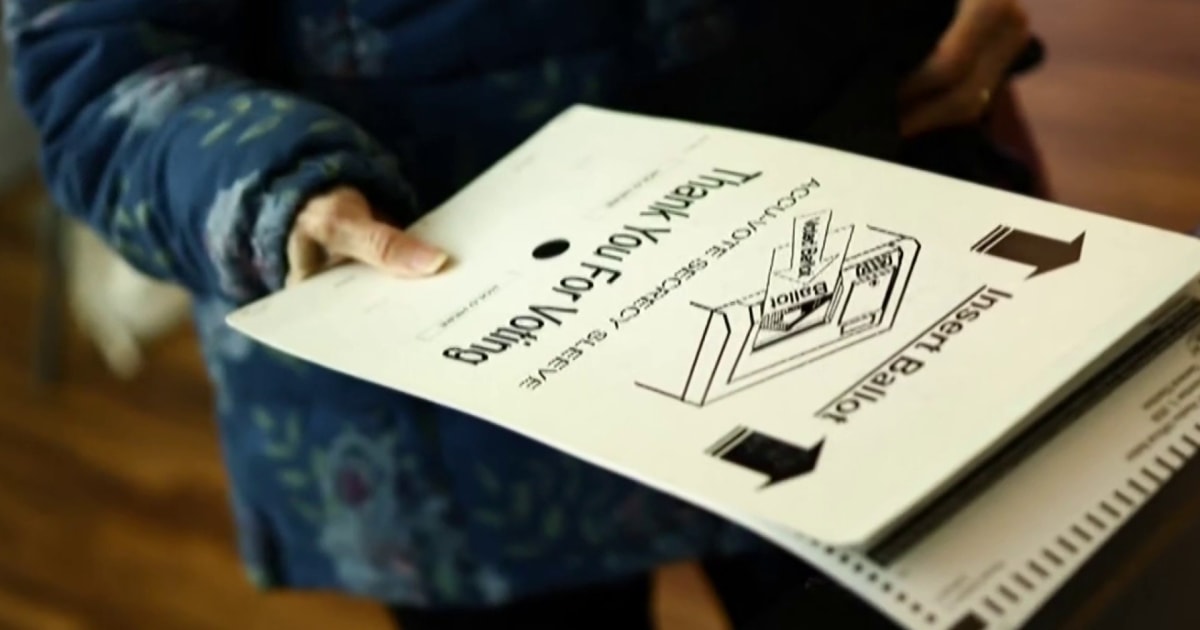
Voters in 49 states will be confused by how Alaska counts its mailed ballots. In Alaska, election officials are telling voters to wait as long as two weeks before anyone declares a winner in the U.S. Senate race, NBC News reported — a timeline that could leave control of the Senate hanging on the Last Frontier well after the rest of the country has moved on.
The delay is not a sign of trouble, officials and election experts say. It is built into how Alaska runs its elections: a 10-to-15-day window for mailed ballots to arrive, followed by a ranked choice counting process that only resolves after that window closes if no candidate wins a majority on the first tally. CNN reported that if the race between incumbent Republican Sen. Dan Sullivan and Democrat Mary Peltola comes down to Alaska, the state’s result may not be final until roughly two weeks after Election Day.
Two Weeks, by Design
Alaska gives voters 10 days to return a ballot mailed within the United States and 15 days for ballots sent from overseas, according to CNN’s reporting. Only after that period does the state run its ranked choice tabulation, in which voters’ second and later preferences are redistributed until one candidate clears 50%. If a candidate wins outright on the first count, the result can be called sooner; if not, the full process runs its course.
“Alaska does it different than everyone,” said Derek Tisler, counsel with the Brennan Center’s Elections and Government Program, in comments reported by CNN. “It’s such a unique state given its geography, given how remote it is and how expansive it is.”
Russell Luke, a political science professor at the University of Alaska Fairbanks, told CNN the waiting period is expected and warned that the gap can become fertile ground for false claims. “If it does take these two weeks to find out the actual composition [of the results], this isn’t a ballot manipulation — it’s not an attempt to alter the results of the election,” Luke said. “It’s simply how long it takes in Alaska. This is to be expected — it’s not extraordinary or outside the norm.”
The Mail Window Meets Ranked Choice
A ballot postmarked by Election Day but still in transit does not count until it reaches an elections office, and Alaska’s rural and remote communities mean mail delivery takes longer than in the lower 48. Then, because Alaska uses ranked choice voting statewide, a close Senate race cannot be resolved on election night percentages alone — the second-round math only becomes final once every eligible mailed ballot has arrived.
For voters watching returns on election night, that means the Senate map may show Alaska unresolved while other states have been called. CNN noted that the drama could escalate if control of the Senate comes down to this one seat, turning a routine tabulation into a national focal point.
A Ballot With Two Dan Sullivans
Complicating the count is a controversy over the ballot itself. CNN reported that a second candidate named Daniel J. Sullivan appeared on the Alaska Senate ballot alongside the incumbent, a development first detailed by The New York Times that sparked lawsuits, a criminal investigation, and threats to block certification if the incumbent loses. Alaska Gov. Mike Dunleavy launched a probe into whether Democrats sought to confuse voters, and he told NewsNation that if the investigation finds “wrongdoing,” certification of the Senate race results could be “stopped or changed.”

David Becker, a former DOJ attorney and founder of the Center for Election Innovation & Research, told CNN that if any state authority tries to delay or deny certification of legitimate results, parties with standing will go to court and “get immediate relief.” Derek Muller, an elections law professor at Notre Dame, told CNN that Alaska law does allow a defeated candidate to contest an election in cases of misconduct, fraud, or corruption sufficient to change the result — but he characterized that as a high bar for the courts, and a different process from a governor withholding certification.
What Happens in the Meantime
While the count runs, the open question is simple and unresolved: who wins. No official call has been made, and the ranked choice tabulation cannot be completed until the mail-ballot window closes. What is known is the calendar — up to 15 days for overseas ballots, then the ranked rounds if needed — and the warning from experts that the wait is a feature of Alaska’s system, not evidence of manipulation. What is not yet known is whether the Senate majority will wait on Alaska, or whether the state will deliver its answer first.
Worth a look

Kansas voters approve 2026 amendment to explicitly ban noncitizens from voting, KWCH reports
Kansas voters approved a constitutional amendment Tuesday that rewrites the state's voting qualification language to state explicitly that...

Starr’s Cave Nature Center hosts stewardship day and cooking program
Volunteers will fan out across Starr's Cave Nature Center on November 14 with trash bags, work gloves, and...

Indiana Democrats Break Republican Supermajority in Statehouse Election Results
Indiana Democrats won 15 House seats Tuesday, ending the Republican supermajority that had dominated the statehouse for over...

U.S. Marshals Arrest Fugitive Wanted in 2025 Springfield Shooting
After 16 Months on the Run, U.S. Marshals Arrest Stanley Smith in Ravenna for 2025 Springfield Township Shooting...