America’s oldest surviving prison sites trace a direct line from colonial copper mines to the concrete cellblocks that held Al Capone, and seven of them now offer regular public tours, World Atlas reported.
The list begins with Old New-Gate Prison in East Granby, Connecticut, where the colony converted an exhausted copper mine into a penal facility in 1773. The first inmate was lowered 67 feet underground that December and escaped 18 days later when his sweetheart lowered him a rope, according to the site’s history.
During the Revolutionary War the caverns held Loyalists, counterfeiters and thieves; inmates slept below ground and made nails on the surface. Connecticut abandoned the mine in 1827, moving prisoners to Wethersfield, and today the state runs guided tours through the tunnels and the 1824 four-story cellblock.
In Philadelphia, Eastern State Penitentiary opened in 1829 on a reform model that isolated prisoners in individual cells to inspire penitence — a system Charles Dickens called “cruel and wrong” after visiting in 1842. Designed with cellblocks radiating from a central hub, the Gothic fortress on Fairmount Avenue held 1,700 people by the 1920s, far beyond its 250-person capacity.
Al Capone served eight months there in 1929 and 1930 for a weapons charge, in a cell fitted with rugs, paintings and a radio. Pennsylvania closed the prison in 1971; hard-hat tours began in 1994 and drew 10,000 visitors the first year. A restored synagogue that opened in 1924 — the first in an American prison — is now part of the self-guided audio route.
Missouri State Penitentiary in Jefferson City took its first inmate in 1836 and operated continuously for 168 years, earning the nickname “bloodiest 47 acres in America.” A September 1954 riot started when two prisoners faked illness, ambushed guards and seized keys; four inmates died and the facility suffered $5 million in damage. Charles “Pretty Boy” Floyd and Sonny Liston both did time there — Liston learned to box in the prison gym and became world heavyweight champion by 1962.
James Earl Ray escaped in 1967 inside a bread truck and assassinated Martin Luther King Jr. the following year. The state moved the last prisoners out in September 2004; history tours run March through November and include the 1868 A-Hall, dungeon cells and the gas chamber where 40 people were executed between 1938 and 1989.
Jackson, Michigan, won the right to host the state’s first prison in 1838, and 35 inmates moved into a tamarack-pole stockade the next year. Ten prisoners escaped in 1840, prompting construction of a stone cellblock behind 25-foot walls that by 1882 held more than 2,000 people — what the city calls the largest walled prison in the world at the time.
The complex became a National Guard armory in 1934 and reopened in 2008 as Armory Arts Village, with 62 apartments and 12 artists’ studios inside the former cellblock. Original painted cell numbers and curved window bars remain; guided tours lead visitors through the four-tier gallery, basement solitary cells and tunnels beneath the yard.
Old Joliet Prison in Illinois opened in May 1858 when 53 convicts arrived at a small stone building and were put to work quarrying limestone to build the walls around themselves. It replaced the Alton penitentiary that reformer Dorothea Dix had condemned in 1847. By 1878 nearly 2,000 inmates were locked up, including Nathan Leopold and Richard Loeb, who began life sentences there in September 1924 for the murder of Bobby Franks, and bank robber George “Baby Face” Nelson.
Illinois closed the prison in 2002; the Joliet Area Historical Museum began tours in August 2018. The entrance floor still bears the inscription “It’s Never Too Late to Mend,” a detail featured in The Blues Brothers and the first season of Prison Break, filmed on site in 2005.
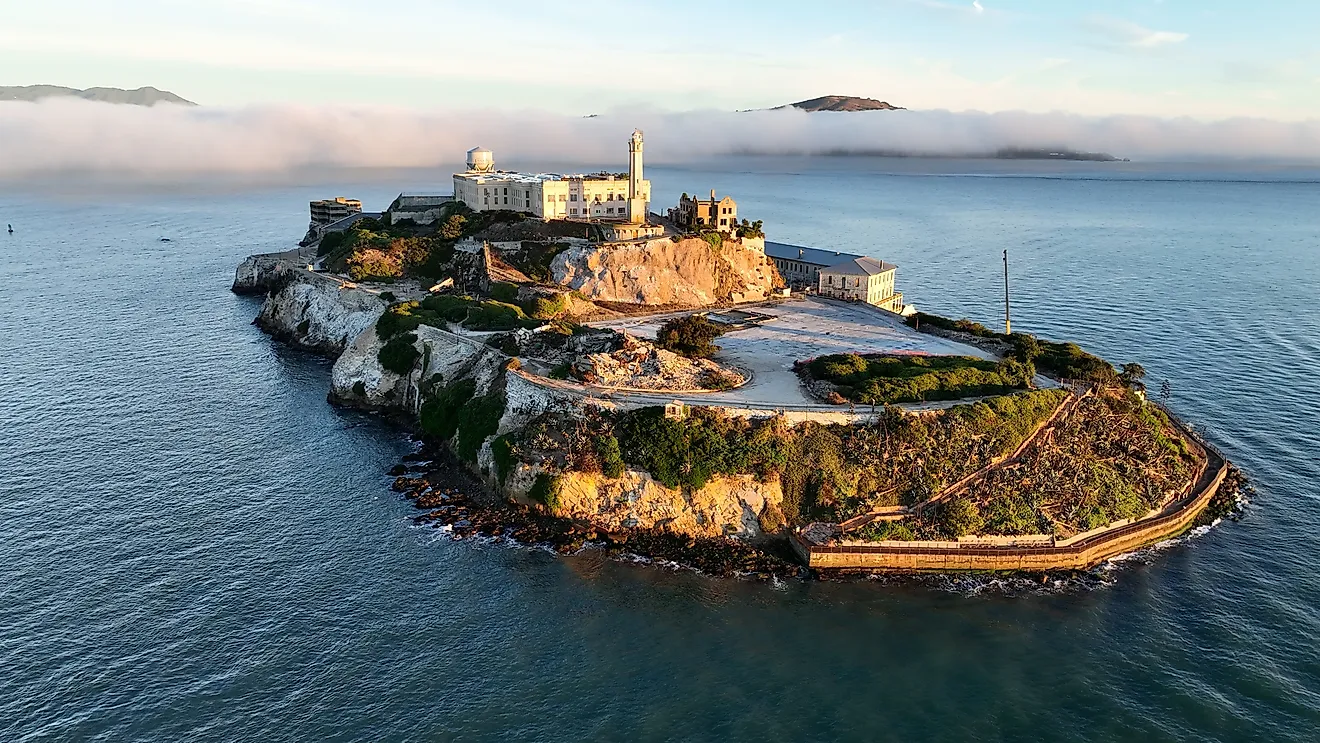
Alcatraz Island in San Francisco Bay received its first permanent Army garrison in 1859; 11 soldiers were confined in the Sally Port basement almost immediately. The Army designated the island a military prison for the Department of the Pacific in 1861, holding Civil War prisoners, the crew of a Confederate privateer and civilians accused of treason. In 1895, 19 Hopi men from Arizona were imprisoned for refusing to send their children to government schools. Military prisoners built the 600-cell concrete cellhouse between 1909 and 1912.
The Army left in 1934, transferring 32 hardened inmates who became the first federal penitentiary residents; later occupants included Al Capone, George “Machine Gun” Kelly and Robert Stroud, the “Birdman of Alcatraz.”
The prison closed in 1963 and the National Park Service now runs the island as part of Golden Gate National Recreation Area. Alcatraz City Cruises provides the only ferry landing, a 15-minute crossing from Pier 33, and admission includes the “Doing Time” cellhouse audio tour narrated by former guards and inmates.
Nevada State Prison in Carson City began in 1862 when the territory bought the Warm Springs Hotel and converted it into a penitentiary. Prisoners cutting sandstone for the state capitol uncovered fossilized footprints of mammoths, sloths and dire wolves. The facility carried out the nation’s first execution by lethal gas in February 1924; the condemned man, Gee Jon, a Chinese immigrant, had been convicted of a gang murder.
After Nevada legalized gambling in 1932, the warden allowed inmates to operate a casino called the Bull Pen, offering blackjack, craps, poker and sports betting with brass tokens until 1967. The last inmates left in January 2012, 150 years after the first arrivals, and the prison opened for 90-minute guided day tours in 2016.
A National Park Service interpreter at Alcatraz said during a 2023 tour briefing that these sites are not just tourist attractions; they are physical archives of how this country has defined crime, punishment and reform across three centuries.

Eastern State Penitentiary relies on a mix of ticket revenue, grants and private donations to stabilize crumbling cellblocks.
Eastern State Penitentiary rose on an eleven-acre plot called Cherry Hill, purchased by Pennsylvania in 1821, and opened on October 25, 1829, as the world’s first true penitentiary with seven heated, skylit corridors built to hold 500 inmates in isolation.
At completion it was the largest and most expensive public structure ever erected in the United States, and its radial plan and separate-confinement system became the model for more than 300 prisons worldwide. Women were incarcerated there beginning in 1831, and by 1836 nineteen were housed in the upper gallery of cellblock 7.
Visitation schedules vary widely. Alcatraz requires advance ferry reservations that sell out weeks ahead in summer; Old Joliet offers ninety-minute guided history tours, self-guided walks and hard-hat tours of the administration building; Nevada State Prison runs 90-minute guided day tours by appointment. Most sites close for winter or limit hours after November.
Worth a look

New Hampshire Fisher Cats’ “Space Potatoes” Identity Merges First Potato Crop With 1961 Hill Alien Abduction
The New Hampshire Fisher Cats, the Double-A affiliate of the Toronto Blue Jays, have adopted the "Space Potatoes"...

Marsha Geier, 71, Sioux Falls, Dies at University of Nebraska Medical Center
Marsha Geier, a nurse who spent 34 years at Mercy Medical Center in Sioux City and a grandmother...
Va. Schools Close Through Thanksgiving Break After 500 Staff Missed Child Abuse Registry Review, Acting Superintendent Says
Albemarle County Public Schools announced Wednesday it would close all 29 schools through Thanksgiving break after discovering more...

Las Vegas Thanksgiving Restaurant Guide: Menus & Prices From $26 to $150
Thanksgiving dinner at a Las Vegas restaurant will cost anywhere from $26 to $150 per person this year,...