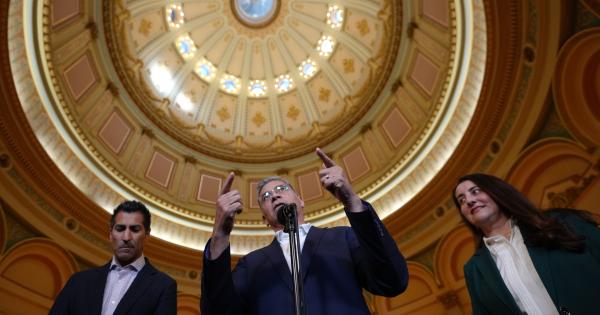
Xavier Becerra won election as California governor, helping continue a streak that highlights the deep ties between the state’s politics and its religious history.
With Becerra’s victory, the state has now elected five consecutive Catholic governors, a remarkable run that highlights how deeply the faith is embedded in the cultural architecture of the nation’s most populous state. As he campaigned for the seat, Becerra pointed directly to his upbringing when explaining his worldview.
“The sanctity of life is something that’s really ingrained in you,” the Democrat and former U.S. health and human services secretary said earlier this year. He then laid out his rationale for supporting abortion rights, a position that often confounds casual observers of religious politics.
That complexity captures a broader reality across the United States, where adherents of the faith defy simple political categorization. “There is no Catholic vote,” said David Gibson, the director of Fordham University’s Center on Religion and Culture. White evangelicals reliably back Republicans, and Black Protestants consistently support Democrats, but Catholic voters occupy a much more fractured middle ground.
Beginning with Gray Davis, who took office in 1999, four of those five governors have been Democrats. California is home to more Catholics than any other U.S. state, with a 2024 Pew Research Center poll showing that 25% of adults in the state identify with the faith, accounting for almost half of its total Christian population.
The political divisions among these voters are stark. About 6 in 10 Catholic voters supported Becerra in the governor’s race, while about 4 in 10 voted for his Republican opponent, Steve Hilton, according to The AP Voter Poll, a survey of roughly 100,000 midterm voters. Latino Catholics broke heavily for the Democrat, with about 7 in 10 supporting Becerra, whereas white Catholics were split between the two candidates.
Faith and Public Policy in California
Catholic theology rarely aligns neatly with either major American political party. Economic strains of Catholic social teaching and explicit opposition to the death penalty often find a comfortable home on the political left, while church doctrines against abortion and in vitro fertilization align firmly with the right.
Gov. Gavin Newsom has frequently found himself at odds with church leadership over his strong support for abortion rights. Yet his recent announcement to change more than 500 death sentences in the state to life in prison without the possibility of parole earned praise from the California Catholic Conference, the public policy organization representing the church.
“I take this action because I firmly believe that state-sanctioned killing is incompatible with California’s values, undermines the foundations of our legal system, and diminishes each of us,” Newsom said in a public letter.
Other religious leaders have taken similarly divergent paths. San Bernardino Bishop Alberto Rojas formally excused parishioners from their weekly obligation to attend Mass last year following immigration detentions on parish properties. On the other end of the spectrum, San Francisco Archbishop Salvatore Cordileone barred U.S. Rep. Nancy Pelosi from receiving Communion in 2022 over her support for abortion rights.
History Woven Into the Landscape
Beyond modern electoral politics, Catholicism has shaped California’s identity for centuries through the 21 missions founded between 1769 and 1823. That legacy carries deep historical friction alongside architectural beauty.
“Obviously, the legacy of the missions is a mixed one and has problematic implications,” Cecilia González-Andrieu, a theology professor at Loyola Marymount University, said. “For Latina theologians like myself, there’s a need for us to be able to hold that in tension, the fact that within our very selves we have this mix of cultures and bloods.”
State schools now teach about how missionaries mistreated Native Americans under a law signed by Newsom that went into effect last year. Historians point out that the mission system also introduced European diseases that devastated Indigenous populations.

Yet the physical landmarks remain central to the state’s aesthetic. For residents like Tracy Creighton, whose ancestry traces back to the missions founded more than two centuries ago by Spanish Franciscan priests, the culture provides a framework for daily life.
“I feel in the last several years we have lost our way in terms of being of service to others,” Creighton said, pointing to Saint Francis of Assisi as a model. “That is why I stay Catholic.”

New Orleans Cemetery Photography Guide: Rules, Permits, and Etiquette
Photographing New Orleans' historic above-ground tombs requires strict adherence to property rules, active preservation efforts, and basic human...

Rickie Fowler Surpasses $73 Million in Career Earnings Milestone
Rickie Fowler spent an October afternoon watching the first-ever WGTL event at the SoFi Center in Palm Beach...

Assemblywoman Marianne Buttenschon Celebrated at Farewell Party
Assemblywoman Marianne Buttenschon marked the end of her eight-year tenure representing the 119th Assembly District as family and...
Kyle Shanahan Says Keenan Allen Suspension Is Possible This Season
San Francisco 49ers head coach Kyle Shanahan said it is “possible” that newly acquired wide receiver Keenan Allen...