
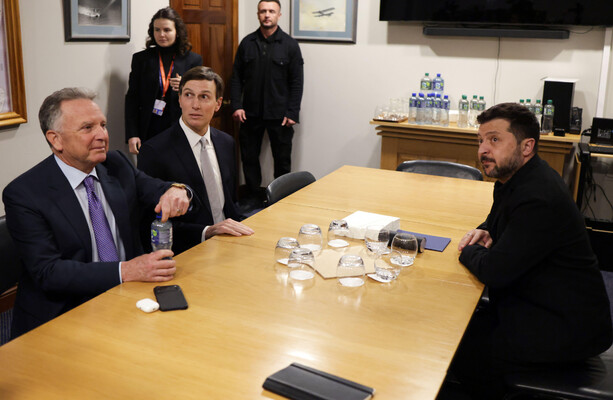
Ukrainian President Volodymyr Zelenskyy and US special envoys Jared Kushner and Steve Witkoff confirmed on Wednesday that European representatives will participate in upcoming peace negotiations with Russia.
Following a briefing at Casement Aerodrome in Dublin, the leaders signaled a shift in the diplomatic process intended to end the war, with Mr. Zelenskyy emphasizing that Europe must have a direct voice in the security architecture of the continent.
The announcement followed trilateral peace discussions in the United Arab Emirates and a subsequent meeting between the US envoys and Russian President Vladimir Putin in Moscow. Mr. Kushner, speaking alongside Mr. Zelenskyy in Baldonnel, said that finalizing a prisoner of war exchange was a primary result of these recent efforts. “We cannot conclude this deal without Europeans being at the table,” Mr. Kushner told reporters, as reported by RTÉ.
For the Ukrainian government, this inclusion is a matter of both sovereignty and future integration. Mr. Zelenskyy said that because the war is occurring within European borders, the involvement of EU nations is essential for long-term stability. According to The Journal, Mr. Zelenskyy described the prisoner exchange as a “real result” that would bring thousands of soldiers home to their families, marking a significant milestone in the ongoing conflict.
The Diplomatic Friction Over Security Architecture
While the prospect of European involvement has been welcomed, the path to the negotiating table remains complex. Earlier on Wednesday, during the first plenary session of the European Political Community in Dublin, Mr. Zelenskyy expressed skepticism regarding the American approach to discussions with Moscow.
He characterized the US strategy of negotiating a new security order with Russia as “a bit strange,” arguing that after 30 years of European efforts to foster trade and cooperation with Russia, the focus should remain on a unified European stance.
The geopolitical tension is underscored by a recent declaration issued by approximately 40 countries at the summit, asserting that matters of European security must be decided in consultation with European governments. French President Emmanuel Macron offered a blunt assessment of the current state of international support, stating that Europe must define its own security principles because “there is no more US support,” according to the RTÉ report.
Mr. Macron and German Chancellor Friedrich Merz have signaled that while the format of the talks is important, the priority remains securing a firm commitment from Mr. Putin to engage in substantive dialogue.
Drone Technology and Operational Disruptions
Beyond the diplomatic arena, technical challenges continue to impact the front lines. Mr. Zelenskyy disclosed that Ukrainian military units have experienced “significant disruptions” to the Starshield and Starlink satellite systems, including speed restrictions that limit drone operations to 161 kph. Kyiv is currently seeking clarity from US officials regarding these limitations, which officials fear could signal a potential decline in American operational support.
Simultaneously, Ireland is exploring a deeper technical partnership with Ukraine. The Irish Times reported that the Department of Defence is in talks regarding a joint memorandum on drone manufacturing and technology.
Taoiseach Micheál Martin confirmed that Ireland is looking to leverage Ukrainian expertise in unmanned aerial vehicles to enhance its own maritime security capabilities. Mr. Zelenskyy indicated that his country is “ready for co-production” of this technology with Ireland, expecting the deal to become operational in the near future.
Security Challenges and Hybrid Activity
The summit in Dublin took place under the largest security operation in the history of the State, prompted in part by a series of recent hoax bomb threats.
Taoiseach Micheál Martin described these incidents as a “European-wide development” and suggested they are part of a broader Russian effort to undermine morale and create a “war-weary continent.” While Mr. Martin said that significant hybrid activity can be traced back to Russia, he emphasized the need for due diligence before assigning responsibility.

As the European Political Community continues its deliberations, the focus remains on maintaining a coherent, unified vision for the region’s future. Mr. Zelenskyy is currently pushing for the opening of the final two negotiating clusters regarding Ukraine’s accession to the European Union before the end of the year.
During his visit to Dublin, he reaffirmed his commitment to the process, telling the EPC meeting, “We will be a member of the EU in the future, that’s why it’s very important.”
The diplomatic maneuvering reflects the high stakes for all parties involved as they attempt to transition from a state of active conflict to a sustainable ceasefire. “I know we’ve been working with President Zelenskyy and his team very closely on the post-war plan for Ukraine,” Mr. Kushner said. “The potential of Ukraine is incredible.”
Keep reading
Rare Corpse Flower Pete Set to Bloom at Geelong Botanic Gardens
Pete, a giant corpse flower currently standing at 1.5 metres tall, is expected to bloom within the next...

Pete Hegseth Awards Medal to Soldier Who Reprimanded Him at Tomb of the Unknown Soldier
Defense Secretary Pete Hegseth awarded the Joint Service Commendation Medal on Thursday to Specialist Thomas Iglesias, the Army...

Insider: Walliams’ Reputation Was ‘In Plain Sight’ Due to Jokes
Public jokes regarding David Walliams' personal life spanned two decades, according to industry insiders and media archives. The...

Hoax Bomb Threats Disrupt Schools Across Italy, UK, and Ireland
More than 300 schools across Italy were evacuated on Wednesday following a wave of emailed bomb threats that...