Mayor Zohran Mamdani on Friday unveiled a plan to close the Rikers Island jail complex, with a goal to end all incarceration at the current facility and relocate its remaining jail population by the end of 2032, five years past the current legal deadline of August 2027.
The announcement, detailed in a planning report released by City Hall, effectively concedes that the August 2027 target set by the City Council in 2019 and signed by then-Mayor Bill de Blasio is unattainable. Construction on the borough-based jails is behind schedule, and the detained population has risen since 2020 to roughly 6,600 as of early November. The four new facilities — in Brooklyn, the Bronx, Queens and Manhattan — are designed for a combined 4,500 beds.
“It is time to finally close Rikers Island,” Mamdani said in a statement accompanying the report.
“For decades, New Yorkers have demanded a correctional system that is safe and humane. This plan puts us on a path to deliver just that: closing Rikers, reducing pretrial detention, tackling the case delays that deprive people of their right to a speedy trial and investing $146m in the evidence-based supports that helps break the cycles of incarceration.”
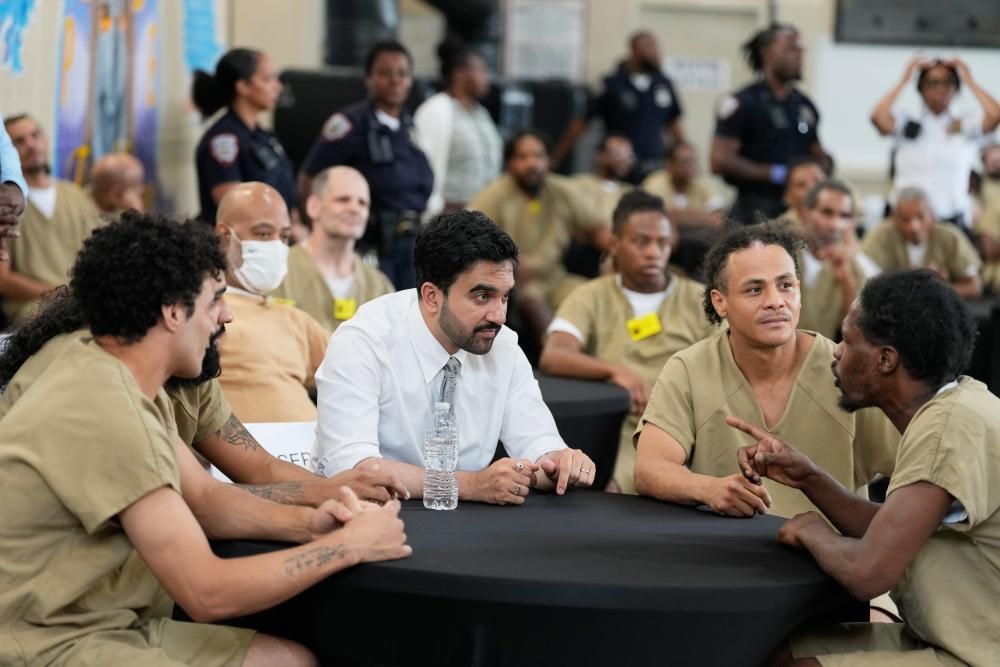
A staggered timeline, a population gap
The blueprint schedules the Brooklyn facility to open in 2029, followed by the Bronx and Queens in 2031 and Manhattan in 2032. To make the math work, the administration projects the jail population must drop to no more than 5,500 by the time Brooklyn opens and further to no more than 4,100 by the end of 2032.
That reduction hinges on shrinking the pretrial population, which accounts for about 5,600 of the current 6,600 detainees. The average length of stay has ballooned to 116 days in fiscal year 2026, up from 87 days the prior year, even as pretrial admissions have fallen 56 percent since 2017. The total population has only dropped 22 percent in that span, the report notes, because people are waiting significantly longer for case resolution.
The cost of delay
Pushing the deadline requires the City Council to pass new legislation. Council Speaker Julie Menin signaled openness Friday, saying delays under previous administrations “have made it clear that more time is needed to fulfill the commitment the City Council made to New Yorkers in 2019.”
“With Rikers now under federal court-ordered oversight, we must bring this troubling chapter in our city’s history to an end once and for all,”
Menin said in a statement.
Rikers has become a symbol of dysfunction, with violence and overcrowding so severe that a federal judge, citing “abnormal and unacceptable” conditions, appointed an outside manager to restore order and implement reforms. Nine people have died in city jail custody so far this year. Mamdani’s plan pledges to work alongside the federal monitor, the Board of Correction and the court-appointed remediation manager to codify the new timeline.
Proposal commits $290 million through 2030 for jail population reduction
The proposal commits $290 million through fiscal year 2030 toward population-reduction strategies. That includes $146 million in the next fiscal year alone for mental health care, substance-use treatment, educational programming and victim services, plus $50 million for vocational training and counseling inside jails and $76 million for community-based reentry and diversion programs. Another $16 million is earmarked for crime victims and survivors.
On the infrastructure side, the administration promises to replace the island’s 2,450 defective doors, improve sanitary conditions and overhaul staff training — an acknowledgment that the culture of dysfunction must not migrate to the new borough jails. The plan also creates a Case Delay Task Force with the Office of Court Administration, district attorneys and the defense bar to attack the court backlog driving the population surge.
The reuse question
Mamdani’s team is already exploring near-term renewable energy and sustainability projects for the 400-acre island once it empties. An earlier Independent Rikers Commission report showed construction costs for the four borough jails have ballooned from $8.7 billion to $15.5 billion, adding financial pressure to a project already years behind schedule.
Since taking office, Mamdani has unveiled a plan to close the Rikers Island jail complex by the end of 2032. In June, the administration shuttered the 1932-era North Infirmary Command, transferring it to the Department of Citywide Administrative Services.
“This report is only the beginning,” the proposal says. “We are committed to demonstrating progress transparently and frequently, through quarterly updates.” The first test comes when the Council takes up the legislation to extend the legal deadline — a vote that will determine whether 2032 becomes a mandate or another aspiration.
Senate Adopts Resolution Honoring Former Sen. Jay Rockefeller by Unanimous Consent
On a Monday afternoon in a chamber that rarely agrees on the time of day, 99 senators put...

No. 6 Youngstown State Bowling Opens Final Fall Tournament at Jersey Jamboree Against Top-Ranked Field
Youngstown State's bowling team opens play Friday at the Jersey Jamboree in Hackensack, New Jersey, the program's final...

“Probably Some More Packs!” Lucas Martell Said
"Probably some more packs!" Lucas Martell said when asked what the brothers would buy first with their winnings....

Georgia Southern Opens Sun Belt Tournament vs. South Alabama, Starters to Return for 2027 Season
Georgia Southern opens the Sun Belt Conference tournament Friday afternoon against South Alabama, the third meeting between the...