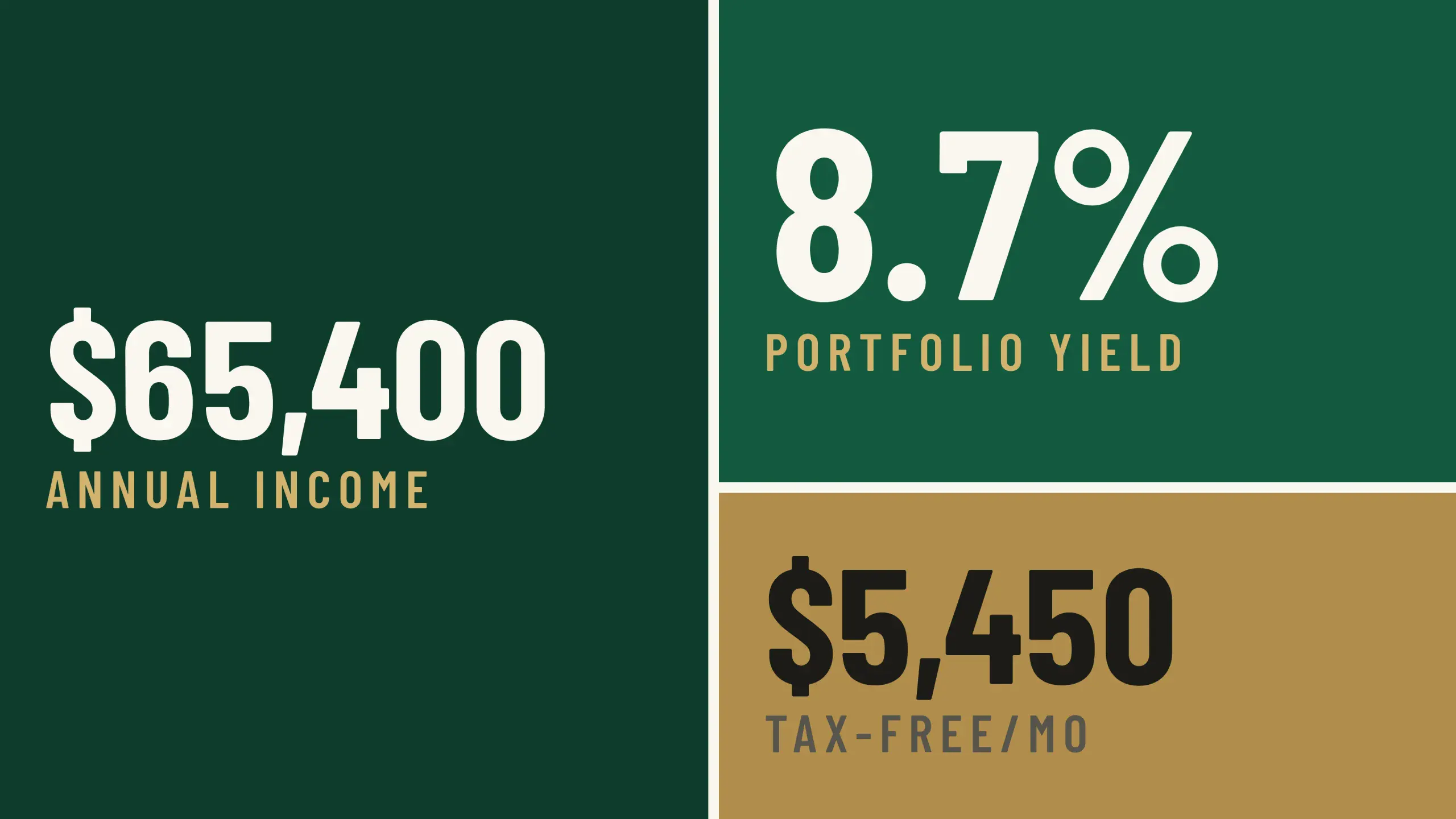
Generating $5,450 in monthly tax-free income requires a precise, high-yield strategy that navigates the intersection of tax code 26 U.S.C. § 408A(d)(1) and the volatility of income-focused assets. As 24/7 Wall St. recently detailed, constructing a portfolio to produce $65,400 in annual tax-free distributions requires roughly $754,000 in capital, assuming an aggregate yield of approximately 8.7%. This strategy relies on a mix of business development companies (BDCs), real estate investment trusts (REITs), and option-income ETFs, each carrying specific structural risks that investors must reconcile before the 2026 tax-filing deadline.
The Bottom Line:
- Achieving a $5,450 monthly payout requires a $754,000 principal at an 8.7% yield, heavily leveraging tax-advantaged Roth structures to avoid ordinary income tax rates.
- The portfolio includes high-conviction assets like Hercules Capital and Altria, but relies on instruments like the NEOS Nasdaq 100 High Income ETF (QQQI), which classified 94% to 99% of its 2025 payouts as return of capital.
- Investors face a hard December 31 deadline for 2026 Roth conversions, a maneuver that remains the most effective way to shelter high-yield, ordinary-income distributions from the IRS.
The Structural Risks of High-Yield Allocation
The core of this portfolio strategy rests on assets that frequently generate ordinary income rather than qualified dividends. Under 26 U.S.C. § 1(h)(11)(D)(iii), REIT dividends often fail to qualify for lower long-term capital gains rates, and BDC income is typically taxed at the investor’s marginal rate. By housing these assets within a Roth IRA, investors circumvent the annual tax drag that Yahoo Finance estimates can reach $9,000 per year on a $750,000 portfolio at a 24% tax bracket.
However, the portfolio’s “Alpha Metric”—the reliance on return of capital (ROC) and floating-rate exposure—demands scrutiny. For instance, the NEOS Nasdaq 100 High Income ETF (QQQI) provides significant income but, according to its Form 8937 for the period ending May 2025, the majority of its distributions were classified as ROC. While this is tax-neutral inside a Roth, it fundamentally alters the cost basis in a taxable account. Furthermore, the Eldridge BBB-B CLO ETF (CLOZ) ties its income generation to short-term interest rates; as the Federal Reserve adjusts the federal funds rate, the underlying coupons on these collateralized loan obligations fluctuate, creating a direct sensitivity to monetary policy pivots.
Institutional Sentiment and Market Mechanics
Institutional investors continue to monitor the credit quality of BDCs like Hercules Capital (NYSE:HTGC), which maintains an 89% first-lien loan concentration. The “Smart Money” is currently focused on the impact of interest rate cuts on net interest margins. As noted in the 24/7 Wall St. analysis, a 25-basis-point drop in the prime rate reduces Hercules Capital’s annual earnings by approximately $0.03 per share. This margin compression is a reality for lenders in the venture-backed tech and life sciences space, where borrowing costs directly influence the health of the underlying portfolio companies.

The dividend yield is not a static number; it is a reflection of the credit spread and the underlying liquidity of the asset. When you chase 8% to 15% yields in a tightening or normalizing rate environment, you aren’t just buying income—you are underwriting the credit risk of the middle market.
Retail investors often overlook the dividend history of these holdings. EPR Properties (NYSE:EPR), while providing an 11% slice of the target income, famously suspended its dividend in 2020 before resuming at a lower rate in 2021. This serves as a reminder that “safe” high-yield monthly payers are subject to the same capital allocation decisions as any other corporate entity.
The Roth Conversion Window
For those looking to build this income stream before year-end, the strategy hinges on the “Roth Window”—the period between retirement and the onset of required minimum distributions (RMDs). By converting traditional 401(k) or IRA assets into a Roth IRA during lower-income years, taxpayers can strategically fill their tax brackets. A married couple converting $151,000 annually can manage their tax liability while keeping their taxable income within the 22% bracket, effectively locking in future tax-free growth.
As AOL.com reported, the tax savings are not merely theoretical; they compound significantly. Reinvesting the annual $9,000 tax savings at a conservative 4% rate could result in an additional $268,700 over two decades. This underscores the reality that for high-yield portfolios, the primary mechanism for wealth accumulation is the mitigation of tax leakage rather than just asset price appreciation. Investors must verify their holdings against the latest 1099-DIV forms and ensure their conversion strategy is completed by December 31 to qualify for the 2026 tax year.

The market trajectory for these assets remains tethered to the broader yield curve and the appetite for credit risk. As long as the spreads on BDCs and CLOs remain attractive, the appeal of a $5,450 monthly tax-free paycheck will persist, provided investors remain vigilant regarding the underlying return of capital and credit grade shifts.
Disclaimer: The information provided in this article is for educational and market analysis purposes only and does not constitute financial, investment, or legal advice. Always consult with a certified financial professional before making investment decisions.
Keep reading

WSET Meteorologist Predicts Snow Totals for Virginia Winter 2026-2027
Virginia’s Winter Forecast: A Season of Uncertainty As residents across Virginia prepare for the colder months, the question...

Vermont House and Senate Election Results by District
Vermont Legislative Shifts: A Detailed Breakdown of the 2016 Election Results The 2016 Vermont legislative elections resulted in...

Shakira Austin Named to 2026 All-WNBA Second Team
Shakira Austin Secures Spot on 2026 All-WNBA Second Team Washington Mystics center Shakira Austin has officially been named...
Sioux Falls Skyforce Enter New Era Under Coach Mario Casamajor
The Sioux Falls Skyforce open their 2026–27 campaign this Saturday, November 7, against the Grand Rapids Gold at...