NASA’s Psyche spacecraft swept past Mars at 12,300 mph on May 15, 2026, utilizing a gravity assist to reshape its trajectory toward a distant metal-rich asteroid. While securing a crucial velocity boost, the probe put its entire scientific payload through a rigorous flight rehearsal, capturing rare vistas and testing instruments.
When an interplanetary spacecraft builds its cameras to inspect a metal-rich world in the outer solar system, testing them on a neighboring planet is the ultimate dry run. On May 15, 2026, NASA’s Psyche spacecraft swept past Mars at roughly 12,300 mph, closing to within 2,864 miles of the surface. Although the Red Planet was never the mission’s final destination, the encounter provided a month-long testing window for navigation teams and instrument specialists alike.
Gravity Assist Mechanics and the Journey to 2029
The primary engineering objective of the Martian encounter was straightforward: steal speed. Gravitational flybys bend a probe’s path and add velocity without consuming propellant, making journeys to the inner or outer solar system far more efficient.
“This gravity assist was years in the making, and the navigation team nailed it — Psyche flew by Mars on exactly the trajectory we needed to set us on a path to rendezvous with the asteroid in the summer of 2029,”
Bob Mase, Psyche’s project manager at NASA’s Jet Propulsion Laboratory in California
Launched in October 2023, the spacecraft is headed for a main-belt asteroid located between Mars and Jupiter that scientists suspect is the exposed nickel-iron core of a former planet.
Instruments Put Through Their Paces During the Flyby
While the navigation team focused on trajectory, science teams utilized the planetary approach to calibrate instruments that were built for a very different target.
The gamma-ray and neutron spectrometer, designed to determine elemental composition at the asteroid, measured escaping neutrons produced when high-energy cosmic rays bombard an atmosphere-free surface. Although Mars was too distant for gamma-ray detection, David Lawrence, science lead for the spectrometer at the Johns Hopkins Applied Physics Laboratory, noted that the neutron count rate climbed near closest approach, matching pre-encounter predictions.
Meanwhile, the spacecraft’s magnetometer achieved a historic milestone. Having spent nearly three years measuring solar wind and coronal mass ejections, the device recorded a planetary magnetic environment for the first time. Ben Weiss, deputy principal investigator and magnetometry lead at MIT, explained that the magnetometer recorded an intense uptick in the bow shock region, validating instrument performance under dynamic conditions while revealing insights into planetary magnetism.
Capturing Mars Through Twin Multispectral Cameras
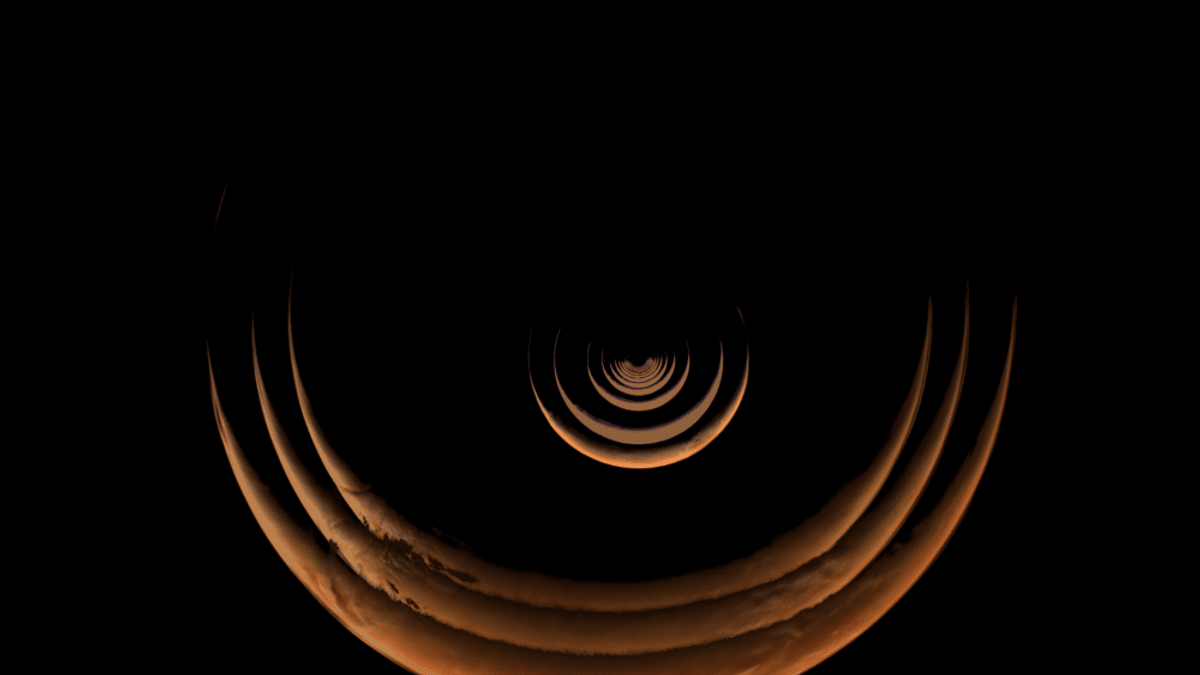
Equipped with twin multispectral cameras designed to map asteroid geology, the mission also captured a striking visual record of the Red Planet. Approaching from a steep angle relative to the sun, the spacecraft initially caught Mars as a slender crescent with just 4 percent of its disk illuminated while its thin atmosphere glowed in scattered sunlight.
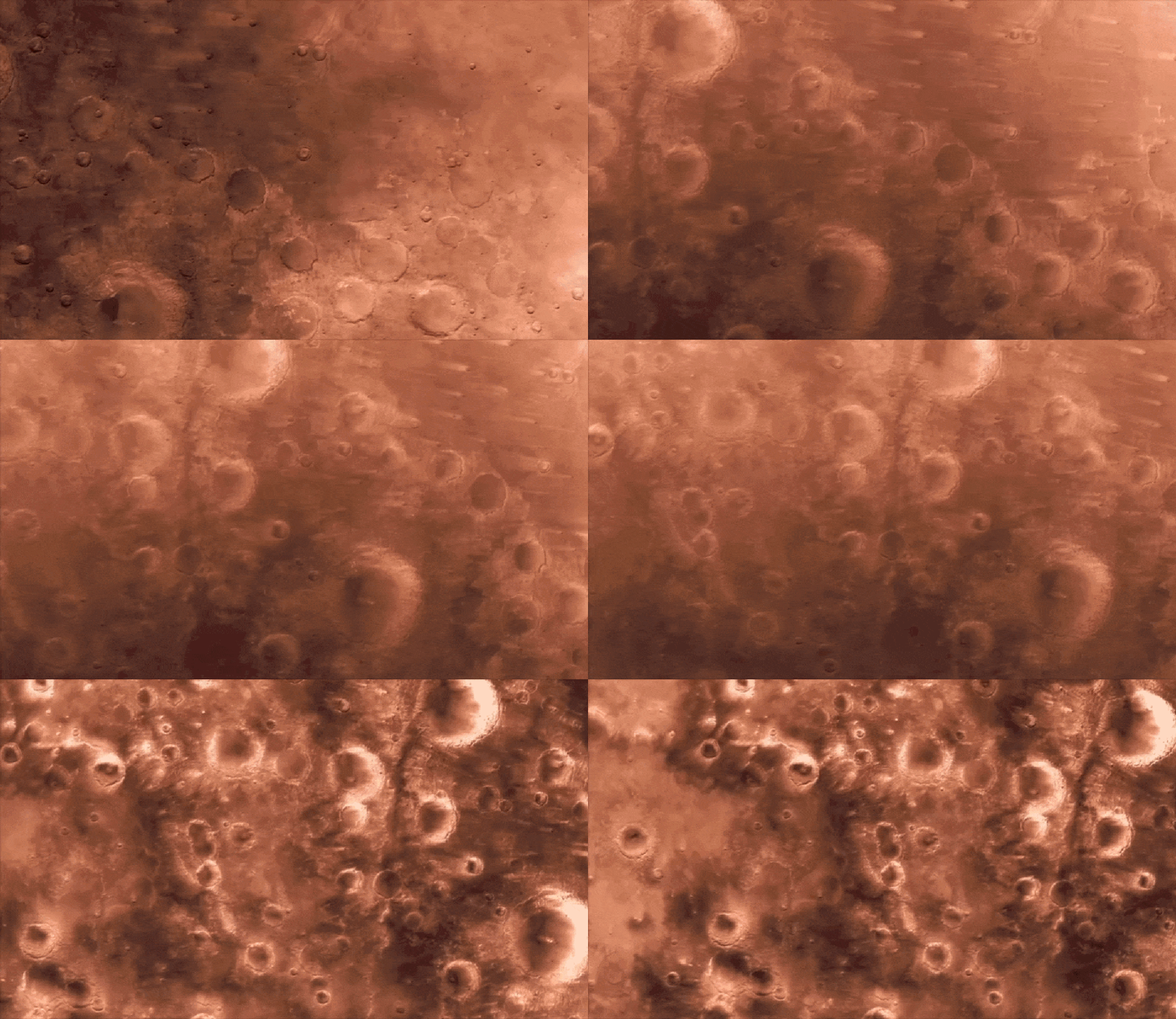
NASA subsequently stitched the month-long sequence of approach and departure frames into a mesmerizing time-lapse video. The footage reveals sweeping ocher vistas pockmarked with impact craters, the expansive south polar ice cap, and the double-ringed Huygens crater.
Jim Bell, who leads the imager instrument team at Arizona State University, noted that the cameras also spotted the Martian moons Phobos and Deimos from afar. This remote detection served as a practical rehearsal for the satellite search the team will perform to look for moonlets when they finally arrive at asteroid Psyche.
Coordinated Observations With Mars Express
The flyby also created an unexpected collaborative opportunity. Upon learning of the trajectory, mission teams behind the European Space Agency’s long-running Mars Express and its High Resolution Stereo Camera coordinated observation plans weeks in advance to image the exact same terrain.
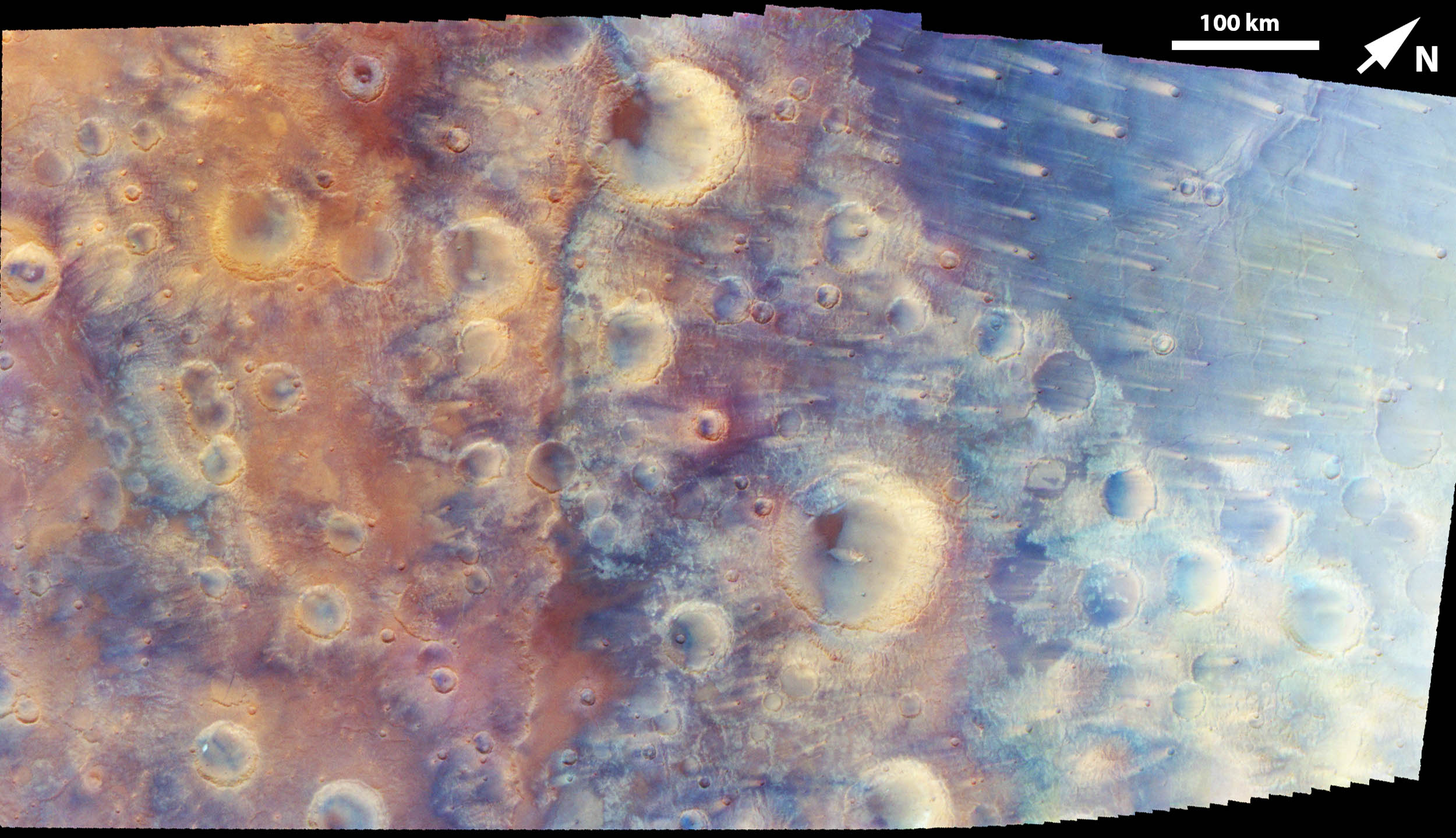
Data exchanges allowed both probes to photograph Noachis Terra, one of the oldest known regions of Mars, just hours apart. While Mars Express observed from an inclined angle at an altitude of 6,000 kilometers, Psyche looked almost straight down from 41,000 kilometers approximately two and a half hours after closest approach. Scientists are currently investigating whether comparing the brightness and color recorded across these differing distances and angles can provide further calibration for Psyche’s camera system.
Webb Telescope Finds Chariklo’s Rings Are Changing Over Years
Astronomers using the James Webb Space Telescope (JWST) have discovered that the two narrow rings surrounding the distant...

SpaceX Launches Final Three O3b mPOWER Satellites for SES
SpaceX successfully launched the final three O3b mPOWER satellites for SES on September 13, 2026, from Cape Canaveral...
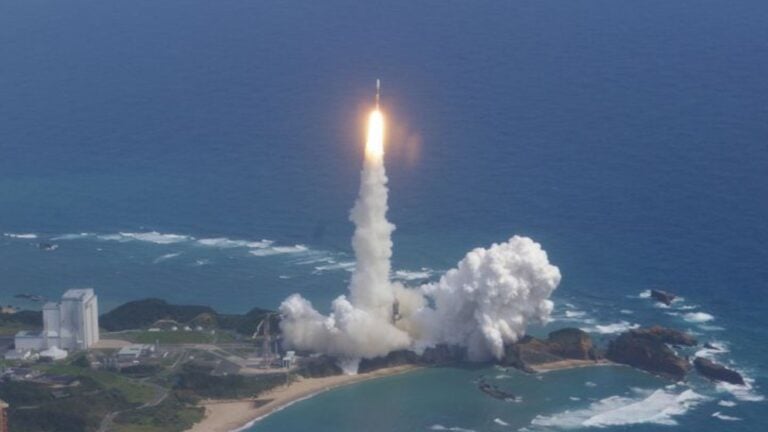
Japan Launches Kaguya Spacecraft to Map Moon in 2007
On September 13, 2007, Japan launched its advanced Kaguya spacecraft from the Tanegashima Space Centre aboard an H-IIA...

Astronomers Identify Eos, a Massive Molecular-Hydrogen Cloud Near the Sun
Astronomers have identified Eos, a massive molecular-hydrogen cloud located roughly 300 light-years away and spanning 40 full-Moon widths...