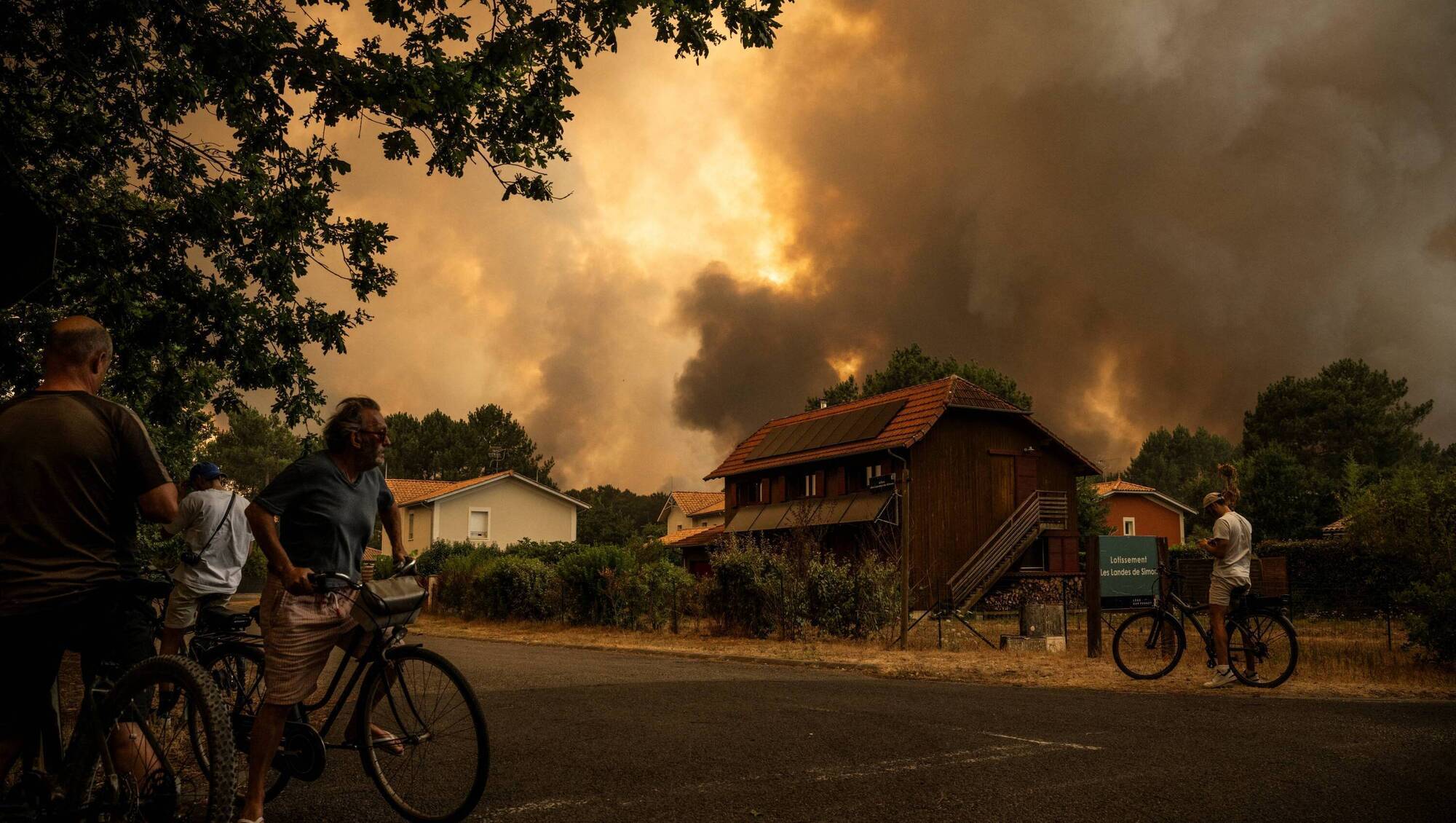
As western Europe braces for its fourth summer heatwave, emergency crews in France and Spain are racing against time to contain massive wildfires. Tens of thousands have evacuated as historic burn totals outpace last year, while international assistance mobilizes to support strained local firefighters.
What began as a volatile season of weather extremes has intensified dramatically. Authorities across both nations are scrambling to secure perimeter lines before baking temperatures and shifting winds reignite dormant hotspots, threatening populated metropolitan borders and tourist sanctuaries alike.
Gironde Fire Pushes Toward Bordeaux as France Mobilizes
In southwestern France, the largest wildfire since 1949 continues to forge an unpredictable path west of Bordeaux. The fire has consumed 42,000 hectares and forced the evacuation of 220,000 people.

Bordeaux Mayor Thomas Cazenave told the BBC that local authorities are bracing for all eventualities as the flames advanced to within 15 kilometers of the city. Firefighters in the Cestas commune have deployed mechanical diggers to uproot trees and carve out wide firebreaks, joining civilian volunteers and international crews. Switzerland responded to Paris’s request by dispatching two Super Puma helicopters and flight crews, while the European Union coordinated the delivery of seven additional planes and four helicopters.
President Emmanuel Macron visited the region to inspect recovery efforts, urging caution as adjacent blazes like the Landes fire remain virulent despite being technically contained. Meanwhile, citizens and visitors in tourist hotspots like the Cap Ferret peninsula and Lacanau have faced heavy smoke, falling ash, and mandatory campground evacuations.
Spain Battles Record Blazes From Madrid to Castellon
Across the border, Spain is confronting its own historic devastation. A fire in the hilly Ávila terrain west of Madrid has set a national record, scorching 50,000 hectares. Combined with separate blazes north-west of the capital, the total scorched land near Madrid has reached 70,000 hectares, while nationwide figures show 172,000 hectares burned this year—six times greater than the equivalent period in 2025.

While Sánchez noted that officials could see light at the end of the tunnel
for certain containment efforts, local leaders urged vigilance. Mayor Fernando Casado of Robledo de Chavela warned that the fire sleeps like a kitten at night but wakes as a mighty lion during the day.
The EU’s civil protection mechanism has rushed assistance to the Iberian Peninsula, with Greece and Italy each dispatching two Canadair water-bombing aircraft, Portugal deploying over 100 military personnel, and Turkey sending two more planes. Despite these reinforcements, roadblocks enforced by the Guardia Civil gendarmerie have kept evacuated families waiting in cars near Aldea del Fresno due to toxic smoke hazards.
A Tipping Point Across a Warming Continent
According to the European Forest Fire Information System (EFFIS), 2025 was Europe’s worst year for wildfires since tracking began in 2006, but current 2026 burn statistics are already outpacing that trajectory. Successive heatwaves and unseasonable spring rainfall have fostered thick vegetation that subsequently dried into tinderboxes under punishing summer temperatures.
Meteorological agencies including Spain’s AEMET and MeteoFrance have issued warnings for a fresh heatwave running through the end of the week, with temperatures projected to spike as high as 42°C in northeastern Spain and 40°C in France. European Commission officials warn that the wildfire season, which began unusually early in April, could persist until early November, leaving nations from Hungary to Greece on high alert.
“Extreme conditions are looming for Hungary, Slovakia and the Czech Republic, in addition to France, the Iberian Peninsula… where the situation is expected to worsen, including in Portugal starting today.”
Hadja Lahbib, EU crisis management commissioner
Related reading
Canada Seeks Unique EU Alliance Amid US Trade War
Canadian Prime Minister Mark Carney addressed reporters in Toronto on Sunday, outlining a new diplomatic and economic direction...
Israeli Attacks in Gaza Kill Pregnant Woman and 10 Others
A pregnant Palestinian woman was shot and killed by Israeli forces in southern Gaza as artillery shelling and...

Iran and Gulf Nations Postpone Oman Talks Over Regional Consensus
The delay comes as oil prices fluctuate, U.S. economic sanctions expand, and military tensions in the region escalate...
After Louvre Heist, Robberies Continue at French Museums
Following a dramatic daytime heist at the Louvre, a string of break-ins has struck museums and churches across...