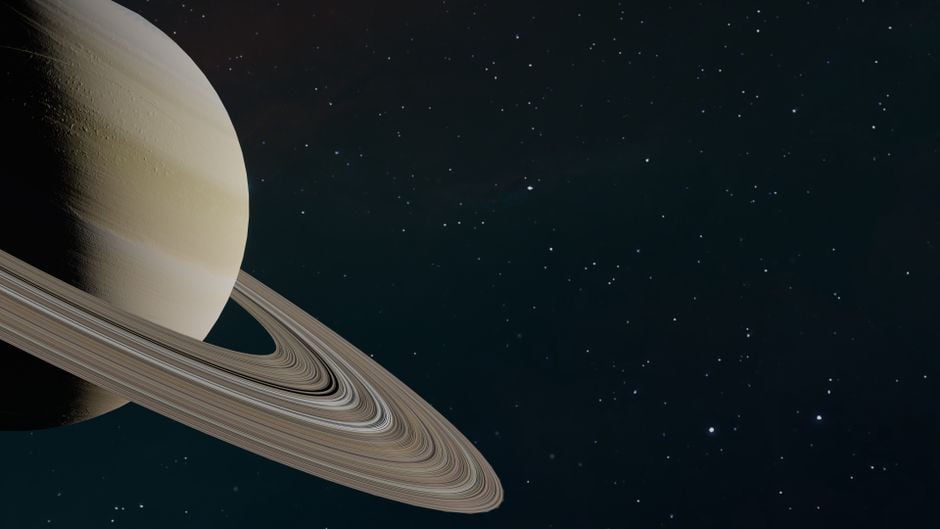
Titan’s shifting distance from Earth ranges from roughly 1.2 billion to 1.65 billion kilometers depending on planetary alignment, stretching a signal’s one-way trip from an hour to past ninety minutes. The mammoth moon features a dense nitrogen atmosphere, methane liquid cycles, and a suspected subsurface ocean.
Spacecraft exploring Saturn’s largest moon must account for an astronomical moving target. Because Earth and Saturn orbit the Sun at vastly different speeds—Earth completing a lap every year while Saturn takes nearly 29 and a half years—the distance between the two worlds is in a constant state of flux. According to reporting on planetary orbital mechanics, this creates a swing of roughly 450 million kilometers, equivalent to about three times the distance separating Earth from the Sun.
Orbital Mechanics and The 450-Million-Kilometer Swing
Titan itself orbits Saturn at an average distance of about 1.2 million kilometers, a figure that NASA planetary data notes is roughly 759,000 miles. Against the vast scale of the solar system, that local orbit barely registers. Saturn sits at an average distance of roughly 1.4 billion kilometers from the Sun, or about 9.5 astronomical units. For calculating the broad gap between Earth and Titan, researchers can essentially treat the moon as if it were Saturn.
The actual variation stems from planetary timing and orbital eccentricity. When Earth and Saturn align on the same side of the Sun, the distance shrinks to roughly 1.2 billion kilometers. When the planets end up on opposite sides, that gap stretches to about 1.65 billion kilometers. Layered on top of this alignment cycle is Saturn’s slightly elliptical orbit around the Sun, which introduces an additional 160 million kilometer variance over the course of its 29-year journey.
Signal Delays and Interplanetary Communications
Distance in deep space translates directly into time. Radio and data transmissions cannot bypass the speed of light, meaning mission controllers talking to a spacecraft near Titan face a variable communication window. At the closest approach, a one-way signal takes a little over an hour to arrive. At the farthest point, that delay stretches past ninety minutes.
Sunlight faces a similar constraint. Sunlight takes about 80 minutes to reach Titan, resulting in solar illumination that is roughly 100 times fainter than what Earth experiences.
Historic Discoveries and an Earthlike Liquid Cycle
Dutch astronomer Christiaan Huygens discovered Titan on March 25, 1655, initially naming the body “Luna Saturni.” The moon later received its enduring moniker from John Herschel. Spanning a radius of about 1,600 miles, Titan is the second-largest moon in the solar system, trailing Jupiter’s moon Ganymede by just 2 percent while standing nearly 50 percent wider than Earth’s Moon.
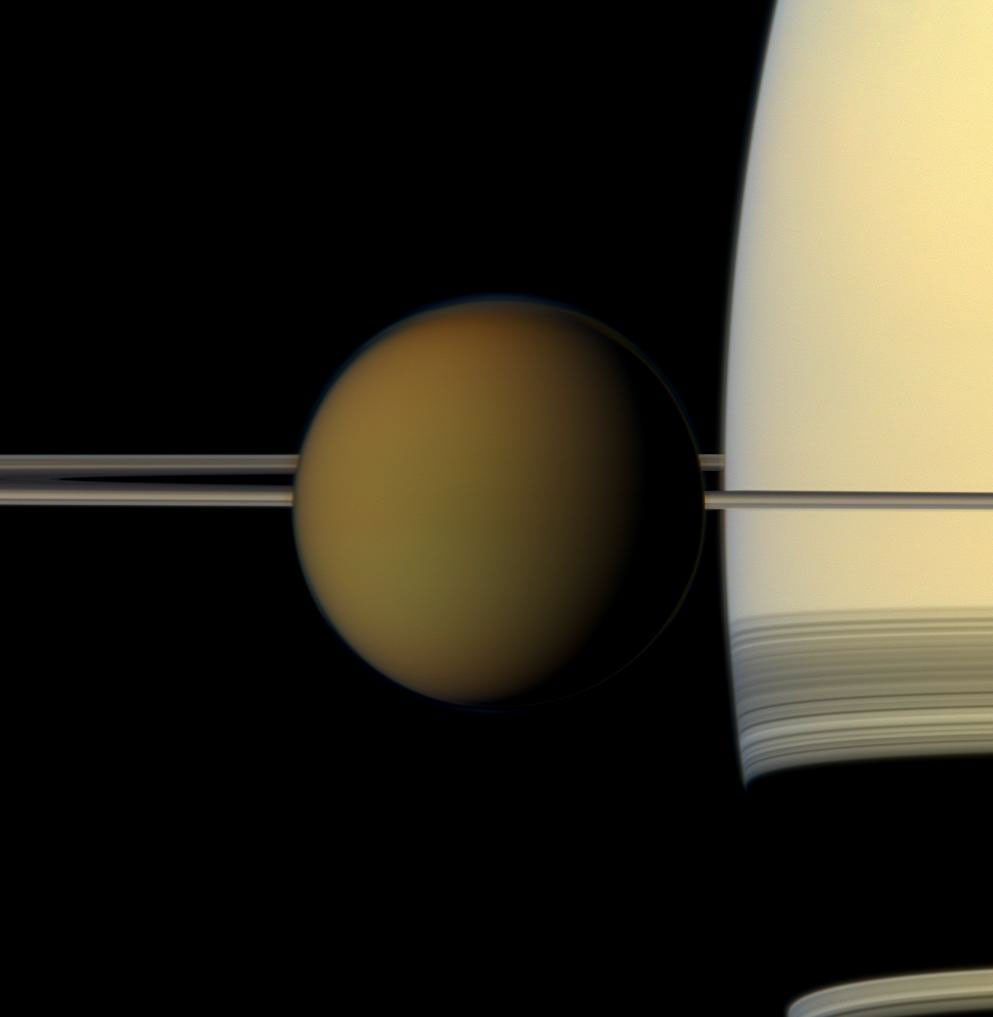
Titan holds the distinction of being the only moon in the solar system with a dense atmosphere, composed primarily of nitrogen with minor amounts of methane. It is also the sole world besides Earth known to possess standing bodies of liquid—including rivers, lakes, and seas—alongside an active hydrological cycle where liquid rains from clouds, carves the surface, and evaporates back into the sky. Beneath its icy crust, gravity and radio measurements from the Cassini-Huygens mission strongly indicate the presence of a global subsurface ocean of water mixed with salts and ammonia.
Mission Timelines from Cassini to Dragonfly
Sending physical hardware across these immense interplanetary gulfs requires sophisticated orbital navigation. The Cassini spacecraft launched in October 1997 and relied on a looping trajectory utilizing gravity assists from Venus, Earth, and Jupiter before reaching Saturn in mid-2004—a cruise of nearly seven years. Cassini subsequently released the European Space Agency’s Huygens probe for a three-week descent to the surface in January 2005.
Future exploration will follow a more direct path. NASA’s nuclear-powered rotorcraft mission, Dragonfly, is scheduled to launch in July 2028 and touch down on Titan in 2034. By selecting a more powerful launch vehicle capable of a direct trajectory, the agency shortened the cruise duration to roughly six years, bypassing the complex gravity-assist detours required during earlier eras of outer planet exploration.
Keep reading
NASA Names Four Astronauts for SpaceX Crew-14 Mission to ISS
NASA has assigned four astronauts from three space agencies to the SpaceX Crew-14 mission, targeting a Falcon 9...
Black Hole Shock Waves Spark Star Formation in Nearby Galaxies
Astronomers studying nine local galaxies have discovered that shock waves from active supermassive black holes consistently travel perpendicular...
UBC Researchers Discover Two New Sea Spider Species in the Salish Sea
Researchers at the University of British Columbia have discovered two new species of sea spiders, Callipallene pilosuspedes and...
Climate Impact Lab Projects 450,000 Heat Deaths From Super El Niño
A newly released Climate Impact Lab report projects that more than 450,000 people worldwide could die from excessive...