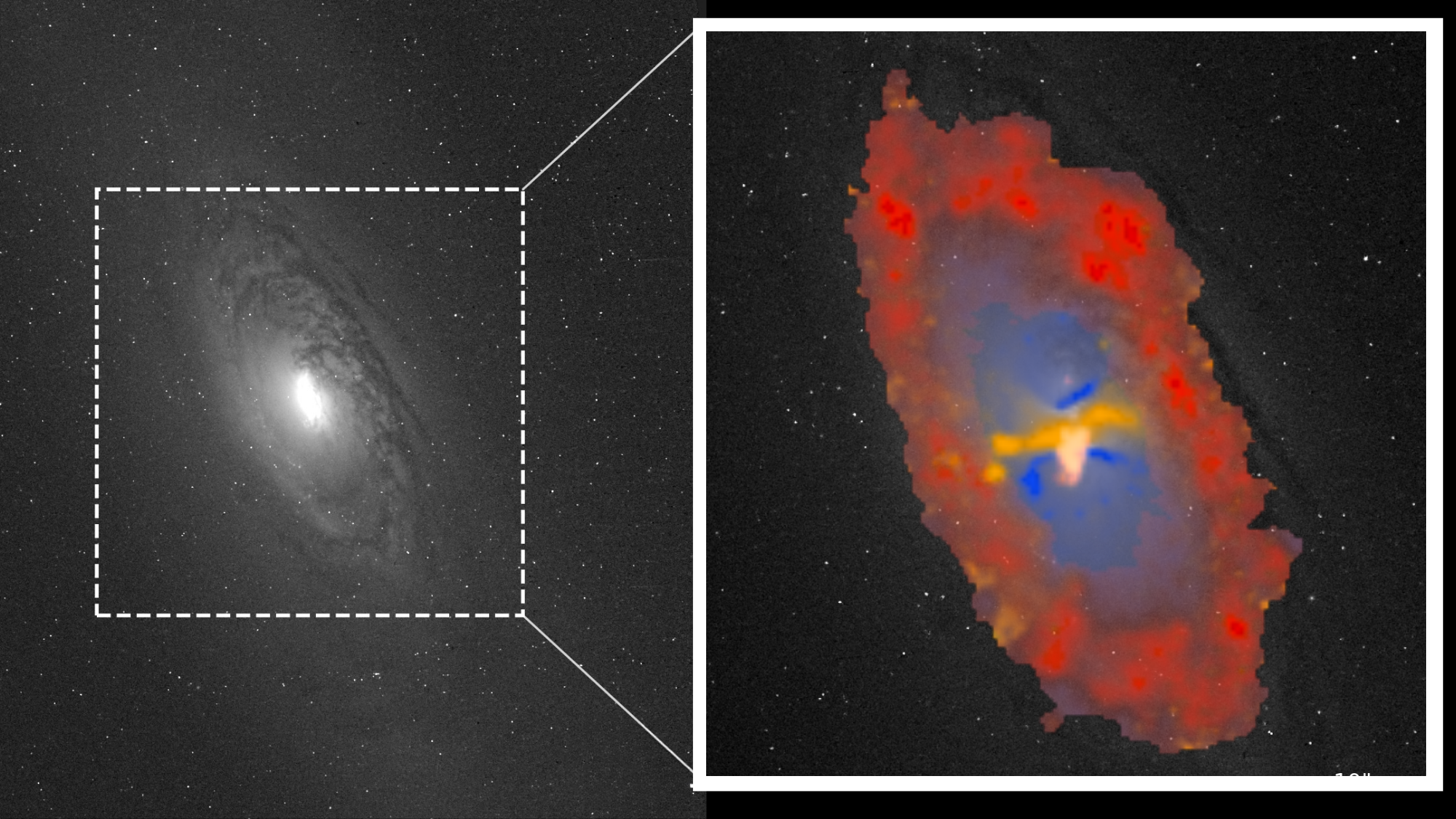
Astronomers studying nine local galaxies have discovered that shock waves from active supermassive black holes consistently travel perpendicular to plasma jets and radiation cones, actively promoting star formation in rings and arcs between 2,600 and 20,000 light-years from their galactic centers.
For decades, astronomers worked under the assumption that supermassive black holes acted primarily as galactic dampeners. As these dense central engines devour gas and dust, they unleash intense radiation, high-temperature plasma, and fast-moving winds that heat surrounding matter, an activity known as active galactic nucleus feedback. Conventional theory held that this intense heating should suppress star formation by boiling away the cold, dense gas reservoirs required to build new stars. But new observational data collected by researchers using powerful ground-based and spaceborne instruments are turning that long-standing hypothesis on its head.
Mapping the Dynamic Galactic Neighborhood with the Very Large Telescope
To understand what happens in the turbulent cores of nearby galaxies, a research team focused on nine local systems studied by the team using high-resolution tools. The scientists utilized the Very Large Telescope and its Multi Unit Spectroscopic Explorer instrument, alongside the Chandra X-Ray Observatory orbiting Earth, to analyze active galactic nuclei where supermassive black holes actively accrete matter. They also drew on optical data from the Dark Energy Spectroscopic Instrument survey and radio measurements from the LOFAR Two-meter Sky Survey to evaluate hydrogen gas signatures across hundreds of active galaxies.
This multi-instrument approach allowed researchers to perform a three-dimensional analysis separating three distinct phenomena: radiation flowing from the active core, the excitation of the interstellar medium by shock waves, and subsequent star formation. Rather than finding a barren wasteland around these feeding black holes, the team discovered organized rings and arcs of stellar birth sitting between 2,600 and 20,000 light-years out from the galactic hubs.
Perpendicular Shocks and Biconical Radiation Jets
The geometric arrangement of these galactic outflows offers a window into how black holes shape their host systems. Meanwhile, fast-moving shock waves ripple through the central regions and travel strictly perpendicular to those radiation cones.
“The most interesting phenomenon about shocks is that they always go perpendicular to where the black hole’s injected outflows go. It is very common, and we see it consistently appearing across the whole nine galaxies.”
Peixin Zhu, Center for Astrophysics
This structured behavior is consistent with theoretical models linking black hole jets to the surrounding interstellar medium. In galaxies hosting less powerful jets, winds from the black holes also contribute to generating these vital shocks.
Reaching Beyond Visible Boundaries into the Circumgalactic Medium
The influence of these central black holes extends far beyond the visible boundaries of their host galaxies. Every large galaxy is wrapped in an enormous envelope of gas called the circumgalactic medium, which stretches 10 to 20 times the size of the visible galaxy and serves as the primary reservoir of raw material for future stars.

A study led by Sanchayeeta Borthakur of Arizona State University and Namrata Roy, now at the Raman Research Institute, investigated how narrow jets of heated plasma affect this vast outer reservoir. By combining measurements along jet axes, the researchers searched for a telltale sign of ionized hydrogen gas known as H-alpha emission.
“This is a pathbreaking result that solves the long-standing mystery of how black holes influence galaxies, their stars, and life as we know it!”
Sanchayeeta Borthakur, Associate Professor in Arizona State University’s School of Earth and Space Exploration
When averaged across all directions, the surrounding gas signal appeared weak. However, directly along the path of the radio jets, the H-alpha signal surged in strength.
Redefining Galactic Evolution Across the Cosmos
The findings published on September 14 in the Astrophysical Journal and Astrophysical Journal Letters demonstrate that actively feeding black holes engage in a complex cycle of accretion and outflow that actively reshapes their surroundings rather than simply starving them of fuel. Lisa Kewley of the Center for Astrophysics noted that the work helps astronomers understand a complex feedback cycle that plays a foundational role in galaxy evolution.
/https://tf-cmsv2-smithsonianmag-media.s3.amazonaws.com/filer_public/2a/63/2a634bde-0304-44d9-ad92-ab859be2d9b5/ngc_1386_legacy_dr10.jpg "Photo: Smithsonian Magazine")
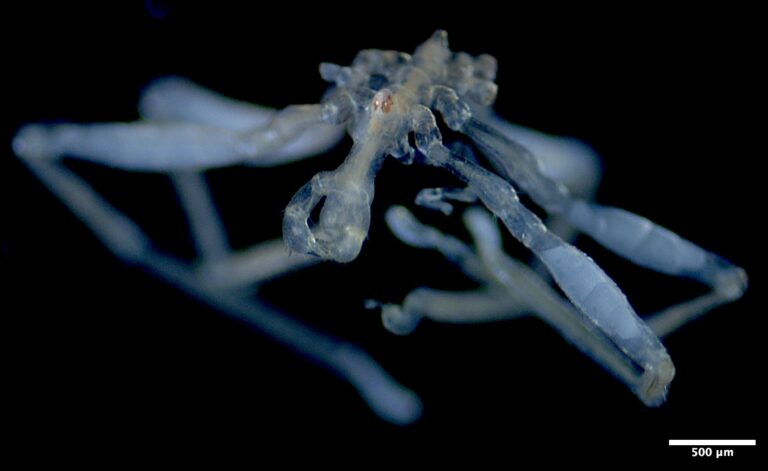
UBC Researchers Discover Two New Sea Spider Species in the Salish Sea
Researchers at the University of British Columbia have discovered two new species of sea spiders, Callipallene pilosuspedes and...
Climate Impact Lab Projects 450,000 Heat Deaths From Super El Niño
A newly released Climate Impact Lab report projects that more than 450,000 people worldwide could die from excessive...

Harvest Moon Rises September 26 to Mark the 2026 Autumn Equinox
Skywatchers are preparing to view the full moon this weekend as the Harvest Moon rises on September 26,...

Prime Video Casts Six New Actors in Historical Drama The Challenger
Prime Video has expanded the cast of its historical drama series The Challenger with six new recurring actors,...