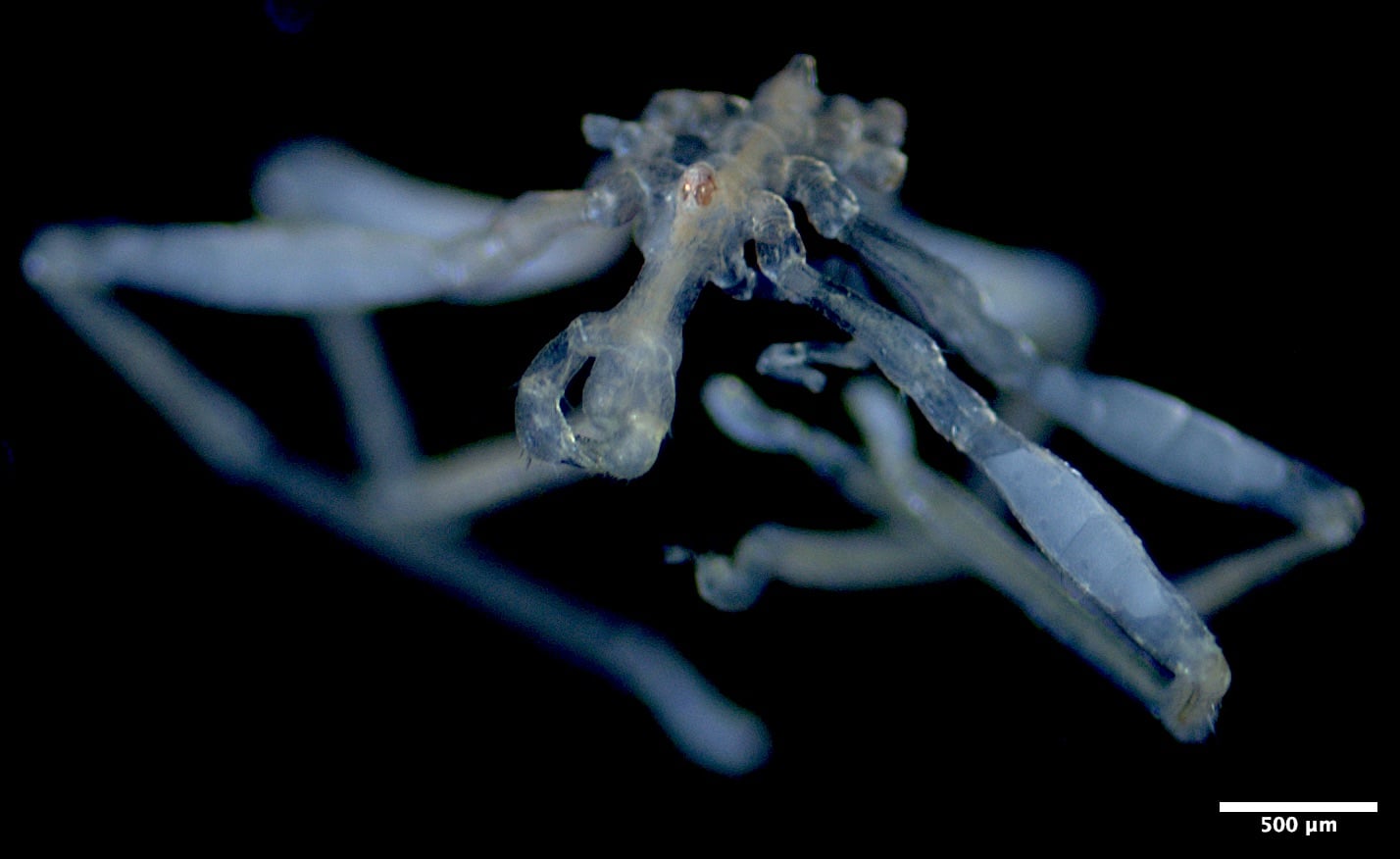
Researchers at the University of British Columbia have discovered two new species of sea spiders, Callipallene pilosuspedes and Tanystylum kiixin, in the Salish Sea. Collected between September 2023 and August 2024 during dives off Quadra Island, Vancouver, Bamfield, and Victoria, these marine arthropods mark the first new sea spider species documented in the region in nearly a century.
Uncovering the Salish Sea’s Hidden Invertebrates
To address this knowledge gap, zoology master’s student Cormac Toler-Scott and a research team at the University of British Columbia conducted shallow water dives up to 18 metres deep across multiple coastal habitats between September 2023 and August 2024.
Working around Quadra Island, Vancouver, Bamfield, and Victoria, the team gathered as many distinct specimens as possible. They analyzed fine-scale body morphology under a microscope and sequenced DNA data, comparing that genetic data with data from other species to confirm discoveries. The resulting documentation represents the first comprehensive study of sea spiders in the Salish Sea using both detailed imaging and genetic sequencing.
Anatomy and Behavior of Callipallene pilosuspedes
The first newly identified species, Callipallene pilosuspedes, earned its name from the Latin-derived descriptor for hairy feet, owing to the fine spines covering its lower legs. Found in only a single specimen during the fieldwork, this invertebrate features red eyes, claws on a short proboscis to grasp food, and a triangular, three-lipped mouth covered in sensory tendrils.

Unlike many shallow-water relatives, this species possesses highly dexterous appendages near its head called ovigers. Under magnification, researchers watched the animal wrap these ovigers around its legs, using comb-like spines to groom itself. The species was discovered living on a hydroid—an organism described as being like a jellyfish that is attached to the ground
—upon which it walks and feeds.
“They never really leave it, they just walk around on it, … They feed on it by eating little pieces of it with their proboscis. So you could consider them a parasite of that larger organism.”
Cormac Toler-Scott, lead author and zoology researcher at UBC, via CBC
Ecosystems Within Ecosystems: Tanystylum kiixin
The second new species, Tanystylum kiixin, takes its name from an ancient Indigenous village site near the collection location. The word is pronounced ‘kee-hin’ and comes from the sound of waves crashing at the base of the village site. In contrast to its hairy-legged counterpart, this organism features much smaller and less dexterous egg-carrying limbs, leaving it unable to groom itself effectively.

Because the creature cannot clean away surrounding sediment, researchers frequently found it coated in dirt, debris, and tiny parasites of its own. This layering led investigators to characterize the specimen as an ecosystem within an ecosystem within an ecosystem.
Evolutionary Context and Future Research
Sea spiders are marine arthropods that evolved around 500 million years ago, predating terrestrial scorpions, horseshoe crabs, and land spiders. Because they are strictly marine and possess a very reduced central body, their internal organs—including ovaries in females—are distributed throughout their jointed legs. During reproduction, females produce eggs that emerge from dedicated pores in their limbs, which males then collect using ovigers, dab them in a leg-secreted glue, and stick them to their own bodies for rearing.
With these additions, researchers have documented 20 total sea spider species in the Salish Sea and Vancouver Island area, a tiny fraction of the roughly 1,400 species known globally. Toler-Scott is next turning his focus to describing the life stages and specific behaviors of Tanystylum kiixin, with the broader goal of understanding how climate change and human disturbance impact marine invertebrates along the West Coast.
Related reading
Climate Impact Lab Projects 450,000 Heat Deaths From Super El Niño
A newly released Climate Impact Lab report projects that more than 450,000 people worldwide could die from excessive...
Harvest Moon Rises September 26 to Mark the 2026 Autumn Equinox
Skywatchers are preparing to view the full moon this weekend as the Harvest Moon rises on September 26,...

Prime Video Casts Six New Actors in Historical Drama The Challenger
Prime Video has expanded the cast of its historical drama series The Challenger with six new recurring actors,...
Empa and Beyond Gravity Develop Phononic Crystal System to Protect Satellites
Researchers at Empa and space company Beyond Gravity have developed a novel payload adapter system for rockets that...