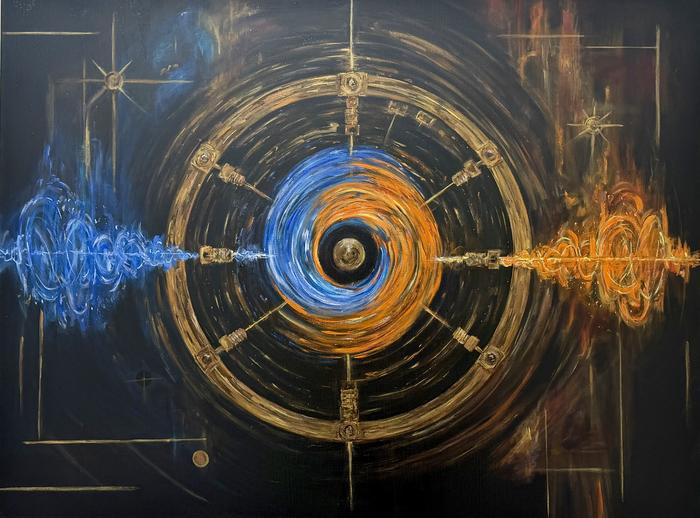
Researchers at the Advanced Science Research Center at the CUNY Graduate Center have successfully simulated black hole physics in a laboratory, demonstrating that synthetic, time-modulated rotation can amplify electromagnetic waves. Published July 8, 2026, in the journal Nature, the experiment provides a practical method for wave amplification that was previously considered theoretically impossible to test.
Recreating the Penrose-Zel’dovich Effect in the Laboratory
For over 50 years, the physics of energy extraction from rotating black holes remained confined to theoretical math. Physicist Sir Roger Penrose originally theorized that particles entering a black hole’s “ergosphere”—a region where space is dragged by the object’s extreme rotation—could split, with one half escaping with more energy than it started with. This concept, known as the Penrose process, suggests that the rotational energy of a black hole could, in principle, be harnessed. Later, in the early 1970s, physicist Yakov Zel’dovich expanded on this, predicting that electromagnetic waves interacting with a fast-rotating object would extract energy from that rotation and undergo amplification, a phenomenon termed super-radiance.

Testing these theories in a real-world environment presented a structural paradox: no physical material could be spun at the necessary speeds to mimic a black hole’s rotation without disintegrating under extreme centrifugal force. According to researchers at the CUNY ASRC, the team bypassed this limit by engineering a stationary radio-frequency device that uses time-varying metamaterials to mimic ultrafast rotation. By manipulating the material’s properties over time rather than moving the material itself, the team created a synthetic environment that replicates the gravitational drag of a black hole.
“Our approach facilitates a new method of wave–matter interaction in which waves with selected rotational properties extract energy from synthetic time-engineered rotation, producing a form of broadband selective amplification,” said Andrea Alù, the lead principal investigator and director of the CUNY ASRC’s Photonics Initiative, as reported by Mirage News. This mechanism allows researchers to observe wave behaviors that are typically buried in the immense gravitational fields of deep space.
Engineering Synthetic Ultrafast Rotation
To simulate the extreme conditions of a rotating black hole, the team built a ring-shaped network of electronic resonators. By rapidly modulating the electromagnetic properties of these resonators in a precise, cascading sequence, the researchers created a traveling wave pattern that circulates around the ring. This process requires sophisticated timing and control systems to ensure the modulation happens at the exact frequency required to simulate rotation.
Although the hardware remains stationary, the shifting electronic pattern forces incoming electromagnetic waves to interact with the system as if it were rotating at superluminal speeds. This setup allows for the observation of rotational super-radiance in a controlled environment. The experiment effectively demonstrates that the laws of physics governing the boundaries of black holes can be mapped onto laboratory-scale electronic circuits.
“Waves with the appropriate rotational characteristics extracted energy from the system and became amplified, reproducing the essential physics of the Penrose–Zel’dovich process,” explained co-lead author Hady Moussa in coverage provided by Mirage News. The ability to control this amplification in a laboratory setting allows for a level of precision that astronomical observation cannot currently match, providing a foundation for testing related hypotheses in wave physics.
Practical Applications for Photonics and Communications
The success of this experiment moves extreme astrophysical dynamics from theoretical models to practical laboratory platforms. By demonstrating that stationary, time-modulated metamaterials can boost specific wave signals, the researchers have identified a new tool for signal processing. This transition from theoretical astrophysics to applied engineering marks a significant milestone in metamaterial research.

As reported by bioengineer.org, the team intends to scale these concepts from current radio frequencies toward photonic and quantum regimes. The implications for technology are broad, as the ability to amplify waves using synthetic rotation could lead to more efficient energy transfer and signal manipulation in compact devices.
- Wireless Communications: Enhanced methods for boosting and manipulating wireless signals, potentially increasing the efficiency of data transmission.
- Quantum Optics: New techniques for processing information within quantum systems, where wave control is essential for maintaining coherence.
- Photonic Chips: The design of next-generation hardware capable of sophisticated light manipulation, which is critical for the future of optical computing.
“This successful experiment moves ideas about extreme rotational dynamics from theory to practice and creates a versatile experimental platform for exploring a broad range of phenomena at the intersection of astrophysics, wave physics, and quantum science,” said lead author Hadiseh Nasari, a post-doctoral researcher at the CUNY ASRC, according to Mirage News.
The research was supported by the U.S. Department of Defense, the U.S. National Science Foundation, and the Simons Foundation. These organizations provide funding for high-risk, high-reward projects that explore fundamental physics with potential long-term technological applications. As the team looks toward future applications, the primary challenge remains adapting these synthetic rotational
Find more reporting in our News section.
Worth a look

Quntis Monitor Light Bar Glow Features RGB LEDs and Ultrawide Support
The Quntis Monitor Light Bar Glow introduces a 20.1-inch metallic gray lighting system featuring an 88-front LED task...

Police Hunt Roommate After Waitress Jovia Namuwulya Murdered in Bukoto
Police in Kampala are investigating the murder of 22-year-old waitress and TikTok content creator Jovia Namuwulya, whose body...

US and Botswana Forces Enhance Planning During Exercise Southern Accord 2026
Exercise Southern Accord 2026 concluded on August 15 at Gaborone Technical College in Botswana, uniting military personnel from...

China Recalls Millions of Teslas Over Flush Door Handles
Minimalist electronic door latches and flush exterior handles have defined the modern electric vehicle aesthetic since Tesla popularized...