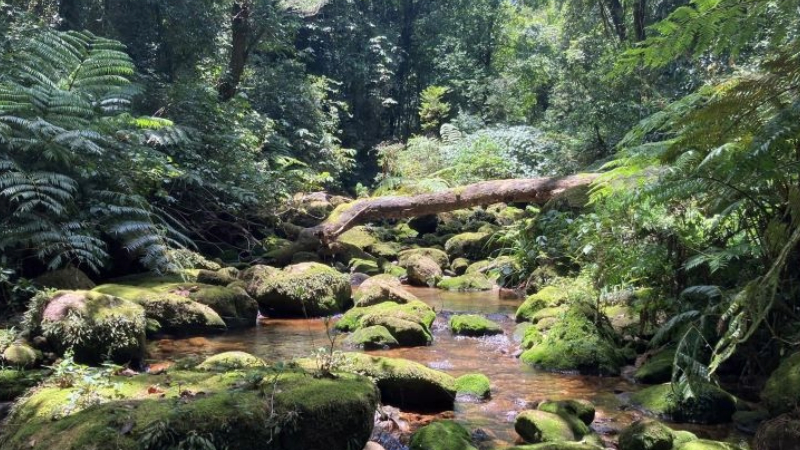
Mozambique formally protected the 9,341-hectare Mount Mabu area in the Lugela district on August 24, granting land stewardship to local communities. The decree follows two decades of biological surveys led by ecologist Julian Bayliss that revealed southern Africa’s largest medium-altitude forest block and hundreds of endemic species.
The mountainous landscape of northern Mozambique has officially transitioned from a remote scientific discovery into a legally recognized sanctuary. Following a decree published on August 24 by the Ministry of Agriculture, Environment and Fisheries, the region now holds formal designation as the Mount Mabu Community Conservation Area, spanning 9,341 hectares (23,082 acres) in the Lugela district.
Instead of placing the fragile habitat under distant state control, the decree grants stewardship of the land directly to the local communities. These residents have kept the forest standing across generations, treating the towering canopies and steep valleys with sacred reverence.
Two Decades of Biodiversity Surveys on Mount Mabu
The formal protection marks a watershed moment after more than twenty years of painstaking field research. Ecologist Julian Bayliss first identified the forest on Google Earth in 2005, subsequently leading numerous scientific expeditions that revealed the site as home to more than 200 species of butterflies.
Every year between October and November, hundreds of those butterflies congregate on the 1,700-meter (5,577-foot) summit to mate in a biological phenomenon known as hilltopping. Naturalist David Attenborough documented this seasonal gathering in 2013, cementing the mountain’s renown by giving it the nickname butterfly forest
.
Beyond its famous lepidoptera, Mount Mabu has yielded more than 30 newly discovered species since 2005, including frogs, chameleons, bats, and insects. Bayliss famously discovered a new-to-science cobalt-blue butterfly, Iolaus mabuensis, during a 2008 expedition, and separately encountered the Mount Mabu forest viper (Atheris mabuensis) in 2009 after accidentally stepping on one beneath a thick pile of leaf litter.
“It’s a great relief,” Julian Bayliss, an ecologist who led several surveys over 20 years that helped build the case for protecting Mount Mabu, told Mongabay by phone. “These forests are very important because they’ve got high levels of endemism.”
The Ecological Significance of the South East Africa Montane Archipelago
The preservation of Mount Mabu is part of a much broader scientific revelation across southern Africa. The research underpinning the new conservation area involves roughly 100 specialists worldwide and ties into a landmark study published in the Nature journal, Scientific Reports. The findings have prompted scientists to formally propose a brand-new ecoregion: the South East Africa Montane Archipelago (SEAMA).

This newly defined ecoregion stretches from northern Mozambique up to Mount Mulanje in Malawi, encompassing small, isolated pockets of rainforest, montane grasslands, and shrublands formed hundreds of millions of years ago. Mount Mabu itself hosts the largest continuous block of medium-altitude forest remaining in southern Africa. According to the collaborative study, the archipelago’s isolated microclimates harbor 127 plant species and 90 animal species found nowhere else on Earth.

Despite their immense scientific value, these isolated ecosystems face severe environmental pressures. Researchers note that since surveys began two decades ago, the region has lost a fifth of its rainforest cover, with losses reaching nearly half in certain areas due to slash-and-burn agriculture, timber logging, and demands for fuel.
“The ecoregion is fragmented across small isolated pockets of rainforest, montane grasslands and shrublands, each with their own unique, but distantly related, plants and animals. There is so much more to discover, but many of these species may go extinct before we can record them.”
Community Stewardship and What Lies Ahead
The newly established community conservation area is legally dedicated to the protection, conservation, and sustainable exploitation of natural resources. Conservation leaders emphasize that the decree is fundamentally an acknowledgement of local resilience.
While the decree provides a vital legal framework, exact restrictions on daily land use remain under development. A comprehensive community management plan that will define specific activity rules has not yet been finalized, leaving local stakeholders and conservation groups to navigate the balance between human livelihoods and the preservation of Africa’s newest protected wilderness.
Keep reading

Rocket Lab Protests NASA’s $700 Million Mars Contract Award to Blue Origin
Rocket Lab filed a formal protest with the Government Accountability Office on September 11, 2026, challenging NASA’s decision...
Researchers Identify Denisovan Remains and Tools in China’s Bianfu Cave
Researchers analyzing bones and stone tools from Bianfu Cave in China’s Yunnan Province have identified seven Denisovan remains...

Webb Telescope Finds Chariklo’s Rings Are Changing Over Years
Astronomers using the James Webb Space Telescope (JWST) have discovered that the two narrow rings surrounding the distant...

SpaceX Launches Final Three O3b mPOWER Satellites for SES
SpaceX successfully launched the final three O3b mPOWER satellites for SES on September 13, 2026, from Cape Canaveral...