Researchers analyzing bones and stone tools from Bianfu Cave in China’s Yunnan Province have identified seven Denisovan remains dating back up to 167,000 years. Published September 9 in the journal Nature, the discovery provides anatomical and technological insights into the extinct human relatives.
Excavation and Protein Identification at Bianfu Cave
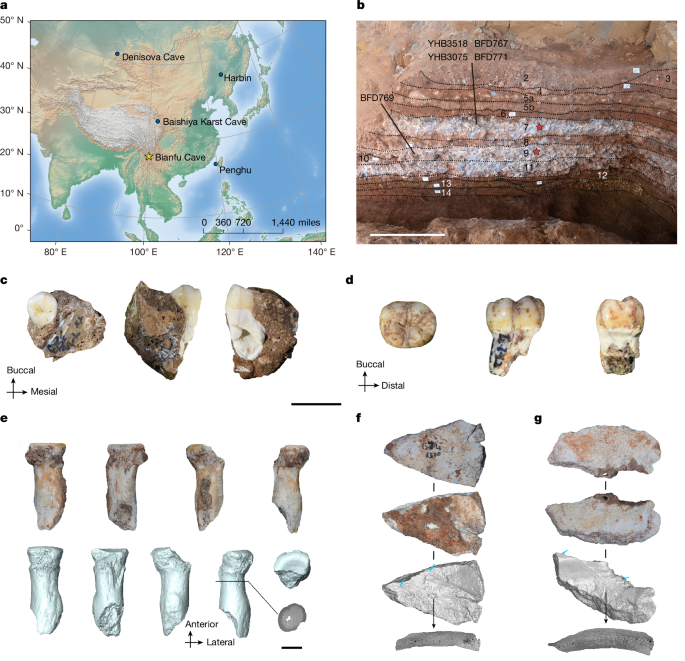
Bianfu Cave (26° 27′ 43.65′′ N, 100° 09′ 55.45′′ E) is located in Heqing County, western Yunnan Province in southwestern China, approximately 2 km south of the Yinhe River, a secondary tributary of the Yangtze River. In 2019, the Yunnan Institute of Cultural Relics and Archaeology and other cooperative institutes conducted excavations on this site. The stratigraphy comprises Holocene deposit, artefact-bearing cultural deposit and underlying cave-fissure deposit. The cultural deposit is further divided into upper (layers 3–6) and lower (layers 7–12) cultural layers. A Bayesian age model combining optically stimulated luminescence and U-series dates yielded a time range spanning approximately 190 ka to 70 ka, making it the earliest Palaeolithic site discovered in western Yunnan.
All cultural layers yielded lithic artefacts, totalling 1,366 stone artefacts, including both core and flake tools. More than 64,000 mammal fossils were recovered from the cultural layers, among which more than 60,000 were fragmentary bones. On the basis of the limited number of morphologically identifiable mammal fossils, more than 100 individuals of deer and bovids were discovered, together with small numbers of rhinoceros, hyenas and other animals. Four hominin teeth were unearthed in the middle of layer 7 (between 148–139 ka and 142–134 ka), suggesting a high likelihood of finding more hominin fossils in this site. The four hominin teeth included a lower left lateral incisor (I2), a lower left fourth premolar (P4) and two lower right second molars (M2). Morphological analysis showed that the lower M2 teeth exhibited close morphological affinity with those of Xiahe and Laos Denisovans, as well as the East Asian late Middle Pleistocene archaic Homo from Hualongdong. Two of these teeth, a lower fourth premolar (YHB3518) and a lower second molar (YHB3075), were selected for proteomic analysis to further confirm their taxonomic attribution. An acid etch approach was used for analysis of the enamel, whereas dentine powder was drilled for protein extraction, resulting in one enamel fraction and three dentine fractions for liquid chromatography coupled with tandem mass spectrometry (LC–MS/MS) analysis. After manual inspection and traditional morphological measurement of more than 60,000 bone fragments on the basis of bone size, cortical thickness, articular surface morphology, muscle attachment marks on long bone surfaces, vascular impressions on cranial internal surfaces and so on, 22 fragments were considered as potential hominin remains, five from the upper layers and 17 from the lower layers.
Sifting through more than 60,000 bone fragments proved challenging according to Hao Li, an archaeologist at the Chinese Academy of Sciences’ Institute of Tibetan Plateau Research. We first identified some isolated teeth and then from the huge amount of animal fossils, we identified the bones—but the fragments were very hard to find at the beginning,
Hao Li told CNN’s Katie Hunt. Scientists sorted the pieces by shape before applying protein-analysis techniques. The researchers identified a protein signature belonging to Denisovans in seven of the excavated bone fragments.
Anatomical Significance of the Denisovan Remains
In 2010, researchers who had extracted DNA from an ancient finger bone revealed that it belonged to a previously unknown human relative. The fossil, recovered from Denisova Cave in Siberia, came from a member of a group nicknamed Denisovans, now formally called Homo longi. But these cousins of ours, who lived in Asia between 400,000 and 30,000 years ago, have remained mysterious in the years since. Relatively few of their fossils have been found, and never a near-complete skeleton. On the other hand, scientists have uncovered thousands of remains that belonged to our Neanderthal relatives. Denisovans were first identified from DNA analysis of a single finger bone unearthed in Denisova Cave in Siberia in 2008. Since then, a handful of bones and teeth attributed to the mysterious human have been found on the Tibetan Plateau in China, Laos and Taiwan and a skull in north-east China.
/https://tf-cmsv2-smithsonianmag-media.s3.amazonaws.com/filer_public/3a/70/3a7012b6-f877-41a0-a0ee-fc2251c68db7/smithsonian_feature_images_17.png "Photo: Smithsonian Magazine")
The new batch of fossils was unearthed from Bianfu Cave, in the Chinese province of Yunnan, in 2019. Getting an idea that [Denisovans] were not just isolated hominins living up in Siberia … is very exciting,
Mike Morley, an archaeologist at Flinders University not involved with the latest discovery, told reporters. The Bianfu Cave assemblage includes part of a radius, a forearm bone, from a Denisovan, the first ever identified. Two new studies describe seven Denisovan remains and more than 1,300 stone and bone tools. Dating of sediment layers indicated the fossils were between 134,000 and 167,000 years old, while the cave appeared to have been used from 190,000 until 70,000 years ago.
Both papers are very welcome because they provide important new information on Denisovans—not only regarding new fossils and evolutionary anatomy, but also their use and production of stone tools and their hunting practices,
Antonio Rosas, a paleoanthropologist at the National Museum of Natural Sciences in Spain who was not involved in the new research, told Gizmodo’s Gayoung Lee.
Tools, Diet, and Environmental Adaptation
The proximity of stone tools, animal bones, and environmental indicators allows researchers to examine multiple facets of Denisovan existence simultaneously. Bo Li, an archaeologist at the University of Wollongong and co-author on one of the papers, emphasized the value of this context. The fossils are directly associated with stone tools, bone tools, animal remains and environmental evidence, allowing us to study Denisovan biology, technology, diet and adaptation together,
Professor Li said.
Mike Morley said objects found around the fossils could tell us about the Denisovans’ lifestyles. This is something we've never had a good idea on,
he said.
Future Prospects Following Site Damage
The cave had to be urgently excavated because nearby engineering work was causing the mountain it was in to collapse. The cave has since been severely damaged by quarrying activity, rendering the entrance inaccessible and collapsing parts of the site. The researchers extracted some 60,000 bone fragments and thousands of stone artefacts before the entrance was destroyed and the site rendered inaccessible. Luckily the fossils and cultural materials were saved and now preserved,
Professor Li said.
Keep reading

Webb Telescope Finds Chariklo’s Rings Are Changing Over Years
Astronomers using the James Webb Space Telescope (JWST) have discovered that the two narrow rings surrounding the distant...

SpaceX Launches Final Three O3b mPOWER Satellites for SES
SpaceX successfully launched the final three O3b mPOWER satellites for SES on September 13, 2026, from Cape Canaveral...

Japan Launches Kaguya Spacecraft to Map Moon in 2007
On September 13, 2007, Japan launched its advanced Kaguya spacecraft from the Tanegashima Space Centre aboard an H-IIA...

Astronomers Identify Eos, a Massive Molecular-Hydrogen Cloud Near the Sun
Astronomers have identified Eos, a massive molecular-hydrogen cloud located roughly 300 light-years away and spanning 40 full-Moon widths...