
Unearthed in Montana’s Hell Creek Formation, a fossilized dinosaur dropping preserved an exquisite feather belonging to a prehistoric diving bird. Published in Current Biology, researchers report that this unexpected specimen from 2016 provides vital clues regarding why certain birds survived the end-Cretaceous asteroid impact while others vanished.
About 66 million years ago, a large predatory dinosaur—likely a Tyrannosaurus rex or a closely related cousin—consumed a small waterbird just before an asteroid strike triggered global devastation. While the collision wiped out nearly all dinosaurs and many primitive avian lineages, a single branch of modern birds known as Neornithes managed to survive, eventually giving rise to every bird flying today. For years, paleontologists debated what protected this lineage from the prolonged impact winter that followed. Now, a tiny, three-dimensional feather trapped inside a fossilized piece of feces, known as a coprolite, offers a compelling anatomical explanation.
An Accidental Discovery in the Hell Creek Formation
The remarkable fossil came to light during 2016 fieldwork in northeastern Montana. David DeMar Jr., a research scientist and Hell Creek Project collections manager at the University of Washington Burke Museum, was conducting fieldwork and crawling up a rocky outcrop collecting fish fossils when he spotted an unremarkable, dark reddish-brown nodule roughly half the size of a golf ball.
Before this discovery, verified feathers had not been recovered within the Hell Creek Formation despite more than a century and a half of intensive prospecting. Nate Carroll, a paleontologist at the Carter County Museum and co-author of the research, noted that processing the digital X-rays revealed an extraordinary interior. Thousands of digitally stacked scans exposed a hidden ecosystem in stunning three dimensions, including multiple feathers, tiny diamond-shaped scales from a gar fish, and intact leg bones belonging to a primitive bird.
Anatomy of a Prehistoric Diving Bird
Based on the accompanying leg bones and feather morphology inside the coprolite, the researchers identified the digested prey as a hesperornithiform. These creatures were aquatic birds ecologically comparable to modern loons. Most were flightless, relying on specialized feet to dive beneath the surface for fish.
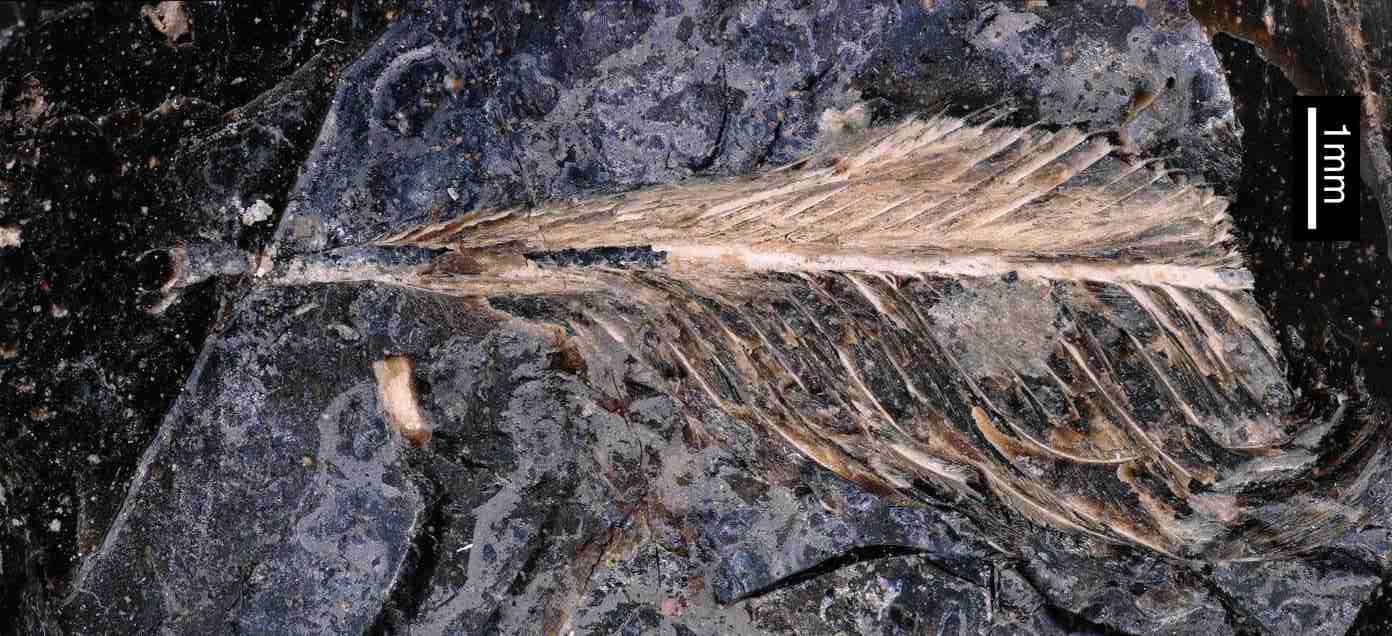
While hesperornithiforms are close evolutionary cousins to the surviving Neornithes lineage, they belonged to a separate branch entirely and did not make it past the Cretaceous period. Lead study author Jingmai O’Connor, associate curator of fossil reptiles at the Field Museum in Chicago, emphasized the exceptional preservation quality of the find.
How Feather Structure Dictated Survival During the Impact Winter
The asteroid collision that ended the Mesozoic era launched billions of tons of dust, sulfur, and other debris into the atmosphere. This dense airborne cloud obscured solar radiation, halting plant photosynthesis for nearly two years and causing global temperatures to plummet drastically. While hesperornithiforms and other Cretaceous birds thrived during the warm greenhouse climate of the Mesozoic, the sudden environmental shift created a severe thermal crisis.
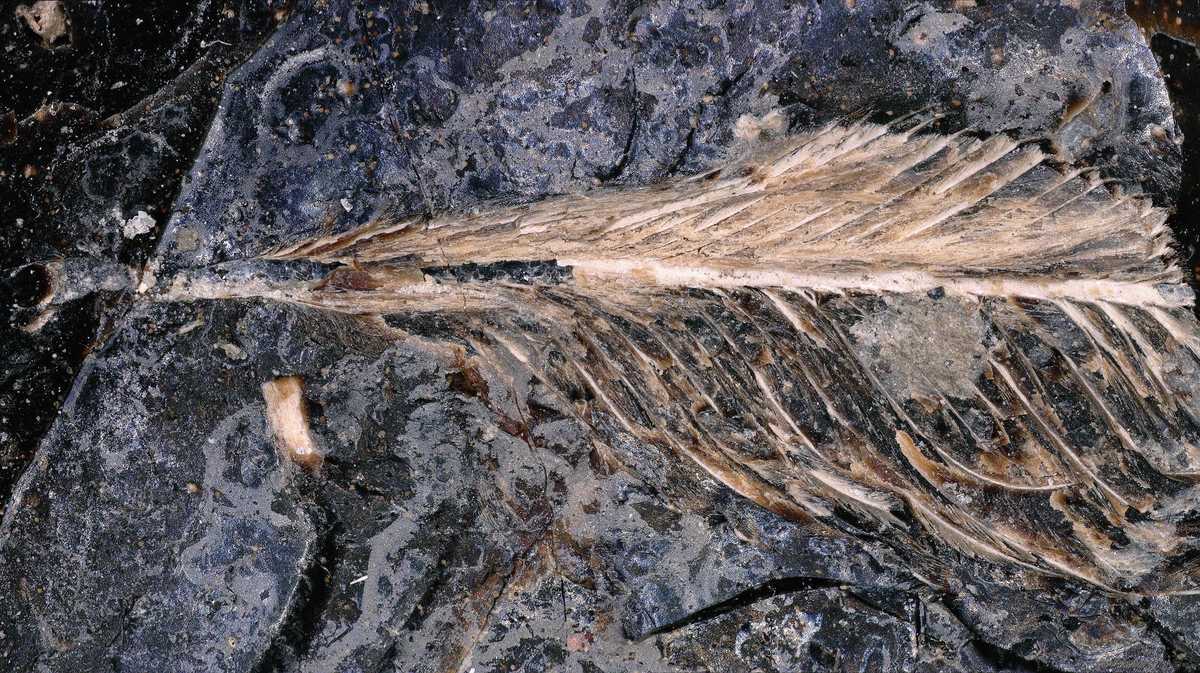
Micro-CT analysis revealed that the fossilized plumage displayed a mix of traits. Some feathers exhibited modern structural advancements, featuring a central shaft with a square cross-section designed to provide lightweight strength. However, other body feathers were shorter, fuzzier, and structurally more primitive. O’Connor explained that these primitive plumages lacked the superior insulating efficiency found in modern body plumage, creating a fatal energy deficit under freezing conditions.
With global temperatures dropping and food webs collapsing, birds required significantly more energy to maintain core body temperatures while finding drastically less food to fuel themselves. Species equipped with advanced, highly efficient insulation possessed a vital biological advantage.
Unresolved Questions in Avian Paleontology
While previous scientific hypotheses suggested that modern bird ancestors survived simply because they lived near aquatic habitats, this discovery complicates that assumption. Hesperornithiforms also inhabited aquatic environments alongside water sources, yet they still vanished completely following the catastrophe.
To definitively prove whether differences in feather insulation formed the primary dividing line between survival and extinction, researchers state that further fossil evidence is necessary.
International Observe the Moon Night 2026 Returns on September 19
International Observe the Moon Night returns on Saturday, September 19, 2026, bringing together astronomy enthusiasts, local communities, and...

Venus May Have Destroyed and Swallowed Its Own Moon, Study Suggests
Venus may have once possessed a natural satellite capable of surviving for up to 1.7 billion years before...

Rocket Lab Protests NASA’s $700 Million Mars Contract Award to Blue Origin
Rocket Lab filed a formal protest with the Government Accountability Office on September 11, 2026, challenging NASA’s decision...

Mozambique Formally Protects Mount Mabu as Community Conservation Area
Mozambique formally protected the 9,341-hectare Mount Mabu area in the Lugela district on August 24, granting land stewardship...