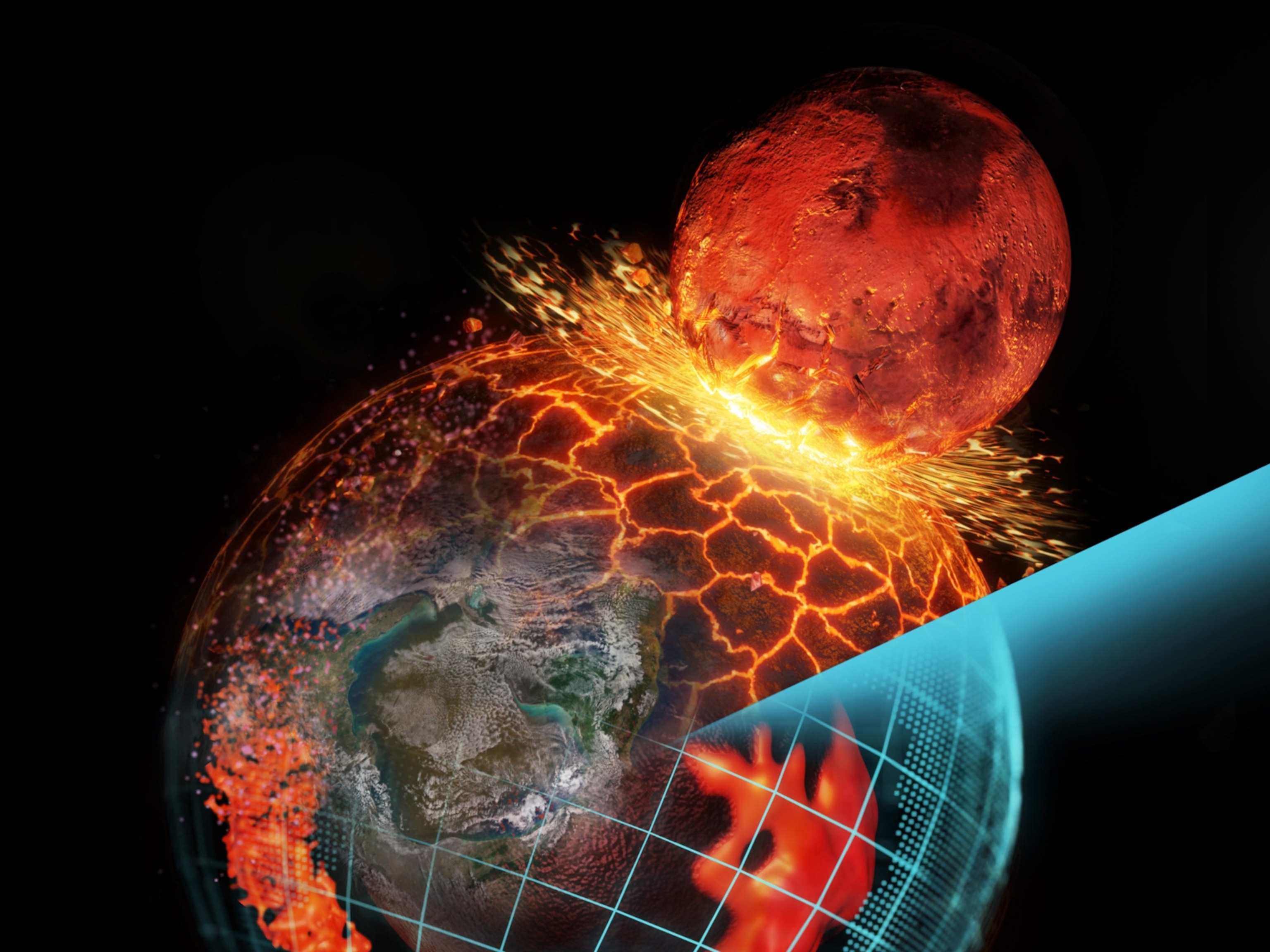
Venus may have once possessed a natural satellite capable of surviving for up to 1.7 billion years before its slow inward migration pushed it past the Roche limit. Researchers modeling gravitational tides between the planet and a hypothetical moon report that the satellite would have ultimately been torn apart and consumed by Venus.
Venus shares nearly the same mass, size, and compositional ingredients as Earth, leading to its frequent description as our planetary twin. Yet the two worlds took starkly divergent evolutionary paths. While Earth enjoys a stable climate nurtured by a large natural satellite, Venus stands as one of two planets in our solar system completely devoid of an orbiting moon. Mercury shares a similar moonless status, though its proximity to the Sun and diminutive size preclude holding onto a satellite.
For Venus, the absence of a companion has puzzled scientists for decades. A paper published in The Astrophysical Journal and explored on the preprint platform arXiv offers a compelling physical explanation. Rather than escaping a cataclysmic impact unscathed, Venus likely formed a moon that was ultimately doomed by orbital mechanics.
Modeling the Gravitational Tug-of-War Over Billions of Years
To understand what might have occurred, researchers built a specialized computer simulation tracking the slow gravitational tides between Venus, the Sun, and a hypothetical moon over billions of years. Led by Stephen Kane, a planetary astrophysicist at the University of California, Riverside, the team systematically varied initial planetary spin rates, orbital eccentricities, internal properties, and potential satellite masses.
The simulations revealed that a moon roughly half the mass of Earth’s satellite could have survived in orbit around Venus for 1.7 billion years. If researchers plugged in a moon twice as massive as our own, the stronger tidal effects would have caused the orbit to decay much faster, allowing the satellite to persist for only 30 million years. Under most plausible scenarios tested by the team, the outcome remained identical: the moon migrated outward initially, but eventually reversed course, spiraled inward, and met a violent end.
The Roche Limit and the Demise of a Venusian Moon
The physical barrier sealing the moon’s fate is known as the Roche limit. This boundary marks the precise distance from a planet where its tidal gravitational forces exceed the internal gravity holding a smaller orbiting body together. Inside that threshold, the primary body tears the satellite apart.
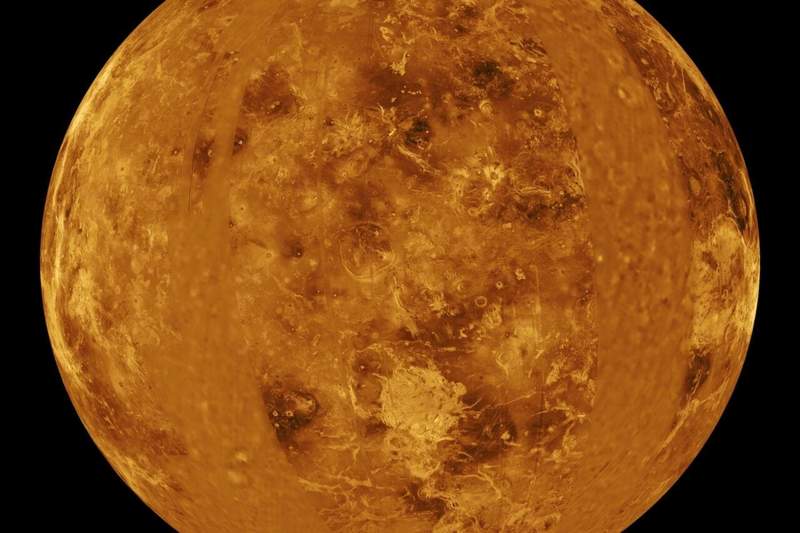
For Venus, researchers calculate the Roche limit at approximately 2.85 Venus radii, or roughly 17,000 kilometers from the planet’s center. Any moon driven inward past that boundary is literally pulled apart, leaving behind a debris ring that eventually rains down onto the atmosphere. The remaining debris would have been swallowed up by the planet.
This dynamic mirrors the physics responsible for Saturn’s rings. Yet unlike Earth—where our Moon migrates outward by a few centimeters each year due to favorable early spin rates—Venus landed on the wrong side of the rotational boundary. Its exceptionally slow retrograde rotation sealed the fate of any early companion.
Clues Hidden Within the Venusian Atmosphere
Proving that a destroyed moon once fed material into Venus presents a formidable observational challenge. Subsequent volcanic outgassing and atmospheric escape have heavily reworked the planet’s envelope. However, researchers suggest that the late delivery of material from a disrupted satellite could leave a distinct chemical fingerprint.

Sensitive atmospheric tracers, such as noble gas abundances and specific isotopic ratios, might carry evidence of this ancient consumption event. NASA’s planned DAVINCI mission, scheduled for launch before the end of the decade, is designed to make in-situ atmospheric measurements during its descent through the Venusian atmosphere. Those measurements could help test whether a long-destroyed moon altered the planet’s surface and atmospheric chemistry.
Establishing this history carries profound implications for astronomy beyond our solar system. If slow rotation generically dooms the moons of rocky planets close to their stars, then rocky exoplanets with Venus-like rotational profiles should also be moonless. That deduction provides a concrete, testable hypothesis for upcoming generations of telescopes as astronomers evaluate the habitability of distant worlds.
Keep reading
Rocket Lab Protests NASA’s $700 Million Mars Contract Award to Blue Origin
Rocket Lab filed a formal protest with the Government Accountability Office on September 11, 2026, challenging NASA’s decision...

Mozambique Formally Protects Mount Mabu as Community Conservation Area
Mozambique formally protected the 9,341-hectare Mount Mabu area in the Lugela district on August 24, granting land stewardship...
Researchers Identify Denisovan Remains and Tools in China’s Bianfu Cave
Researchers analyzing bones and stone tools from Bianfu Cave in China’s Yunnan Province have identified seven Denisovan remains...
Webb Telescope Finds Chariklo’s Rings Are Changing Over Years
Astronomers using the James Webb Space Telescope (JWST) have discovered that the two narrow rings surrounding the distant...