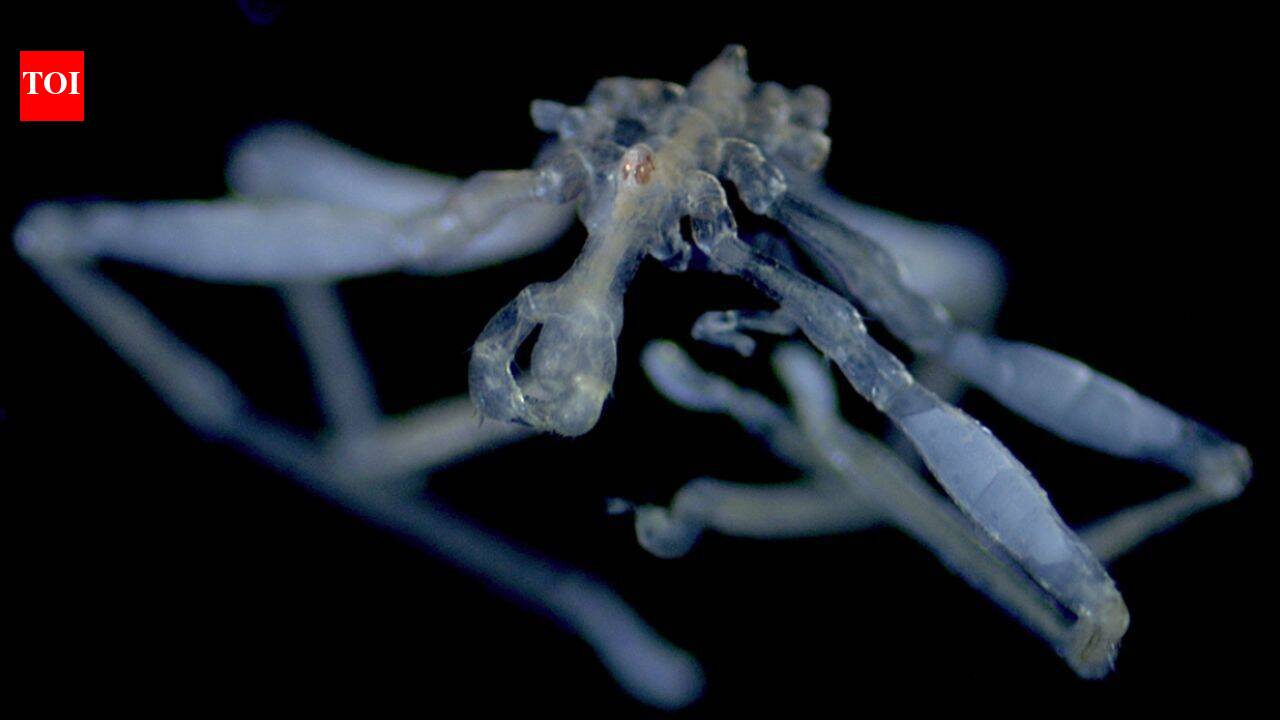
Researchers have identified two previously unknown species of sea spiders in the Salish Sea, marking the first such discovery in the region in nearly a century. The findings, published in the journal Organisms Diversity & Evolution, highlight the significant gap in scientific knowledge regarding marine invertebrates living in these coastal waters.
Anatomical Oddities: Callipallene pilosuspedes
One of the newly described species, Callipallene pilosuspedes, is distinguished by its striking appearance and specialized behavior. Its name, derived from the Latin for hairy feet,
refers to the long, curved spines covering the lower segments of its legs. Beyond its unique leg structure, the creature possesses distinct red eyes and a triangular mouth divided into three lips, which researchers describe as having a menacing appearance when viewed under magnification.
Perhaps its most unusual feature is its use of ovigers—appendages typically associated with carrying eggs. According to the University of British Columbia, this species uses its highly mobile ovigers to clean its own body. Under a microscope, researchers observed the animal wrapping the appendages around its legs and using attached comb-like spines to clean itself,
the university reported.
Tanystylum kiixin and the Ecosystem of Debris
The second species, Tanystylum kiixin, presents a stark contrast to its hairy-legged counterpart. Its name honors Kiix̣in, a sacred site and the traditional capital of the Huu-ay-aht First Nations on Vancouver Island, where the species was first collected. Unlike Callipallene pilosuspedes, this sea spider has smaller, less dexterous ovigers, which limits its ability to groom itself. Consequently, the animal often accumulates dirt, debris, and microorganisms.
“an ecosystem within an ecosystem within an ecosystem.”
Cormac Toler-Scott, Lead author
Researchers frequently observed the spiders hosting various protists and parasites, a phenomenon lead author Cormac Toler-Scott described as an ecosystem within an ecosystem within an ecosystem.
Research Methodology and Regional Biodiversity
The study, which involved researchers from the University of British Columbia, relied on specimens collected during scuba dives at depths of up to 18 meters between September 2023 and August 2024. The team surveyed marine habitats around Quadra Island, Bamfield, and Victoria. By utilizing both high-resolution scanning electron microscopy and DNA analysis, the scientists were able to formally describe these species, addressing a long-standing void in regional marine taxonomy.

Toler-Scott initiated the project while pursuing his master’s degree in zoology, driven by a concern that baseline data on local invertebrates was insufficient to assess the impact of human disturbance and climate change. I was interested in how sea spiders are impacted by climate change and human disturbance, because marine invertebrates in the Salish Sea are particularly at-risk, and I couldn’t find anything,
he explained. That’s largely because people don’t know much about what species exist here and what their lifestyle is.
The Evolutionary Significance of Sea Spiders
Sea spiders are pycnogonids, an ancient lineage of marine arthropods that trace their origins back approximately 500 million years. Despite their name, they are not true spiders but are related to scorpions and horseshoe crabs. Their physiology is notably unconventional; many species lack lungs or gills, relying instead on direct oxygen exchange through their skin. In some species, the central body is so small that major organs and digestive tracts extend into their legs.
While the discovery of these two species adds to the nearly 1,400 known varieties of sea spiders globally, researchers emphasize that their work serves as a necessary step for future conservation. With the Salish Sea shoreline increasingly populated and subject to rapid development, identifying the species currently inhabiting the region is critical to understanding which areas require the most urgent protection.
More on Salish Sea
NASA Viking Missions Mark 50 Years Since Historic Search for Life on Mars
Fifty years ago, NASA's Viking missions conducted the only direct search for extraterrestrial life in history.
NASA Roman Telescope Powers Up 300-Megapixel Instrument in Space
NASA’s Nancy Grace Roman Space Telescope launched aboard a SpaceX Falcon Heavy rocket and has now successfully powered...
Perseverance Rover Finds Volcanic Rocks at Mars’ Jezero Crater Rim
NASA’s Perseverance rover found volcanic igneous rocks instead of expected sedimentary layers along the inner rim of Mars’...
SpaceX Targets First Orbital Flight for Starship on September 28, 2026
SpaceX is targeting September 28, 2026, for Starship's 14th test flight from Starbase, Texas, with a 75-minute window...