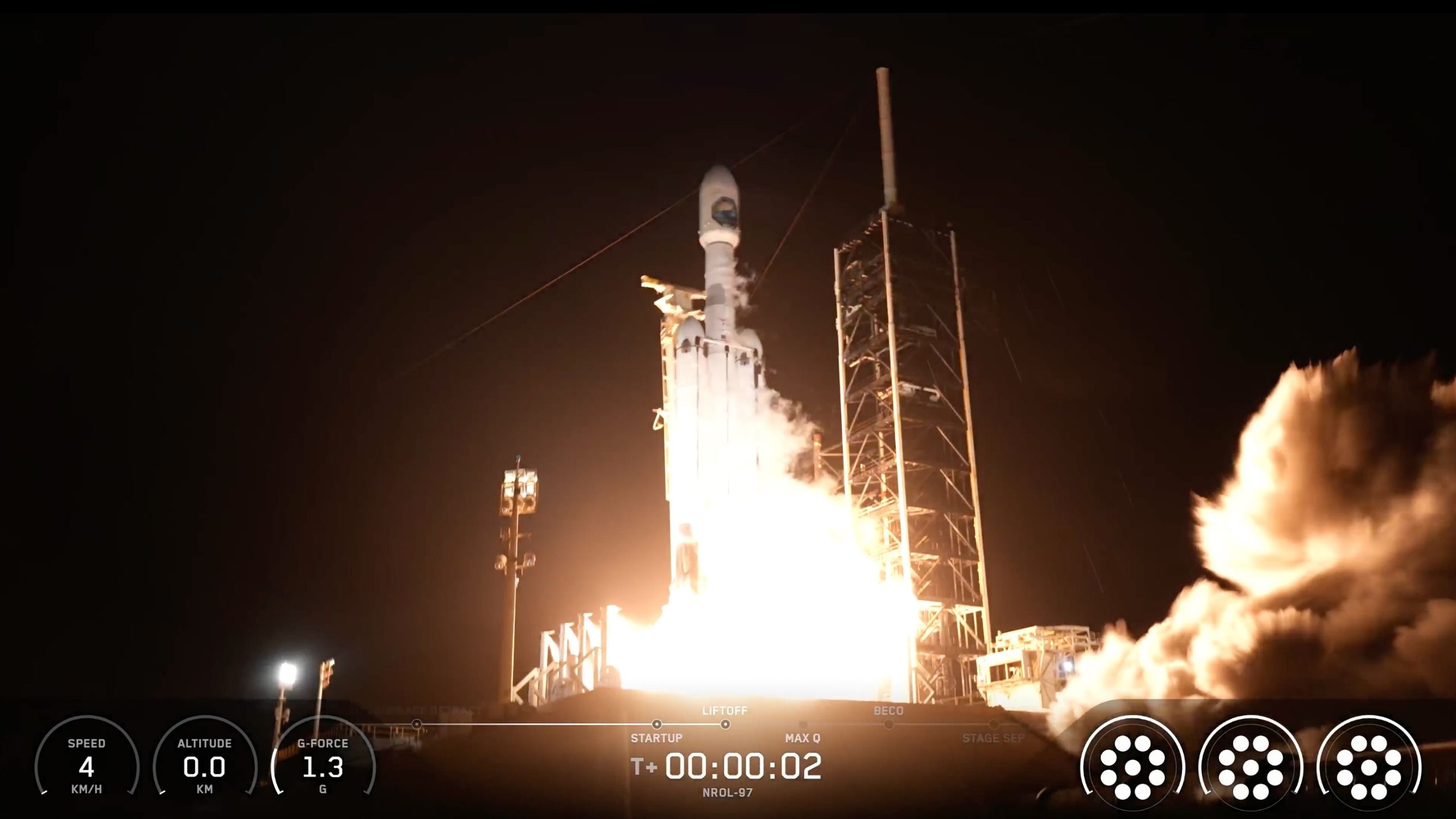
SpaceX launched a classified National Reconnaissance Office payload aboard a Falcon Heavy rocket from Florida on Thursday night, marking a milestone heavy-lift mission for the spy satellite agency while completing a rare tripleheader day for the commercial spaceflight provider.
The Falcon Heavy lifted off from Launch Complex 39A at NASA’s Kennedy Space Center at 11:54 p.m. The mission, designated NROL-97, represents the first time the National Reconnaissance Office has entrusted a payload to SpaceX’s most powerful operational rocket.
National Reconnaissance Office Debuts Heavy-Lift Launch
Until Thursday night, the intelligence agency relied exclusively on Falcon 9 rockets for its 22 previous flights with the company. Procurement of the NROL-97 mission occurred through the competitive National Security Space Launch Phase 3 Lane 2 contract.
Orbital destinations and payload details remain classified. The choice of a Falcon Heavy points to a heavy payload or a distant destination. The rocket’s three modified Falcon 9 first stages generate 27 Merlin 1D engines worth of thrust, giving the system the capacity to lift cargo comparable to a fully loaded Boeing 737 jetliner into orbit.

Brevard County Emergency Management officials deactivated the agency’s launch operations support team following the successful liftoff. Ahead of the flight, local authorities and SpaceX issued advisories warning residents across Brevard, Orange, Osceola, Indian River, Seminole, Volusia, Polk, St. Lucie, and Okeechobee counties that they might hear one or more sonic booms during the booster returns, depending on weather and atmospheric conditions.
Two Flight-Proven Boosters Return to Cape Canaveral
As the central core stage, serial number B1106, expended its fuel and was left unrecovered in the Atlantic, the two side boosters returned to Earth at Cape Canaveral Space Force Station. The boosters touched down at Landing Zones 1 and 2 roughly eight minutes after liftoff, generating thunderous sonic booms across Brevard County and neighboring regions.
The mission relied heavily on flight-proven components. The two side boosters, designated B1104 and B1072, previously flew just a month prior to launch NASA’s Nancy Grace Roman Space Telescope, marking their second and fourth flights respectively. Meanwhile, the payload fairing protecting the classified cargo flew previously on the NROL-95 mission in July.
A Historic Tripleheader Day for SpaceX Operations
The midnight liftoff served as the dramatic conclusion to an intense three-launch day for SpaceX. It marked the first calendar day the company successfully managed four booster returns across its operational ranges.
The rapid cadence placed the Falcon Heavy flight directly on the heels of a Starship test flight on Monday, bringing all three of SpaceX’s primary rocket architectures into active flight rotation within a 72-hour window.

Mission Patch Details 9/11 Memorializing
The official mission patch for NROL-97 carries a distinct visual tribute, featuring a lighthouse graphic surrounded by symbolic astronomical and historical markers. According to agency officials, the imagery honors the 25th anniversary of the September 11 terrorist attacks.
The design incorporates specific alignments: the endpoints of the light beam rest on the numbers 9 and 11 on a clock face, four prominent stars stand for the aircraft lost, and the depicted moon phase matches the exact appearance from September 11, 2001. The emblem also displays the Latin motto Orbem mundi mutandum conservare,
translated by the agency as to preserve a changing world
or to preserve the world by transforming it.
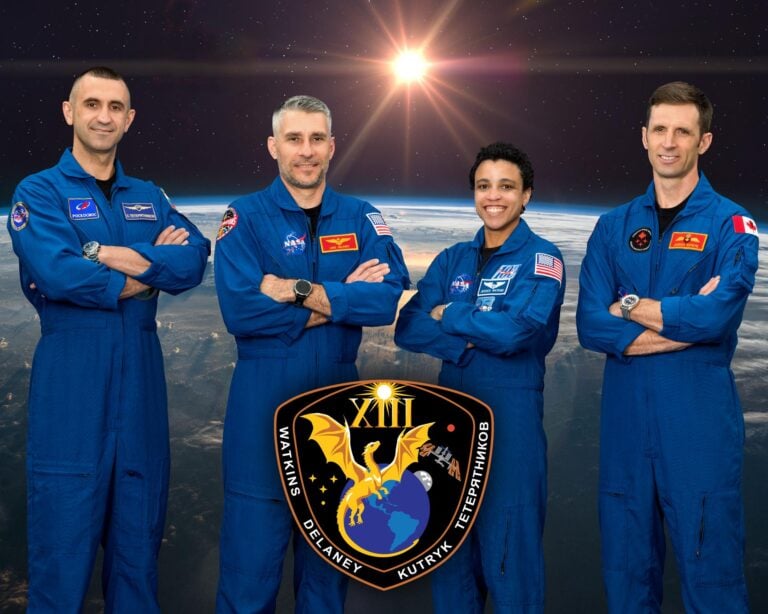
SpaceX Crew-13 Docks at ISS After Record-Breaking Flight
Four astronauts docked at the International Space Station on Thursday following a record-breaking eight-hour express flight from Florida.
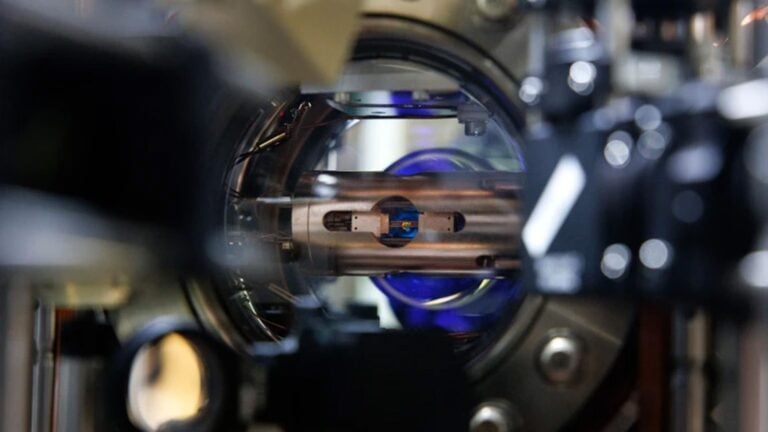
Singapore Researchers Build Most Precise Atomic Clock Using Lutetium
Researchers in Singapore have unveiled a record-breaking atomic clock built from lutetium, achieving precision to 19 decimal places.

University of Sydney Researchers Identify New Giant Stick Insect Species
Researchers at the University of Sydney have discovered two new giant stick insect species in Australia and reinstated...
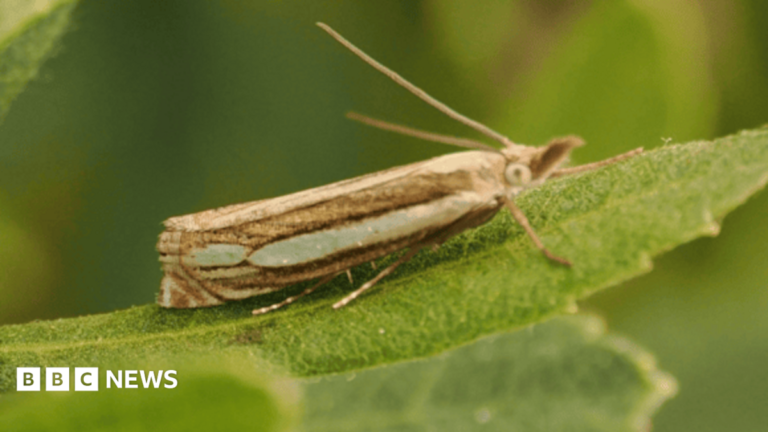
Bog Grass Moth Discovered for First Time in North Wales Reserve
Conservationists surveying a north Wales nature reserve discovered 19 Bog Grass Moths in a single night of trapping,...