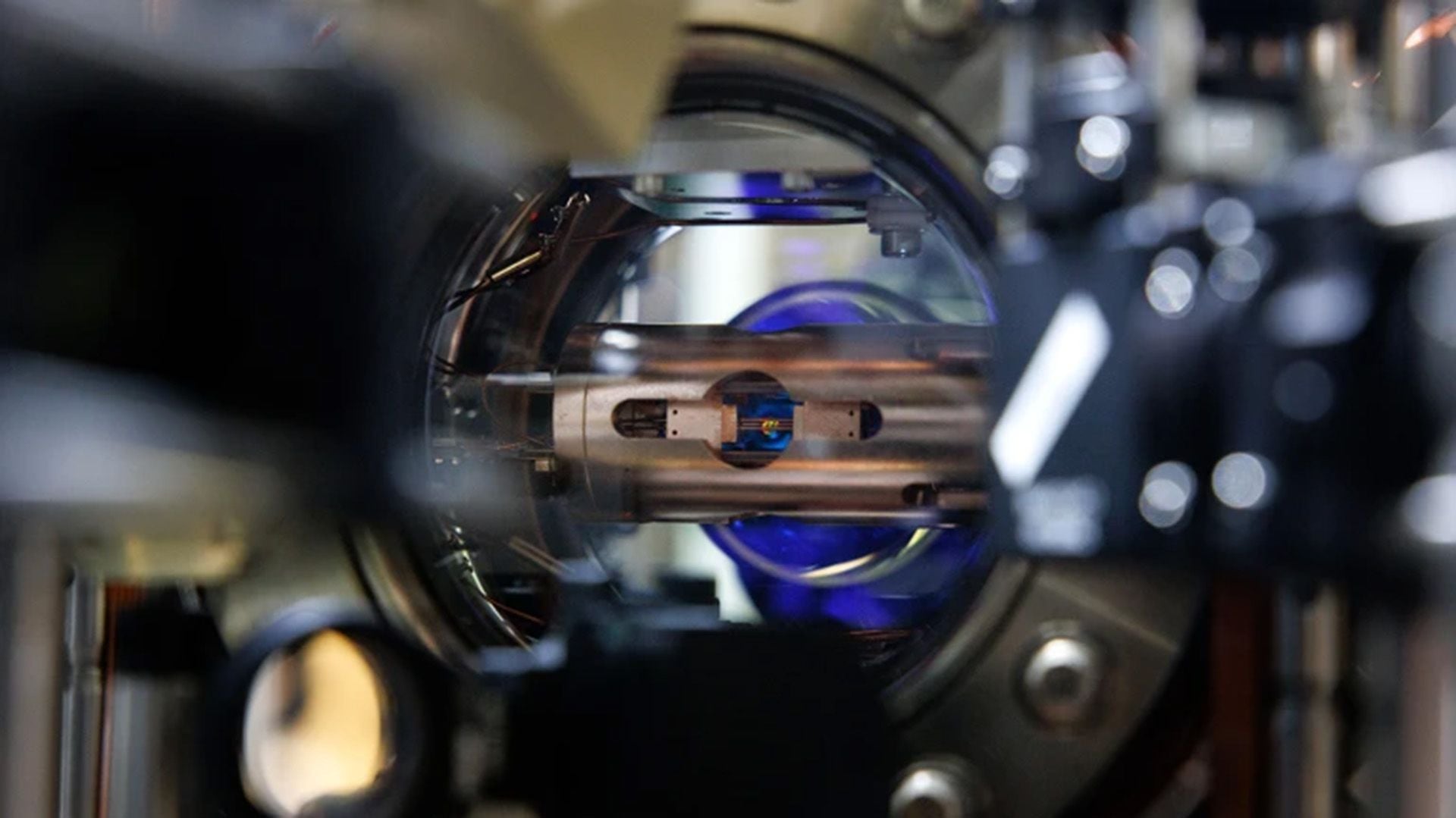
Researchers in Singapore have unveiled a record-breaking atomic clock built from lutetium, achieving precision to 19 decimal places.
That figure represents a 41% improvement over previous optical timekeepers, establishing what researchers describe as the most precise clock ever constructed.
Traditional atomic clocks rely on cesium-133 atoms, a standard established internationally since the 1960s. Officially, 9.19 billion vibrations of a cesium atom mark one second.
Today, atomic clocks are the cornerstone for systems such as GPS, the internet and military technology.
However, as contemporary technology demands higher degrees of precision, scientists turned toward optical clocks featuring much greater transition frequencies; these provide an increased number of oscillations to tally across any given duration, thereby driving more precise timekeeping.
The CQT group states its lutetium device has surpassed the performance of earlier record holders relying on strontium, aluminum, and ytterbium.
Lutetium Defies Environmental Interference
Previous optical atomic clocks built from elements like ytterbium, strontium, and aluminum achieved remarkable oscillation speeds, but remained vulnerable to minute external disturbances.
Temperature swings, magnetic fields, and background radiation can alter an atomic transition frequency, forcing laboratories to maintain tightly controlled environments.
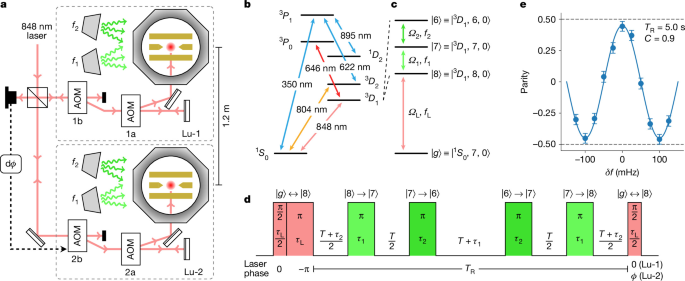
The CQT team bypassed these limitations by utilizing a single charged lutetium-176 ion excited by an 848-nanometer laser.
After spending more than a decade engineering the setup, the researchers found that lutetium possesses natural resilience against environmental fluctuations.
While other elements demand that ambient temperatures be regulated within a few thousandths of a degree, lutetium-176 maintains its steady ticking through an external temperature variation of 5 degrees.
Our job is to make sure the runner can go the distance.
Twin Lutetium Clocks Verify Measurement Accuracy
Proving the accuracy of a device when nothing else exists to measure it requires ingenious validation methods. To confirm their calculations, the CQT researchers constructed two independent lutetium clocks and compared their performance over about 12 days in 11 runs totaling 200 hours.
Each individual lutetium clock reached an aggregate uncertainty level of roughly 1 part in 10 quintillion, corresponding to a mistake in the 19th decimal place.
High Precision Clocks Detect Gravity Variance
The extreme sensitivity of the new clocks brings both opportunities and immediate physical limitations. According to Einstein’s theory of relativity, gravity slows the passage of time, causing clocks at different elevations to tick at slightly different rates.
Optical timekeepers functioning at the 10⁻¹⁹ precision tier are capable of sensing this phenomenon across vertical separations as small as a few millimeters.
The side-by-side CQT evaluation successfully detected a 5-millimeter (roughly 0.2-inch) variance between two devices positioned on the exact same table.

Because researchers know the difference in gravity between two distant sites only to within the equivalent of an inch or two of height, that leaves more blur in a long-distance comparison than these clocks carry themselves.
Therefore, transporting the clock physically offers a viable solution, prompting the investigators to move past lab constraints and build a portable apparatus for upcoming gravity investigations.
Data gathered from novel optical atomic clocks is presently being evaluated by the global organization governing time measurement to inform a planned redefinition of the second targeted for 2030 or later.
With its unmatched stability and error margin in the 19th digit after the decimal point — meaning it would take more than 260 billion years to lose a single second — lutetium has emerged as a leading candidate to replace cesium.
In the future, I just don't see how this clock can be beaten.
In addition to timekeeping, this novel atomic apparatus could assist investigators in addressing a more fundamental cosmological question: whether basic physical constants, such as the gravitational constant G, remain unchanging over time. There is some speculation that fundamental constants may actually be changing,
Barrett said. So ultra-precise clocks give us the tools to explore that.

University of Sydney Researchers Identify New Giant Stick Insect Species
Researchers at the University of Sydney have discovered two new giant stick insect species in Australia and reinstated...

Bog Grass Moth Discovered for First Time in North Wales Reserve
Conservationists surveying a north Wales nature reserve discovered 19 Bog Grass Moths in a single night of trapping,...

NASA and SpaceX Target Oct. 1 Launch for Crew-13 Mission to the ISS
NASA and SpaceX are targeting an 11:10 a.m. EDT liftoff on Thursday, Oct. 1, for the Crew-13 mission...

EDF Energy Chief Backs Rosebank and Jackdaw North Sea Projects
EDF Energy chief executive Simone Rossi has backed the development of the Rosebank and Jackdaw North Sea fields,...