The Federal Aviation Administration issued a nationwide ground stop on Friday, November 13, paralyzing air travel across the United States for several hours.
While the agency cited critical communication issues within air traffic control, the ripple effects of the order hit the college football world at its most vulnerable moment: the day before a full slate of Saturday games.
For most programs, the directive to keep aircraft grounded created a logistical nightmare. However, the University of Alabama managed to sidestep the chaos entirely. According to Tide 100.9, the Crimson Tide avoided the disruption because the team had already committed to a bus trip to Nashville, Tennessee, for their upcoming contest against the Vanderbilt Commodores.
The FAA has issued a nationwide ground stop for all flights. @CNN reports it's a communications issue. There are 5,000 delays and 319 cancellations, per CNN.
This decision, finalized months ago, proved remarkably prescient. While other SEC programs scrambled to weigh their options as the clock ticked toward kickoff, Alabama’s travel itinerary remained untouched by the FAA’s afternoon advisory. The team is scheduled to arrive in Nashville around 5:00 p.m. CT, maintaining the stability of their preparation for the 11:45 a.m. CT kickoff on Saturday, November 14.
The situation for other teams was far more precarious. CBS Sports reported that Auburn found itself at the airport, forced to evaluate alternative transportation for its game against Mississippi State in Starkville, a destination roughly four hours away by road.
Ole Miss was grounded in Oxford while attempting to travel to Norman, Oklahoma, to play the Oklahoma Sooners, and Tennessee faced delays as it prepared for its longest air-travel trip of the season to face Texas A&M.

The logistical strain extended well beyond the SEC. Teams like Arizona State were reportedly stranded on the tarmac, waiting for clarity as the hours slipped away, while Minnesota and Washington dealt with uncertainty regarding whether they could reach their opponents' campuses in time for game day.
The SEC acknowledged the gravity of the situation, releasing a statement that it was in close communication with its member schools and leaving the door open for potential schedule adjustments if the ground stop persisted.
Transportation Secretary Sean Duffy noted on X that the FAA was actively investigating the technical issues, providing a window of uncertainty that lasted from roughly 3:54 p.m. ET until the order was lifted around 8:30 p.m. ET. Even with the restriction ending early, the three-hour window of total paralysis left a massive backlog of flight plans and displaced personnel.
Alabama has departed Tuscaloosa and is en route to Nashville. The team is making the entire trip by bus. The Tuscaloosa airport is undergoing work to extend its runway, so Alabama has had to travel to Birmingham to fly to games this year. Nashville is only about 3.5 hours away,… pic.twitter.com/v3TZvlVO8j
This reality forced several conferences to shuffle their schedules to accommodate the travel delays. According to reports, games like Michigan State versus Washington were pushed back by over an hour, while other matchups saw kickoff times shifted significantly to account for teams that could not depart on their original schedules. Some programs, including Tennessee, initially directed their travel parties to return to campus until the situation stabilized.
The reliance on air travel has long been a standard, if occasionally fragile, pillar of modern collegiate athletics. When the Federal Aviation Administration restricts the national airspace, the impact cascades through the entire sports economy, affecting everything from broadcasting schedules to local hotel bookings and stadium operations.
The current Department of Transportation protocols are designed with safety as the absolute priority, but the human cost in this instance was a frantic scramble for alternative transit and the near-disruption of high-profile sporting events.
Statement from the Southeastern Conference on FAA nationwide ground stop: pic.twitter.com/IIU4TnwMVJ
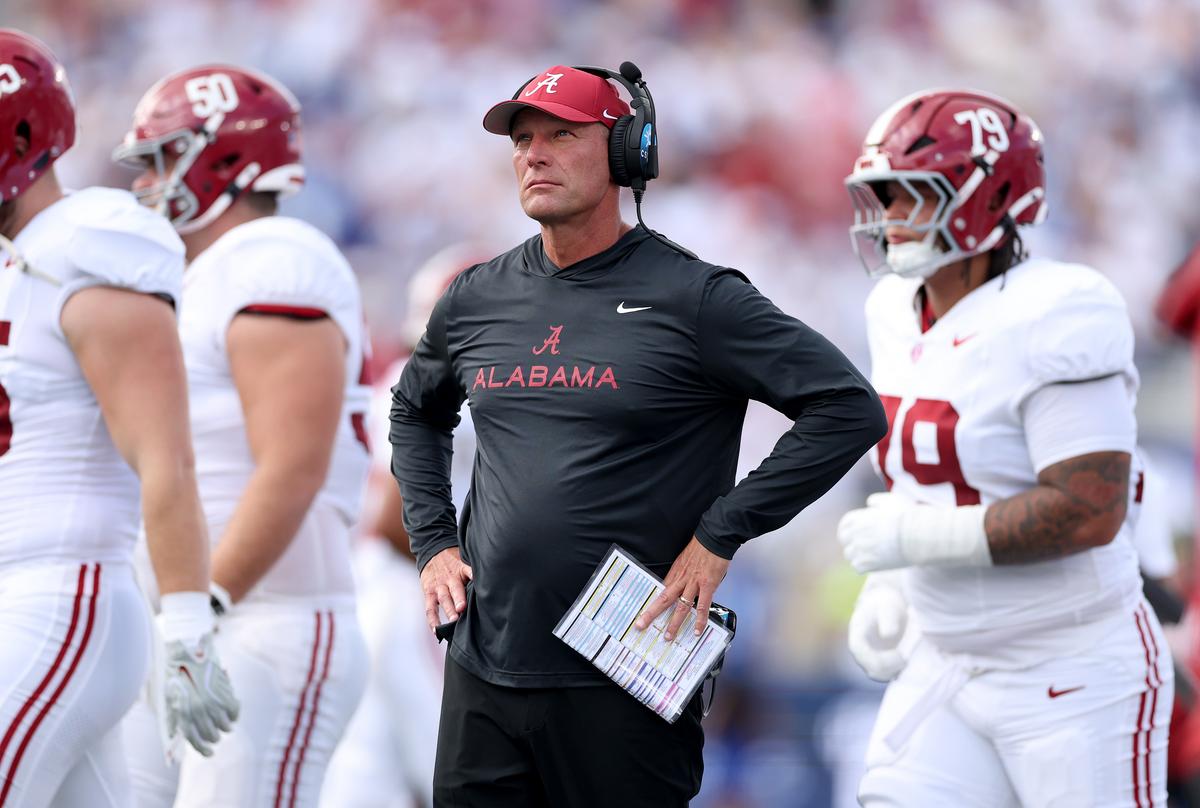
For Kalen DeBoer and the Alabama staff, the bus trip to Nashville stands out as a rare instance where a conservative logistics choice provided a distinct competitive advantage. While the rest of the conference wrestled with the unpredictability of the skies, the Crimson Tide maintained their routine, arriving on the ground in Tennessee without the added stress of a grounded fleet.
The situation shows how quickly the modern, high-speed world of college football can be brought to a halt by a single technical failure in the nation's air traffic control infrastructure.
As teams regroup and kickoff times are finalized, the event highlights the fragility of the travel schedules that support the multi-billion dollar college football industry. The games will proceed, but the scramble of Friday afternoon proved that even the most well-oiled athletic machines are ultimately at the mercy of the nation’s broader transit systems.
Keep reading

Malin Akerman Says Moving to Connecticut Allows 1950s-Style Upbringing
Actress Malin Akerman has traded the constant stimulation of Los Angeles for a quieter, more traditional lifestyle in...

Arizona Man Sentenced to 10 Years for $7 Million Car Dealership Fraud
A 59-year-old Arizona man will serve a 10-year federal prison sentence for orchestrating two separate fraud schemes that...

Woody Nestor, 80, Former DC Police K-9 Officer and Marine Dies
Woodrow L. "Woody" Nestor, a former Metropolitan Police Department K-9 officer and Marine veteran, died Monday, October 26,...

Wisconsin Gov. Tony Evers Grants 14 Commutations, First in Decades
Governor Tony Evers granted commutations to 14 individuals on Friday, marking the first time a Wisconsin governor has...