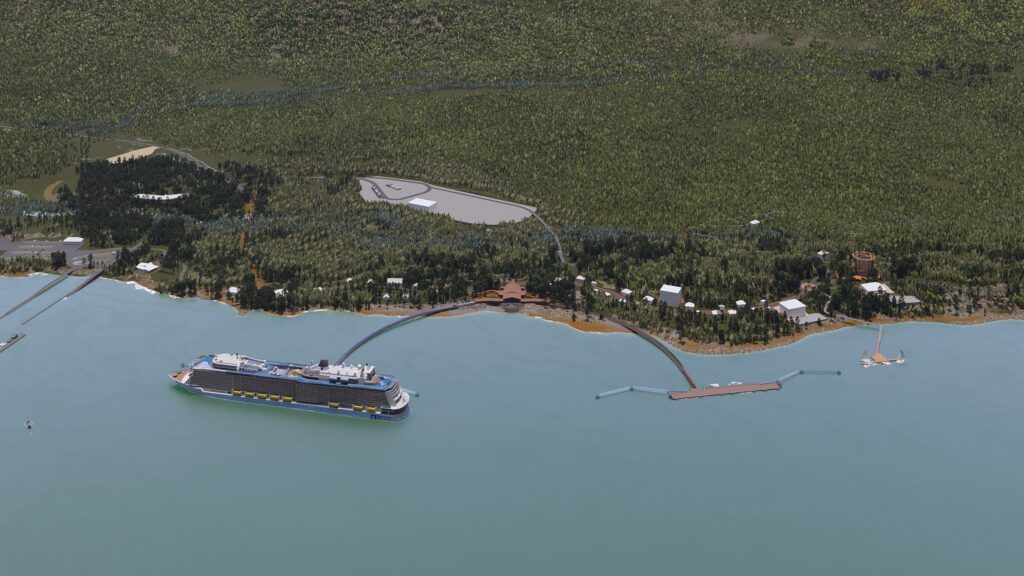
The State of Alaska has issued a preliminary decision to approve a 25-year lease of state-owned tidelands on Douglas Island to Goldbelt Inc., clearing a major hurdle for a proposed $500 million cruise ship port. The decision, detailed in a public notice from the Alaska Department of Natural Resources, would allow the Alaska Native corporation to develop approximately 152 acres of submerged land in Stephen’s Passage, roughly 9.3 miles west of downtown Juneau.
This move brings Goldbelt and its partner, Royal Caribbean Group, significantly closer to breaking ground on a facility designed to handle up to 10,000 guests and 3,000 ship workers during the peak tourist season, as reported by Alaska News. The project represents a bet on the expansion of Juneau’s tourism footprint, shifting the center of gravity for cruise arrivals toward the northwest coastline of Douglas Island.
The 25-Year Compromise
The state didn’t give Goldbelt everything it asked for. While the corporation originally sought a 55-year lease, the Division of Mining, Land and Water recommended a shorter 25-year term. The reasoning is pragmatic: a shorter window allows the state to re-evaluate land use and resource impacts more frequently. It ensures that the government isn’t locked into a half-century agreement without the ability to reassess the environmental or economic costs.
Financially, the lease starts at a minimum of $1,000 per year. However, that figure is a placeholder. An appraisal will eventually determine the fair market value, and if that value is higher, Goldbelt will be required to pay the difference back to the start of the lease. To protect the state from potential abandonment or environmental damage, Goldbelt must post a $600,000 performance guaranty for cleanup and restoration.
Crab Fisheries and Marine Migration
The economic promise of the port clashes directly with the biological reality of Stephen’s Passage. The Alaska Department of Fish and Game has warned that the development could have a “significant impact” on both commercial and personal crab fisheries. The data supports this concern: between 2015 and 2025, eleven permit holders harvested an average of 67,075 pounds of commercial Dungeness crab annually from the specific statistical area where the port would sit, according to Alaska News.
Beyond the crab pots, there is the matter of the whales. While the area isn’t designated as “critical habitat,” it is a known range for humpback whales, sea lions, porpoises, and otters. To mitigate the damage, the state has imposed strict construction blackouts. No work can occur from June 15 to July 15, the last two weeks of August, or the first week of November. The state also requires that in-water pile driving be minimized between April 15 and June 1 to protect migrating young salmon.
“Once developed, the port is expected to become one of Juneau’s largest taxpayers,” Goldbelt President and CEO McHugh Pierre stated in a vision statement in May.
The Local Friction Point
By proposing docks on Douglas Island, Goldbelt plans to expand Juneau’s tourism footprint, with the project located just past the end of North Douglas Highway.
There is also the political battle over ship limits. In September 2025, McHugh Pierre told a Juneau Assembly committee that prospective customers intend to honor the city’s five-ship daily limit. The Assembly has already moved to write this limit into city code to prevent future creep.
The Remaining Red Tape
The tideland lease is a win for Goldbelt, but it is not the final green light. The project still requires a conditional use permit and a floodplain development permit from the city of Juneau. Without these, the $500 million plan remains a conceptual design. The public will have another chance to voice their concerns regarding the conditional use permit at a future Juneau Planning Commission meeting.
For now, the clock is ticking on the state lease. Anyone wishing to appeal the final decision must “meaningfully participate” by submitting written comments. Those comments must be received by the Department of Natural Resources by 5 p.m. on November 23, 2026. If the public outcry is significant enough, the state may be forced to modify its preliminary decision or issue a new public notice entirely.
If all permits align, Goldbelt hopes to welcome its first cruise ship in May 2028.
Related reading

Bill Essayli fights to block thousands of California ballots
Bill Essayli, the interim U.S. Attorney for the Central District of California, is fighting to block thousands of...

Arkansas vs. Missouri: Why the Razorbacks Must Stop Losing the Battle Line Rivalry
Arkansas has lost 10 of its last 12 annual SEC matchups against Missouri, a stretch of dominance that...

Arizona Auto Theft Trends: The Rise of High-Value Vehicle Fraud
Arizona is seeing a paradoxical shift in auto theft: while official reports show the lowest number of stolen...

Why Alaska Is a Cheap Bargain for National Political Power
A U.S. Senate seat in Alaska carries the exact same weight as one from California or Texas when...