
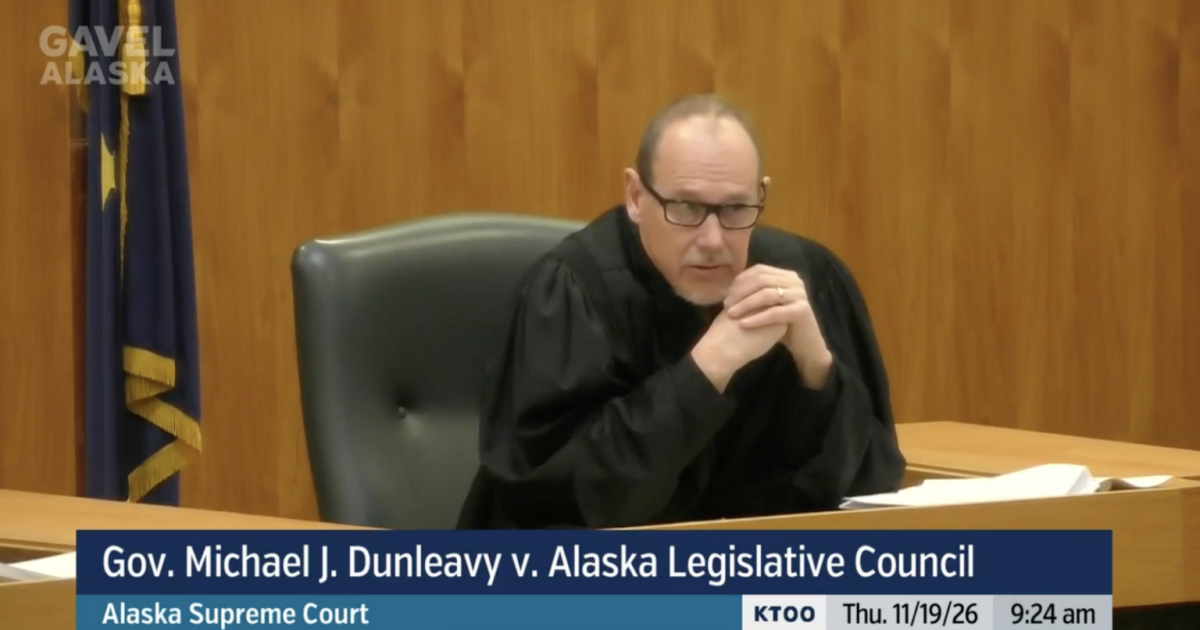
The Alaska Supreme Court heard arguments Thursday on whether Gov. Mike Dunleavy can create a new cabinet department by executive order during a 30-day special session without lawmakers voting it down before they adjourn.
The case centers on an August 2025 order that would have established an Alaska Department of Agriculture — something a food security task force recommended in 2022. Lawmakers had rejected a similar order earlier and preferred to create the agency by statute, but they failed to pass a bill during the 2025 session.
When Dunleavy reissued the order in the special session, legislators declined to hold a disapproval vote, then sued to block it. Juneau Superior Court Judge Mariana Carpeneti ruled at the end of 2025 that the Legislature was correct, and the administration appealed.
The constitutional text at issue, Article III, Section 23, gives lawmakers “sixty days of a regular session, or a full session if of shorter duration, to disapprove these executive orders.” The dispute is whether “session” includes a special session limited to 30 days, or only a regular session.
The governor’s plain-language argument
Alaska Department of Law attorney Laura Fox told the justices they should stick to the words on the page. “A special session is a session,” she said. “The court does not add missing words to the constitution, and you’d need to add missing words in order to limit the governor’s executive reorganization power … to only regular sessions of the Legislature,” she said.
The Legislature’s historical argument
Legislative attorney Kevin Cuddy countered that the constitutional convention’s records show the framers never contemplated special sessions in this context. Three preliminary drafts of Article 23 all specified that executive orders would take effect at the close of the “next regular session” unless vetoed, Cuddy explained.
The final version dropped that language because its authors envisioned having no end date for the regular session, he said. “There is simply no mention of special sessions anywhere. It’s not in the drafts. It’s not in the committee reports. Not even mentioned once in all of the debates. That silence matters,” Cuddy said.

He also framed the practical stakes: “No governor in the history of the state has ever attempted to … shoehorn 40 changes of Alaska statutory law into a special session that is constitutionally limited to just 30 days.”
The Alaska Supreme Court was founded about six months after statehood, replacing the United States Territorial District Court that had served as the territory’s highest judicial body since 1884. The court originally consisted of three justices and was expanded to five in 1967, when the chief justice’s term was also limited to three years.
A court shaped by the governor
Four of the court’s five members were appointed by Dunleavy. Chief Justice Susan Carney, the lone member who was not, was absent Thursday; court staff said she could participate if needed to break a tie. Justice Dario Borghesan presided over the arguments and said the court will issue a written decision at a future date.
Related reading

Michigan Supreme Court Declines Appeal on Clean Energy Zoning Law, Sets 2027 Arguments
The Michigan Supreme Court on Friday declined to hear an appeal from 79 local governments challenging the state's...

Mamdani Unveils Plan to Close Rikers Island by 2032, Pushing Past 2027 Deadline
NEW YORK — Mayor Zohran Mamdani on Friday unveiled a roadmap to close the Rikers Island jail complex...

Storms Threaten KC Current Watch Party Saturday; Cold Blast Follows for Chiefs Game
A warm, windy Friday gives way to a stormy Saturday evening across the Kansas City metro, with the...
Mamdani Unveils Plan to Close Rikers Island by 2032, Five Years Past Legal Deadline
Mayor Zohran Mamdani unveiled a roadmap Friday to close the Rikers Island jail complex by December 2032, pushing...