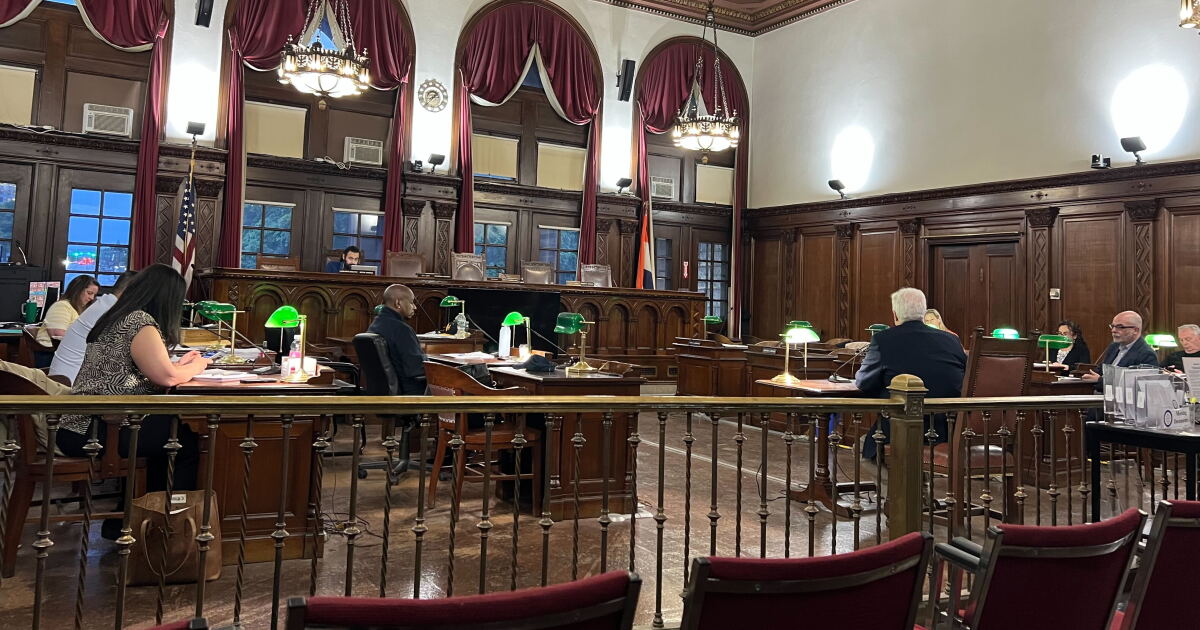
Finance Committee Chair Megan Keegan introduced two bills capping the tax override at 12% or 13.5% at a Council meeting this week.
Albany property owners are likely staring at a double-digit tax hike this year, but the final number will probably land below the 15% spike the mayor requested.
The Common Council is coalescing around a 12% increase, a figure that still requires overriding the state tax cap but avoids a charter quirk that could have frozen the city out of its own revenue until 2028.
The maneuvering played out at a Council meeting this week, where Finance Committee Chair Megan Keegan introduced two competing bills: one capping the override at 12%, the other at 13.5%. The higher figure carries Mayor Dorcey Applyrs’ endorsement, but Keegan told WAMC the votes simply aren’t there for 15%, and the 12% option has the support to pass.
“It’s the worst possible thing that could happen,” Keegan said of the scenario where the Council rejects the override but the 15% levy takes effect anyway, leaving the city unable to spend the money for two years.
“So what we have been trying to figure out legally is: can we put a number in there that constrains what the administration can do in terms of the tax levy override? And our reading of state law is that we’re not prohibited from actually putting a number in there.”
The charter trap
Albany’s 300-year-old charter is the ghost in the machine. Unlike other New York municipalities, the Council cannot vote down the mayor’s budget outright. If they refuse to override the state-imposed tax cap, the mayor’s proposed 15% increase becomes law by default — but the city cannot touch a dime of that new revenue until 2028.
That structural flaw forced the Council’s hand, turning a budget vote into a high-stakes negotiation over exactly how much pain to inflict on taxpayers.
The $1.6 million gap
Choosing 12% over 15% blows a $1.6 million hole in the $257 million budget. Applyrs has already proposed $9 million in cuts; the Council’s lower tax ceiling forces the administration to find another round of reductions. Under the charter, the mayor retains the power to decide what gets cut, and Keegan argued the Council should wash its hands of the specifics.
“The best course of action for the council legally may be to just not act on the proposed budget, with the exception of addressing the property tax levy itself, and allow the administration to carry their proposed spending plan and essentially be responsible for their proposed spending plan,” she told WAMC.
That stance reflects a Council that lacks both the legal mechanism and the internal consensus to surgically reduce the budget themselves. The result: the executive branch decides which services shrink, while the legislative branch takes the heat for the tax bill.
A push to rewrite the rules
The dysfunction has reignited talk of charter reform. Councilmember Tom Hoey put it bluntly: “And again, I’m going to stress one more time: we need to look at this charter and try to get it fixed so that we’re not taking the blame for a process that was invented 300 years ago.”
Any amendment requires a voter referendum, and Keegan indicated the Council aims to move proposals early next year for a November ballot.
Meanwhile, the Council is also looking backward. Members discussed inviting former Budget Director Gideon Grande — now Schenectady County’s director of management and budget — to testify on how the city reached this precipice under the previous administration. Grande is no longer a city employee, so a subpoena is off the table, but the political will to ask him appears strong.
Thursday’s deadline
A deal is expected Thursday. For homeowners, the difference between 12% and 15% is real money, but either way, the bill is going up sharply. The charter remains the same. And the next budget cycle starts the moment this one ends.
Keep reading

Providence Uses 14-0 Run to Defeat Sacred Heart 86-67 Behind Page’s 18 Points
Providence survived a late scare from Sacred Heart on Tuesday night, using a 14-0 run to turn a...

Oregon Erases Halftime Deficit, Beats Murray State 97-76 Behind Fiso’s 31
Katie Fiso scored 31 points as Oregon erased a nine-point halftime deficit with a 34-13 third quarter to...

Chris Columbus Fired the Only Actor of His Career After Four Days on ‘Home Alone’ Set
Chris Columbus wanted Joe Pesci and Daniel Stern as his Wet Bandits, but the studio would only pay...

Comedian Nate Jackson Announces 2027 Miracle Baby Tour
Comedian Nate Jackson announced a 2027 North American tour Monday, adding Oklahoma City to a routing that already...