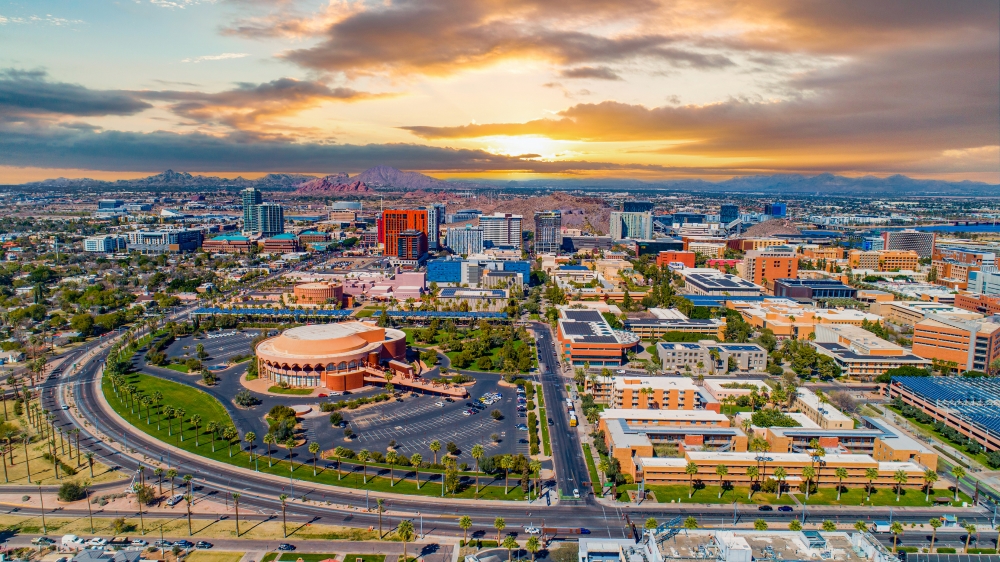
Amkor Technology doubled its Peoria campus investment to $12 billion as Greater Phoenix semiconductor commitments topped $200 billion.
Amkor Technology vaulted its planned Peoria campus from a $7 billion project to a $12 billion one in September, doubling down on advanced packaging capacity that customers have already booked beyond the first phase.
The expansion, confirmed by the company and tracked in Site Selection Magazine’s Conway Projects Database, marks the largest single investment in a North American semiconductor deal ranked this year.
Phase one, still on track for a 2028 opening, targets 33,000 square meters of cleanroom space and roughly 3,000 jobs averaging $90,000 annually. Phase two adds 60,000 square meters, pushing the campus past 93,000 square meters — over one million square feet — and lifts the expected headcount above 3,500.
“This next phase reflects the confidence our customers have placed in Amkor, the critical role advanced packaging plays in enabling the future of semiconductor innovation, and the strategic importance of our Arizona campus.”
Kevin Engel, Amkor’s president and CEO, said in the September announcement.
The Peoria site, which Amkor calls the first U.S. high-volume OSAT facility for advanced packaging, sits on 170 acres with room for further growth. Construction on phase two is slated to begin late 2027, with completion targeted for the end of 2029.
The $200 Billion Cluster Takes Shape
Greater Phoenix has now attracted more than $200 billion in semiconductor commitments since 2020, a figure that folds in Amkor’s leap alongside TSMC’s fab complex, Intel’s expansion, and a lengthening roster of materials, equipment, and assembly partners.
Site Selection Magazine ranked the $7 billion Amkor plan as North America’s top deal in its annual Top Deals list this past May, citing the collaborative effort among the City of Peoria, the Arizona Commerce Authority, Greater Phoenix Economic Council, Arizona Public Service, and the Western Maricopa Education Center. The publication noted the project’s jump from an initial $2 billion scope as evidence of accelerating demand for domestic packaging capacity.

Diplomacy as Deal Flow
In August, the Arizona Commerce Authority led a delegation to South Korea that included Amkor, Peoria officials, and GPEC. The most recent Korean anchor in the region is LG Energy Solution’s $121 million, 876-job battery plant in Queen Creek.
Weeks later, a 100-plus-person ACA delegation traveled to Taiwan for the American Institute in Taiwan Workforce Summit and a SEMICON Network Summit organized by Taiwan’s Ministry of Economic Affairs. Taiwan ranked as Arizona’s second-largest trading partner in 2025, with bilateral trade exceeding $21 billion.
The ACA opened its Arizona-Taiwan Trade & Investment Office in Taipei in 2023; this year, Taiwan’s Ministry of Foreign Affairs announced plans to open a Taipei Economic and Cultural Office in Phoenix.
Sandra Watson, president and CEO of the Arizona Commerce Authority, described the partnership as “one of the most important international partnerships anywhere in the world.”
From Oceania to the Workforce Pipeline
In April, Australia-based Syenta opened its first U.S. facility — a 3,500-square-foot operation at ASU Research Park in Tempe. CEO Jekaterina Viktorova cited Tempe’s talent density and research collaboration as decisive factors.
“Tempe is a natural choice for our first U.S. operations,” Jekaterina Viktorova, CEO and founder of Syenta, said.
Arizona State University was selected as one of eight universities to lead The Foundry School, a U.S. Department of State and Department of Labor initiative to train the next generation of manufacturing leaders. Meanwhile, the University of Arizona and Taiwan’s National Sun Yat-sen University launched the SPARK center to accelerate semiconductor commercialization and joint workforce training across Southern Arizona and Taiwan.
SEMICON West Anchors in Phoenix
The ecosystem’s coming-out party arrives in spring 2027. SEMICON West, SEMI’s flagship North American event, will make the Phoenix Convention Center its long-term home starting March 30–April 1, 2027, shifting to an annual spring cadence. Joe Stockunas, president of SEMI Americas, said the move creates “greater consistency for attendees while building on the tremendous momentum of Arizona’s rapidly expanding semiconductor ecosystem.”
LG Energy Solution, already building its cylindrical battery plant in Queen Creek, opened a Future48 Workforce Accelerator training center with the ACA, Pinal County, and Central Arizona College in 2025. Richard Ra projected 1,500 total jobs by 2027.
Amkor Technology traces its roots to 1935, when Hyang-Soo Kim founded ANAM Industries in Seoul, which became South Korea’s first semiconductor business in 1968; the name “Amkor” itself is a portmanteau of “America” and “Korea.” The company went public on Nasdaq in 1998, moved its headquarters from Pennsylvania to Arizona in 2005, and by 2022 employed roughly 31,000 people worldwide with $7.1 billion in annual sales.
Amkor’s 170-acre campus still has undeveloped acreage. The next question is whether the next $5 billion arrives from a supplier that hasn’t announced yet.
Related reading
- Undue Hardship and the Problem of Hypothetical Costs After Groff v. DeJoy
- Gallatin Upends Billings West 17-3 to Reach First State Title Game
- Indonesia Could Secure Another US$15 Billion in Investment Commitments From China on Friday (world-today-news.com)
- Debt Edged Past GDP by $9.9 Billion; Interest Runs $7,803 a Household (daybreakwire.com)
Undue Hardship and the Problem of Hypothetical Costs After Groff v. DeJoy
The Supreme Court's decision in Groff v. DeJoy rewrote the standard for religious accommodations in the workplace, but...

Gallatin Upends Billings West 17-3 to Reach First State Title Game
Gallatin High School punched its ticket to the program's first state championship game Friday night, shutting down Billings...

NetChoice Sues Indiana Over Age-Verification Law in Federal Court Nov 18
Indiana required every user of major social platforms to prove their age and state residency before opening or...
Greater Pittsburgh Workforce Summit Addresses Shrinking Labor Pool, 97% Replacement Openings
Joshua Counselman told the Greater Pittsburgh Workforce Summit that 97 percent of future job openings will come from...