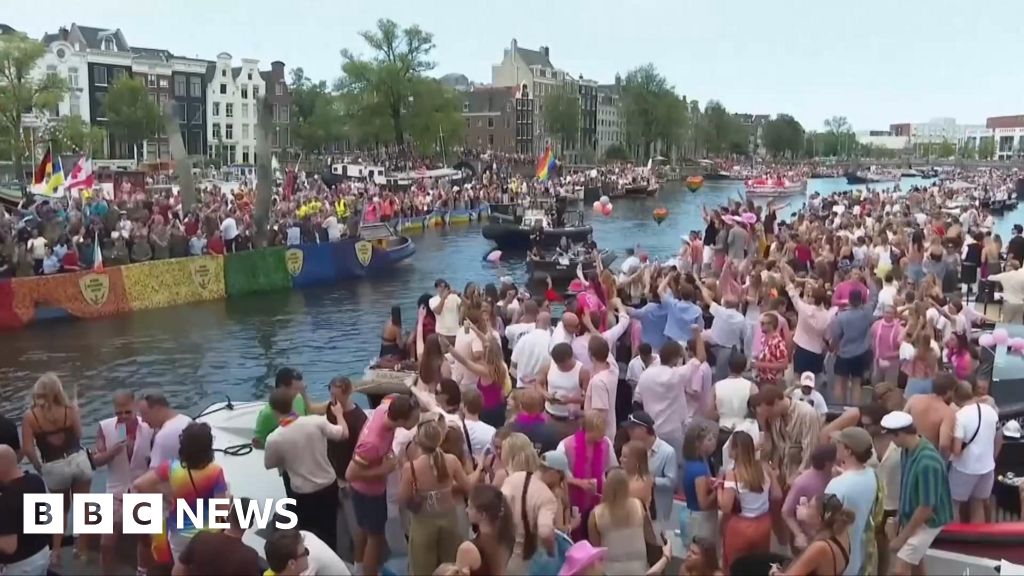
Hundreds of thousands of people lined Amsterdam’s canals for the city’s annual Pride boat parade. The event coincided with WorldPride against a backdrop of heightened security following a deadly attack on a Pride festival in Berlin one week prior.
Amsterdam came alive with music, colour, and celebration as crowds flocked to the Dutch capital’s waterways. Costumed participants danced and waved from a colourful flotilla of 80 decorated vessels making their way through the city. The annual canal boat parade serves as the traditional highlight of Amsterdam’s Pride festival, which shares the calendar this year with a city-hosted WorldPride celebration.
Prime Minister Rob Jetten Joins the Flotilla Amid Security Measures
Openly gay Dutch Prime Minister Rob Jetten participated in the parade, waving to participants and spectators from a small boat. Dressed in a white shirt, black life vest, and gold necklace, Jetten joined the route as techno music pumped from speakers along the canals. His presence marked a notable milestone, as reporting noted he is the first Dutch prime minister to ever take part in the boat parade.
Security remained visibly heightened throughout the route. Police officers cruised the canals in motorboats while a helicopter hovered overhead. Mayor Femke Halsema stated in the aftermath of a recent attack in Germany that authorities would where necessary take extra measures that visitors will hopefully notice as little as possible.
The Shadow of the Berlin Attack and Global LGBTQ+ Security
The festive atmosphere unfolded exactly one week after a deadly attack on a Pride event in Berlin left one person dead and 29 injured. Authorities identified a suspect, Abdul Ballout, who allegedly drove a van into a crowd near the festival before attacking others with a machete in what investigators believe was an Islamic extremist attack. Police shot and killed Ballout during a confrontation in a suburb, and prosecutors indicated he had previously sought to join the militant Islamic State group.
Reflecting on the climate surrounding the celebrations, Prime Minister Jetten posted a video on X addressing the broader geopolitical context. He stated that the event was more important than ever because worldwide the freedom and security of the LGBTQ+ community is under pressure with new discriminatory legislation, lack of safety on the street or last week’s terrible attack in Berlin.
Similar security concerns influenced Pride events elsewhere in Europe. In Hamburg, Germany’s second-biggest city, a Pride parade drew an estimated 300,000 attendees—up from about 260,000 the previous year—under the protection of roughly twice as many police officers as the year before.
Manifestos, Historical Tributes, and Political Statements on the Water
The 80 vessels in the Amsterdam parade represented a broad cross-section of society, including Dutch government ministries, the military, police, and various LGBTQ+ organizations and clubs. The Netherlands LGBTQ+ rights group COC marked its 80th anniversary with a dedicated boat carrying a manifesto calling for human rights progress. That vessel also displayed a portrait of activist Marsha P. Johnson, commemorating her participation in the 1969 Stonewall rebellion.

President Donald Trump and Russian President Vladimir Putin. Dressed in Delft blue-and-white costumes and clutching tulips, the figures leaned toward each other for a kiss in the style of traditional Dutch pottery figurines. Creators of the display stated on their website that the figures were meant not to provoke, but to pause power for a moment and highlight something human.
International Visitors and Domestic Tensions in the Netherlands
Visitors traveled from across the globe to witness the WorldPride festivities. Rod Lugtenburg, 55, visiting from Toronto, stood near the city’s Skinny Bridge wearing a rainbow maple leaf T-shirt.
Lugtenburg added that he has Dutch heritage and has always admired the Netherlands for leading the way in LGBTQ+ rights, noting that Canada follows closely behind.
This international celebration took place against a domestic backdrop of rising reports concerning verbal and physical assaults against the LGBTQ+ community in the Netherlands. Highlighting ongoing legal responses to such incidents, an Amsterdam court convicted a man on Friday of using discriminatory language at a festival event earlier in the week, sentencing him to 40 hours of community service.

Ethiopian Airlines Adds Nacala to Mozambique Network
Ethiopian Airlines is expanding its Mozambique network by launching thrice-weekly passenger service to Nacala starting October 27, 2026.
Macklemore Pledges $1 Million Ed Sheeran Tour Salary to Palestine Relief
American rapper Macklemore has announced that he will donate his entire $1 million salary earned as an opening...

Rachida Dati and Carlos Ghosn Face Trial in Paris Over Renault Payments
Former French culture minister Rachida Dati went on trial in Paris alongside fugitive former executive Carlos Ghosn, facing...

NBC4 News Helicopter Crashes in Chatsworth Killing Three
Three people were killed when a news helicopter used by NBC4 and Telemundo affiliates crashed and burst into...