Anchorage Faces a $15 Million Fiscal Gap as Assembly Weighs Mayor’s 2027 Budget
Anchorage residents are preparing for a crucial second public hearing on Wednesday, November 4, to weigh in on Mayor Suzanne LaFrance’s proposed fiscal year 2027 budget. With final action scheduled for November 17, the $692.5 million operating budget presents a delicate financial tightrope for city officials trying to maintain baseline municipal services while grappling with an immediate $15 million shortfall.
The proposed spending plan sits roughly $34,000 under the property tax cap, framing the expenditure as a continuation of current service levels. To bridge the deficit, the city administration is relying on one-time funding streams. These include approximately $8.4 million left from the ML&P sale alongside cuts to vacant positions across departments. However, officials have already warned that these stopgap measures expire next year, projecting that the shortfall could nearly double to roughly $30 million in 2028.
Balancing Core Services and Departmental Bumps
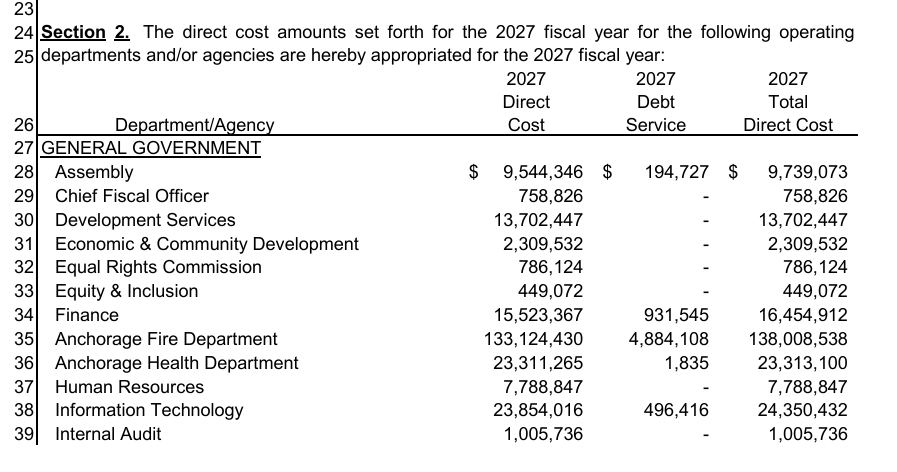
While the city faces a fiscal cliff, the proposed budget still allocates modest increases to core protective services. The Police Department sees an increase of about $2.4 million, while the Fire Department is slated for a nearly $4.9 million boost. Maintenance and Operations is growing with a shift toward more in-house snow removal. Meanwhile, homelessness programs continue, including crisis care, outreach, and shelter contracts.
At the same time, the Equity & Inclusion department is receiving a 2.5 percent funding increase, pushing its budget from $438,057 to $449,072. Almost the entirety of these new funds is allocated toward compensation and perks, climbing to $388,066 for a pair of full-time staffers whose responsibilities involve monitoring “equity benchmarks” and tracking “systemic disparities.” With the city depending on temporary revenues to prevent deeper cuts this current year, detractors have questioned the justification for expanding that office at all.
Capital Bonds and Voter Decisions
Beyond the operating budget, the capital side proposes an $87.9 million bond package—excluding the school district—targeted at roads, drainage, parks, fire equipment, and other projects. If approved by voters in April 2027, these bonds are repaid through property taxes.

As noted in municipal records, past initiatives like the 2020 alcohol tax were established to shore up safety nets when public services reached a breaking point. Similarly, the voter-approved Anchorage Child Care and Early Education Fund (ACCEE Fund) demonstrates how the city channels specific tax revenues toward targeted community needs.
Individuals living in the area can speak directly at the November 4 Assembly Meeting or sign up to submit written or telephone testimony through muni.org/testify.
Worth a look

Amick Farms expands South Carolina footprint with new Edgefield County operations
Amick Farms Invests $54.78 Million to Build Trenton Hatchery Amick Farms is expanding its South Carolina footprint with...

Log in | Nevada Portal
A Centralized Digital Hub for Case Management Litigants, attorneys, and the public now have access to a centralized...

SNHU Men’s Soccer Claims NE10 Regular Season – Northeast 10 Conference
Southern New Hampshire University has secured the No. 1 seed in the Northeast 10 Men's Soccer Championship for...

A Song of Grief and Union in “Lincoln in the Bardo” | The New Yorker
Missy Mazzoli’s “Lincoln in the Bardo” Opens at the Metropolitan Opera The sixth opera by American composer Missy...