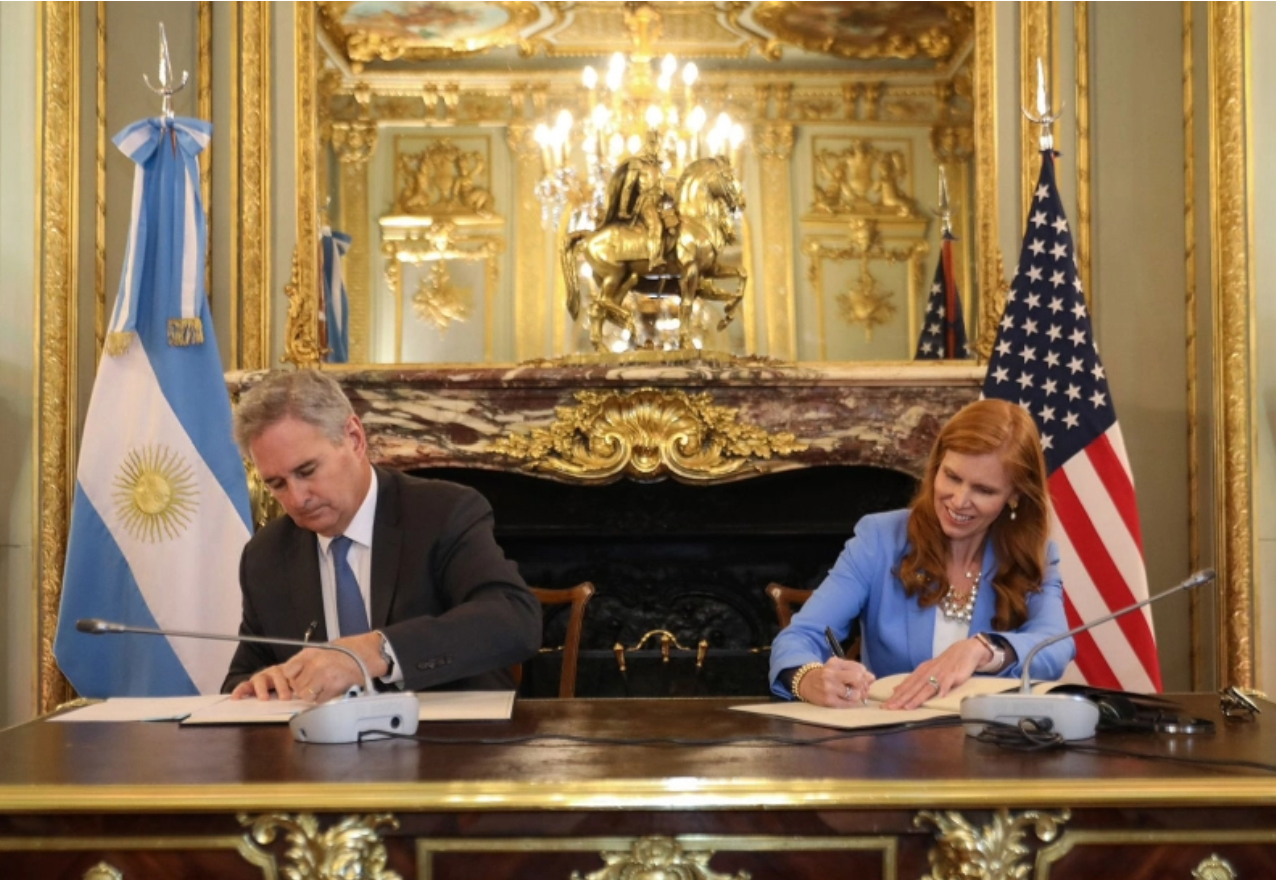
Argentina joined the Geneva Consensus Declaration on August 13, aligning with an international initiative asserting that there is no international right to abortion and that each nation retains sovereignty over its domestic policies, according to officials and regional reports.
President Javier Milei’s administration formalized Argentina’s accession to the Geneva Consensus Declaration on Promoting Women’s Health and Strengthening the Family, a diplomatic move that places the South American nation alongside more than 40 other signatory countries. The decision was orchestrated in relative secrecy before being brought to light through reporting in the United States and subsequent confirmations by Argentine officials.
Secret Signatures and Official Confirmations in Buenos Aires
Ambassador to Argentina Peter Lamelas. Despite the high-profile nature of the pact, the Milei administration initially made no public announcement. Word of the accession first broke on the conservative U.S. website Daily Signal via a report from White House-accredited journalist Elizabeth Troutman Mitchell, which featured celebratory remarks from U.S. officials.
When contacted by the newspaper Perfil, Argentine foreign ministry officials initially offered evasive responses, while other government branches directed inquiries back to the ministry. The accession was officially acknowledged two days later, on August 12, when both Quirno and Lamelas published statements on the social media platform X. Bethany Kozma, director of global affairs at the U.S. Department of Health and Human Services, traveled to Buenos Aires around the same time, appearing in photographs with Quirno and Lamelas to mark the occasion alongside Argentina’s Secretary for Religious Affairs and Civilisation, Agustín Caulo.
Behind the scenes, the timing of the public rollout was linked to international administrative shifts. In June, the United States assumed control of the Geneva Consensus Secretariat, taking over the role previously held by Hungary. U.S. Secretary of State Marco Rubio formally announced the leadership transition on August 12, aligning with the public disclosure of Argentina’s membership.
The Principles of the Geneva Consensus and Domestic Legal Realities
Originally introduced in 2020 during the first administration of U.S. President Donald Trump, the Geneva Consensus Declaration centers on protecting human life, supporting women’s health, and strengthening family structures. Signatories maintain that abortion should not be promoted as a method of family planning and that no international obligation exists for states to fund or facilitate the procedure. Proponents emphasize that the framework asserts national sovereignty, allowing individual countries to determine their own health and family laws.

Legal experts and political analysts in Argentina have stressed that the declaration carries no legal weight. Dr. Carlota López, a lawyer and coordinator of ACIERA’s Lawyers’ Association, noted that the text is not legally binding and does not create legal obligations for participating nations.
Domestically, the accession leaves existing legislation untouched. Law 27.610, which governs the voluntary termination of pregnancy in Argentina, remains fully in force. Political scientist Marcelo Díaz described the move to a kind of putting on the pro-life jersey as a state,
noting that while it signals political alignment with international conservative networks, it alters no local statutes.
Culture Wars, Think Tanks, and International Policy Strategy
The groundwork for Argentina’s accession was laid weeks prior through a series of events organized by the ultra-conservative think tank Political Network for Values. In July, the organization hosted meetings in Buenos Aires featuring Valerie Huber, an American pro-life activist widely regarded as an architect of the Geneva Consensus. Foreign Minister Quirno participated in these discussions, meeting directly with Huber at the Palacio San Martín.
While libertarian and conservative allies viewed the signing as a significant ideological victory, analysts remain divided on whether the move signals an impending legislative battle over abortion rights or serves primarily as an instrument of foreign policy. Miriam Donati Brusco, a lawyer representing Women for the Nation, suggested that the agreement raises the issue of each country’s sovereignty to decide its public policies while functioning largely as a matter of international diplomacy rather than immediate domestic reform.
Keep reading

USS Abraham Lincoln Deployment Triggers Crew Mental Health Crisis
More than 5,000 staff members have been on board the flagship aircraft carrier, which has been conducting maritime...

Trump Orders Pentagon to Scale Back S. Korea Military Drills
U.S. President Donald Trump ordered the Pentagon on Sunday to substantially reduce planned joint military exercises with South...

Hakainde Hichilema Leads Zambia Election Results for Second Term
Zambian President Hakainde Hichilema maintains a lead in national election results published on Sunday, August 16, 2026, putting...

Gaza Residents Dig by Hand as Heavy Machinery Scarcity Hinders Body Recovery
Operating two excavators in Gaza City, Samir Sabra and his son Uday struggle against soaring fuel costs and...