Trans-Pacific Internet Infrastructure Faces Severe Sabotage Threats
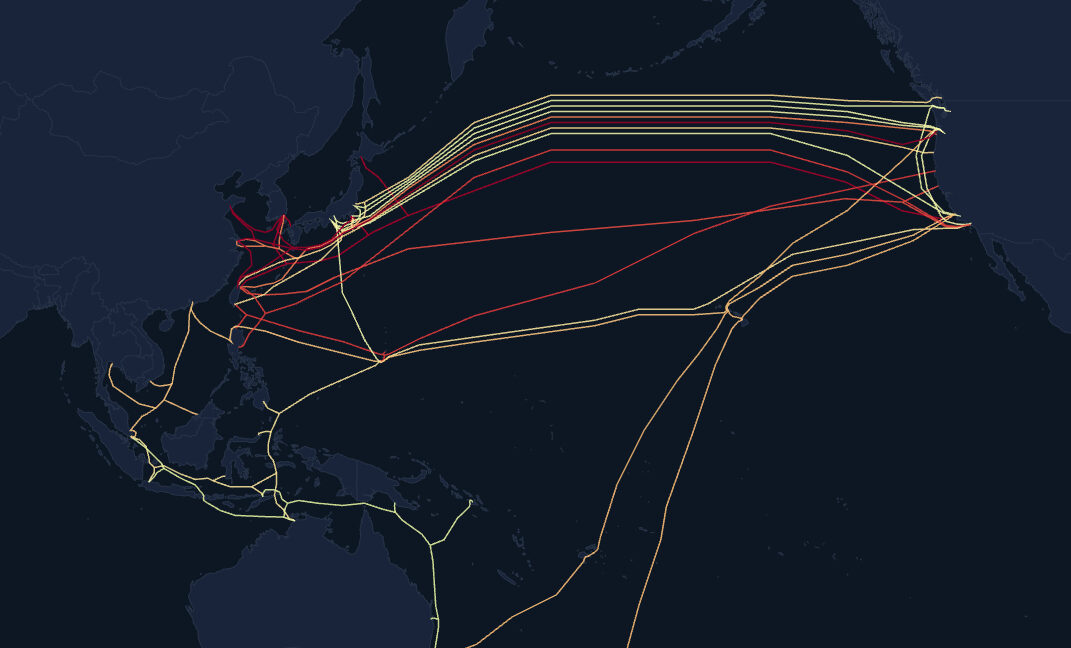
Trans-Pacific subsea internet cables linking the United States to Taiwan, Japan, and the Philippines face severe sabotage risks due to regional shipping congestion and sovereignty disputes, Ars Technica reported, citing a new threat index.
The index identifies 10 trans-Pacific cables as being most at risk. Vulnerability spikes heavily around Taiwan, Japan, and the Philippines. This heightened exposure stems partly from China’s territorial claims over Taiwan and partly from the physical geography of the region, where data lines must cross shallow waters crowded with heavy maritime traffic.
Tech Giants Back High-Risk Undersea Cable Projects
Several of these high-risk infrastructure projects remain under active development while backed by major US technology and telecommunications firms. Google owns the TPU project, Meta owns the ORCA cable, and Verizon co-owns the E2A cable alongside corporate partners in Japan, South Korea, and Taiwan. All three of these development projects earned risk scores placing them in the top five.
Capacity Risks Threaten Global Financial Trading and Cloud Services
Report authors warn that any serious disruption to a single trans-Pacific cable could risk overwhelming current available capacity on direct routings between the United States, Taiwan, Japan, and the Philippines. That failure mode would force massive volumes of internet data onto slower, less direct routes.
A broader crisis involving multiple cable cuts—potentially during a geopolitical escalation over Taiwan—could significantly reduce headroom and even overwhelm trans-Pacific capacity as a whole. Under such conditions, communications between the US and the Indo-Pacific would require emergency rerouting through alternative global pathways, triggering major economic consequences for internet traffic, cloud computing services, and international financial trading.
Global Powers Expand Submarine Fleets and Undersea Drones
This physical vulnerability report arrives as major global powers continue expanding their fleets of military submarines and unmanned undersea drones. Navies are simultaneously developing and deploying dual-use technologies, including specialized undersea cable cutters capable of executing either deep-sea repairs or covert sabotage.
Compounding these operational risks, China has deployed a fleet of research vessels equipped with advanced seabed-mapping technologies. According to a separate report published in October 2026 by the Center for Strategic and International Studies (CSIS), a Washington, D.C.-based think tank, these mapping vessels have operated in close proximity to critical trans-Pacific undersea cables.
Worth a look

Viable Explosive Device Discovered at Derry Hotel During Halloween Celebrations
Derry Hotel Evacuated After Viable Postal Device Triggers Controlled Explosion A suspicious postal package delivered to a hotel...

Spain Train Crash: At Least 10 Dead After High-Speed Collision in Toledo
Tragedy Strikes Madrid-Seville High-Speed Line as Rear-End Collision Kills Ten Ten people are confirmed dead and 176 injured...

AIEC 40: Australia Looks Toward Transnational Education for Growth
Sydney Convention Centre Hosts 40th Anniversary of Australian International Education Conference More than four decades after the conference...

€2 EU Handling Fee on Non-EU Packages to Curb Chinese Imports
European customs authorities are bracing for a volume of low-value imports as the European Union prepares to launch...