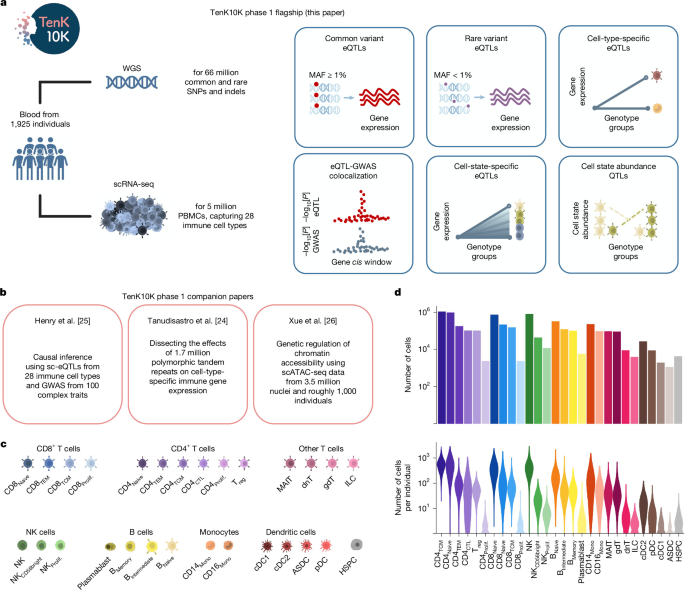
Australian researchers have linked genetic risk loci for 16 diseases to specific mechanisms within immune cells, using a dataset of 5.4 million cells from 1,925 individuals. Published in Nature, the findings identify nearly 1,500 genes that may drive cancer, neurological, and immune disorders.
Cancer, neurological, and immune disorder treatments may become more targeted now that scientists can trace the path from a DNA variant to a clinical symptom. The team mapped genetic activity across 28 different immune cell types by analyzing the genomes of nearly 2,000 Australians as part of the TenK10K project. This approach shows how the same genetic variation acts differently depending on the cell it inhabits.
Immune Cells Drive 16 Disease Risk Regions
The research identified nearly 1,500 genes potentially implicated in a variety of diseases. The team discovered how immune cells likely contribute to risk regions for 16 different diseases by tracing tens of millions of genetic variants.
One specific finding highlighted a genetic variant that increases the expression of the OSM gene in natural killer cells. This is associated with a higher risk of developing irritable bowel disease.

With our findings, we’ve gone from understanding very few to thousands of the potential causal mechanisms connecting genetic variation to disease risk, which is huge.
Joseph Powell, PhD, Garvan Institute of Medical Research
- Common and Rare Variants: Researchers tested 21,404 genes. They found common effects for 83% and rare effects for 47%. This identified 893 genes linked to blood traits or diseases that had no previously known association with genetic variation.
- Tandem Repeat Variation: The team found more than 69,000 tandem repeat variants. About 30.7% of these were specific to only one of the 28 immune cell types.
- Chromatin Accessibility: The team studied the spatial architecture of DNA. They identified more than 240,000 variants linked to chromatin accessibility. This explains up to 23% more genetic loci associated with diseases than gene activity alone.
TenK10K Project Uses Australian Cohorts
The findings rely on a massive scale of single-cell RNA technology. Researchers collected blood samples from 2,339 individuals across two biomedical cohorts to build the dataset. The Tasmanian Ophthalmic Biobank (TOB) provided 983 individuals recruited between January and February 2018. The BioHEART study also contributed participants.
The researchers could identify cell-type-specific gene expression by separating the immune system into individual cell types. They studied T cells, B cells, monocytes, and dendritic cells rather than treating the system as a uniform tissue.
This granularity helps explain why certain inherited risks only trigger disease in specific biological pathways.

Somatic Mosaicism Creates Epigenetic Ceiling
Separate research highlights the role of somatic mosaicism, while the TenK10K project focuses on inherited variation. Somatic mosaicism involves changes in genetic material that occur during a person’s lifetime. Factors like radiation, chemical exposure, or aging cause these “invisible” changes. They create a patchwork of cells with different genetic sequences.
Researchers discovered that somatic epimutations are pervasive. These changes do not alter the DNA sequence itself. They can create what researchers call an epigenetic ceiling
on the influence of genetic variation.
Because they don’t change the DNA sequence, they are invisible to the sequencing tests we rely on today. Yet when we look at how the function of the genome changes within a person’s cells, they turn out to play an important role.
Andrew B. Stergachis
Genetic Variants Inform Targeted Therapies
This data could help identify which patients are most likely to respond to specific treatments for conditions like multiple sclerosis, Alzheimer’s, and various cancers. The ability to pinpoint which genetic variant drives a disease in a specific cell type opens a path toward more targeted therapies.
This is a fundamental shift in what’s possible. When you know which genetic variant is driving a disease—and in which cell, through which mechanism—you can start to identify patients who are likely to respond to a particular treatment, and develop drugs toward targets we didn’t know existed.
Joseph Powell, PhD, Garvan Institute of Medical Research
Current blood-based analysis may not fully represent immune cells in affected tissues like the lungs, skin, or joints. It is not yet known how environmental exposures modify variant-dependent expression or how these genetic effects change during active disease flares.
Related reading

Bayern Munich defeat Magdeburg 6-1 as Nollenberger nutmegs Olise
Alexander Nollenberger, a left-back for second-division 1. FC Magdeburg nutmegged Bayern Munich superstar Michael Olise during a DFB-Pokal...

Hearts 2-2 Rangers: Makhanya Late Goal Rescues Point on McInnes’ Tynecastle Return
Rangers secured a 2-2 draw against Hearts at Tynecastle, as Olwethu Makhanya scored a late equalizer to deny...

Taylor Hall Out Indefinitely With New Injury for Carolina Hurricanes
Edmonton Oilers forward Zach Hyman is returning to injured reserve with a neck injury, missing at least one...

Luka Doncic Ruled Out for Lakers vs. Clippers Game With Back Tightness
Luka Dončić will sit out the Los Angeles Lakers’ game against the Los Angeles Clippers on Wednesday, Oct....