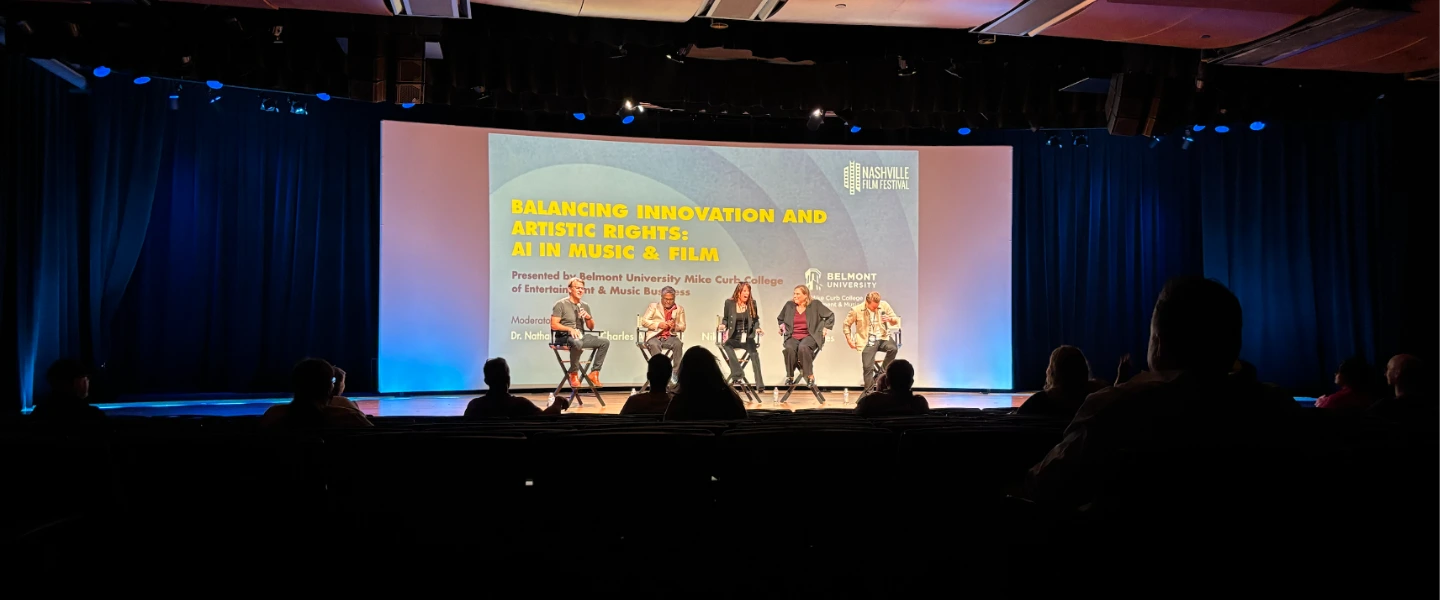
When Stephen Hauser packed up his notes after speaking on a panel at the Nashville Film Festival, he didn’t head home to rest. Instead, the Belmont University film and television writing instructor sent a cryptic invitation to a handful of eager students, inviting them to meet on campus at 10 p.m. to simply start making something.
That late-night gathering sparked a creative chain reaction across campus. Shortly after, a roughly 10-person student crew formed specialized production teams to tackle an analog horror movie about an empty campus, a choose-your-own-adventure YouTube project, a short television program, and a sketch comedy writers’ room.
Building a Creative Economy in Middle Tennessee
Hauser was joined at the festival by two academic colleagues: Dr. Nathan Adam, associate professor of media production, and Rick Rekedal, creative arts collective for Christian life and faith thought leader. Although their academic fields span everything from media production to screenwriting, their festival discussions all pointed toward a shared conclusion: Nashville is evolving into a sustainable hub where film and media careers can launch, expand, and persist.
Rekedal moderated a festival panel titled “Growing Tennessee’s Creative Economy,” which featured industry leaders Gisela Moore, Brian Loschiavo, Chris Conner, and Bob Raines. The conversation looked past the immediate influx of productions to focus on long-term infrastructure. The goal, Rekedal explained, is to invest in local storytellers the exact same way Nashville has traditionally nurtured its songwriters for decades.
“Our dream is of a creative economy, an ecosystem that supports film and media in Tennessee,” Rekedal said afterwards. He pointed out that while earlier student generations may have felt compelled to earn their degrees in Tennessee before relocating to coastal hubs for employment, the exact reverse is currently proving true.
To back up these ambitions, Belmont Innovation Labs is currently leading an impact study on the future of film and media across the state, working alongside industry partners. Bob Raines offered a crucial insight during the panel discussion that resonated deeply with Rekedal: young creatives who get early traction in their first year or two tend to stay.
A Cocoon of Talent and Technological Shifts
That retention relies heavily on practical, project-based work while students are still undergrads. Dr. Nathan Adam has watched his media production students step directly into creative roles with the Nashville Predators, CMT, TV stations, and in-house creative teams.
While artificial intelligence continues to reshape industry standards, Adam emphasizes that emerging software simply alters the mechanics rather than replacing the core of the work. AI will undoubtedly become one fundamental tool in any media producer’s toolkit, he notes, but you still need somebody that knows what good video looks like.
Beyond classroom technology, Adam points to peer collaboration as Belmont’s advantage. Students operate within a cocoon of talent, surrounded by peers who are constantly building, filming, and searching for collaborators they already know and trust.
Keeping Production Local
For Hauser, who spent the early years of his career writing screenplays in Los Angeles before relocating to Nashville where he has been based for over a decade, the local artistic landscape feels familiar. The city now possesses the infrastructure to handle each step of the creative process right here, with little that still has to be outsourced.
During the festival, independent filmmaker Pete Ohs shared insights regarding the power of small, tight-knit collaborative crews. Reflecting on that mindset, Hauser noted that creators today possess both the technology to create and the means to distribute whatever they want. Creators just need to be able to create, and people can find them.
That structural shift is already visible on Belmont’s campus late at night, where students are developing their own series concepts and filming horror shorts. They are no longer preparing for creative careers in some distant city. They are building their futures right here in Nashville.
Related reading

Lawmakers call to reform Louisiana’s ‘blatantly unconstitutional’ justice of the peace system
Louisiana Lawmakers Demand Reform of Fee-Driven Eviction Courts A bipartisan group of senior Louisiana lawmakers has called for...

Trump cancels Iowa, Kansas midterm events, opts for ‘tele-rallies’ – Al Jazeera
With just days left until the November 3 midterm elections, President Donald Trump has scrapped his physical campaign...

A Busy Halloween Weekend in Leelanau County | The Ticker
Leelanau County Prepares for a Rare Weekend Halloween Lineup When Halloween lands squarely on a Friday and Saturday,...

Zac Brown Band, Lady A To Headline New Moon Crush Weekend In Orlando
Zac Brown Band and Lady A to Headline Inaugural Moon Crush Sunshine Live in Orlando When the Moon...